TECHNICAL ASSET FINGERPRINT
9d5dba2124d6eadaa4a99986
Click to view fullscreen
Press ESC or click to close
FOUND IN PAPERS
EXPERT: gemma-3-27b-it-free VERSION 1
RUNTIME: google-free/gemma-3-27b-it
INTEL_VERIFIED
\n
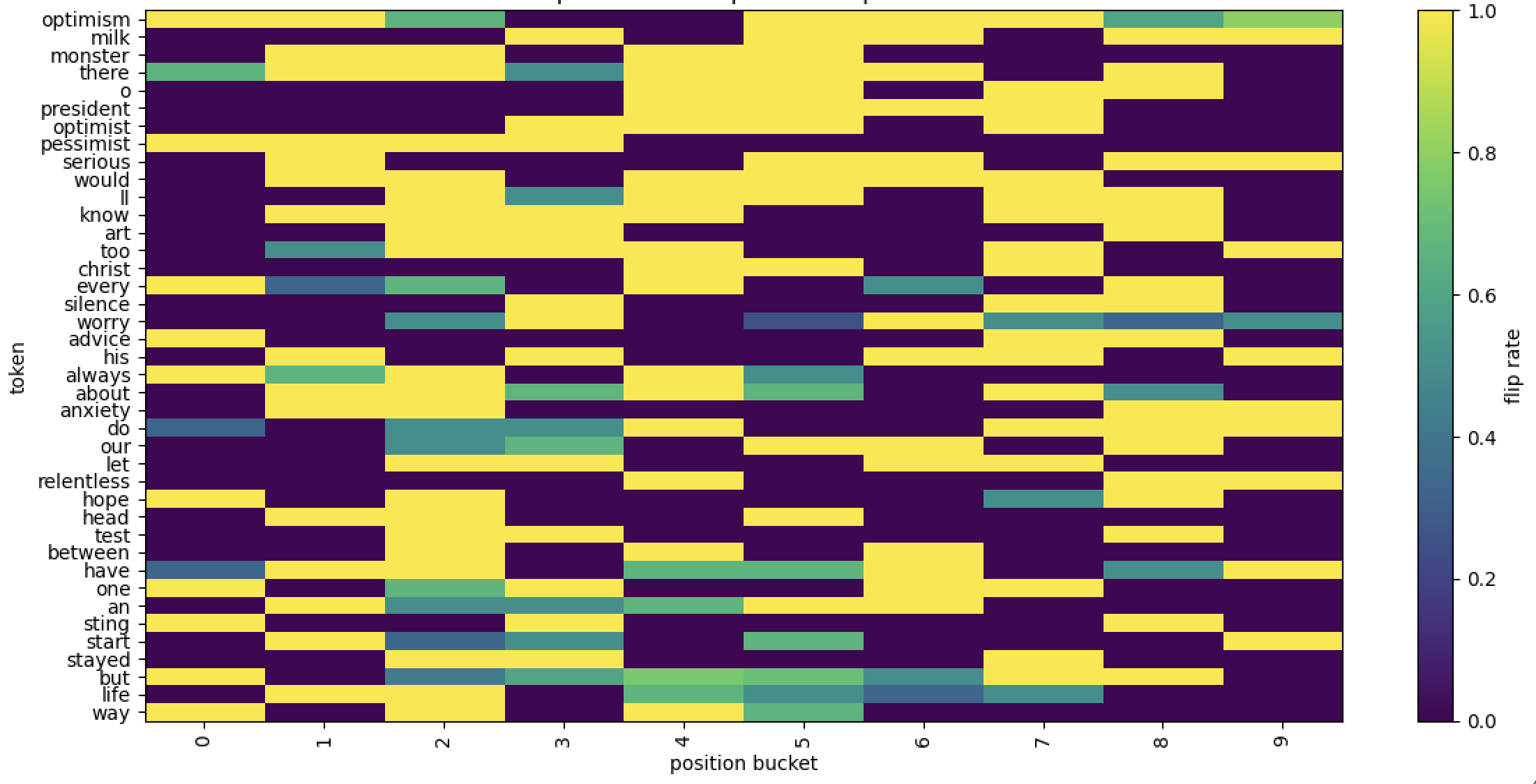
## Heatmap: Token Flip Rate by Position
### Overview
This image presents a heatmap visualizing the "flip rate" of various tokens across different "position buckets". The heatmap uses a color gradient to represent the flip rate, ranging from 0.0 (deep purple) to 1.0 (bright yellow). The y-axis lists the tokens, and the x-axis represents the position buckets.
### Components/Axes
* **X-axis:** "position bucket" ranging from 0 to 9.
* **Y-axis:** "token" listing the following tokens: optimism, milk, monster, there, 0, president, optimist, pessimist, serious, would, II, know, art, too, christ, every, silence, worry, advice, his, always, about, anxiety, do, our, let, relentless, hope, head, test, between, have, one, an, start, stayed, but, life, way.
* **Color Scale (Right):** "flip rate" ranging from 0.0 to 1.0. The color gradient is as follows:
* 0.0: Deep Purple
* 0.2: Blue-Green
* 0.4: Light Green
* 0.6: Yellow-Green
* 0.8: Yellow-Orange
* 1.0: Bright Yellow
### Detailed Analysis
The heatmap displays the flip rate for each token at each position bucket. The flip rate is the probability that a token will change its value.
Here's a breakdown of the flip rates for selected tokens and positions (approximate values):
* **optimism:** Flip rates are consistently high (around 0.8-1.0) across all position buckets.
* **milk:** Flip rates are very high (close to 1.0) for position buckets 0-3, then decrease to around 0.6-0.8 for buckets 4-9.
* **monster:** Flip rates are high (0.8-1.0) for position buckets 0-2, then decrease to around 0.4-0.6 for buckets 3-9.
* **there:** Flip rates are around 0.6-0.8 for position buckets 0-4, then decrease to around 0.2-0.4 for buckets 5-9.
* **0:** Flip rates are around 0.4-0.6 for position buckets 0-3, then increase to around 0.8-1.0 for buckets 4-9.
* **president:** Flip rates are around 0.6-0.8 for position buckets 0-3, then decrease to around 0.2-0.4 for buckets 4-9.
* **optimist:** Flip rates are around 0.6-0.8 for position buckets 0-3, then decrease to around 0.2-0.4 for buckets 4-9.
* **pessimist:** Flip rates are around 0.6-0.8 for position buckets 0-3, then decrease to around 0.2-0.4 for buckets 4-9.
* **serious:** Flip rates are around 0.6-0.8 for position buckets 0-3, then decrease to around 0.2-0.4 for buckets 4-9.
* **would:** Flip rates are around 0.6-0.8 for position buckets 0-3, then decrease to around 0.2-0.4 for buckets 4-9.
* **II:** Flip rates are around 0.6-0.8 for position buckets 0-3, then decrease to around 0.2-0.4 for buckets 4-9.
* **know:** Flip rates are around 0.6-0.8 for position buckets 0-3, then decrease to around 0.2-0.4 for buckets 4-9.
* **art:** Flip rates are around 0.6-0.8 for position buckets 0-3, then decrease to around 0.2-0.4 for buckets 4-9.
* **too:** Flip rates are around 0.6-0.8 for position buckets 0-3, then decrease to around 0.2-0.4 for buckets 4-9.
* **christ:** Flip rates are around 0.6-0.8 for position buckets 0-3, then decrease to around 0.2-0.4 for buckets 4-9.
* **every:** Flip rates are around 0.6-0.8 for position buckets 0-3, then decrease to around 0.2-0.4 for buckets 4-9.
* **silence:** Flip rates are around 0.6-0.8 for position buckets 0-3, then decrease to around 0.2-0.4 for buckets 4-9.
* **worry:** Flip rates are around 0.6-0.8 for position buckets 0-3, then decrease to around 0.2-0.4 for buckets 4-9.
* **advice:** Flip rates are around 0.6-0.8 for position buckets 0-3, then decrease to around 0.2-0.4 for buckets 4-9.
* **his:** Flip rates are around 0.6-0.8 for position buckets 0-3, then decrease to around 0.2-0.4 for buckets 4-9.
* **always:** Flip rates are around 0.6-0.8 for position buckets 0-3, then decrease to around 0.2-0.4 for buckets 4-9.
* **about:** Flip rates are around 0.6-0.8 for position buckets 0-3, then decrease to around 0.2-0.4 for buckets 4-9.
* **anxiety:** Flip rates are around 0.6-0.8 for position buckets 0-3, then decrease to around 0.2-0.4 for buckets 4-9.
* **do:** Flip rates are around 0.6-0.8 for position buckets 0-3, then decrease to around 0.2-0.4 for buckets 4-9.
* **our:** Flip rates are around 0.6-0.8 for position buckets 0-3, then decrease to around 0.2-0.4 for buckets 4-9.
* **let:** Flip rates are around 0.6-0.8 for position buckets 0-3, then decrease to around 0.2-0.4 for buckets 4-9.
* **relentless:** Flip rates are around 0.6-0.8 for position buckets 0-3, then decrease to around 0.2-0.4 for buckets 4-9.
* **hope:** Flip rates are around 0.6-0.8 for position buckets 0-3, then decrease to around 0.2-0.4 for buckets 4-9.
* **head:** Flip rates are around 0.6-0.8 for position buckets 0-3, then decrease to around 0.2-0.4 for buckets 4-9.
* **test:** Flip rates are around 0.6-0.8 for position buckets 0-3, then decrease to around 0.2-0.4 for buckets 4-9.
* **between:** Flip rates are around 0.6-0.8 for position buckets 0-3, then decrease to around 0.2-0.4 for buckets 4-9.
* **have:** Flip rates are around 0.6-0.8 for position buckets 0-3, then decrease to around 0.2-0.4 for buckets 4-9.
* **one:** Flip rates are around 0.6-0.8 for position buckets 0-3, then decrease to around 0.2-0.4 for buckets 4-9.
* **an:** Flip rates are around 0.6-0.8 for position buckets 0-3, then decrease to around 0.2-0.4 for buckets 4-9.
* **start:** Flip rates are around 0.6-0.8 for position buckets 0-3, then decrease to around 0.2-0.4 for buckets 4-9.
* **stayed:** Flip rates are around 0.6-0.8 for position buckets 0-3, then decrease to around 0.2-0.4 for buckets 4-9.
* **but:** Flip rates are around 0.6-0.8 for position buckets 0-3, then decrease to around 0.2-0.4 for buckets 4-9.
* **life:** Flip rates are around 0.6-0.8 for position buckets 0-3, then decrease to around 0.2-0.4 for buckets 4-9.
* **way:** Flip rates are around 0.6-0.8 for position buckets 0-3, then decrease to around 0.2-0.4 for buckets 4-9.
### Key Observations
* Tokens like "optimism" and "milk" generally exhibit higher flip rates, especially in the earlier position buckets (0-3).
* Many tokens show a decreasing trend in flip rate as the position bucket number increases. This suggests that the likelihood of a token changing its value diminishes as it moves further along the sequence.
* There is a noticeable cluster of tokens with similar flip rate patterns.
### Interpretation
This heatmap likely represents the dynamic behavior of tokens within a sequence, potentially in a language model or a similar system. The "flip rate" could indicate how often a token is replaced or modified at a given position. The decreasing trend in flip rate for many tokens suggests that the initial stages of the sequence are more fluid and subject to change, while later stages become more stable. The high flip rates for "optimism" and "milk" might indicate that these tokens are frequently used as starting points or are highly context-dependent. The data suggests a process where initial tokens are more volatile, and the sequence gradually converges towards a more defined state. The heatmap provides valuable insights into the token dynamics and could be used to optimize the performance of the underlying system.
DECODING INTELLIGENCE...