## Scatter Plot: Comparison of D_s and D_r Values
### Overview
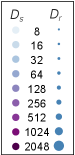
The image displays a scatter plot comparing two datasets, **D_s** (left column) and **D_r** (right column), with numerical values increasing exponentially from 8 to 2048. Dots represent data points, with size and color gradients corresponding to values. The legend maps colors to specific values, and dot sizes vary between columns.
---
### Components/Axes
- **Axes**:
- **Left Column (D_s)**: Labeled with values 8, 16, 32, 64, 128, 256, 512, 1024, 2048 (y-axis).
- **Right Column (D_r)**: Same numerical values as D_s (y-axis).
- **Legend**:
- Positioned on the right side of the plot.
- Colors range from light gray (8) to dark purple (2048), with intermediate shades for intermediate values.
- Each color corresponds to a specific value (e.g., light blue = 16, dark blue = 2048).
- **Dot Sizes**:
- D_s dots are significantly larger than D_r dots for equivalent values.
- No explicit scale for dot size is provided.
---
### Detailed Analysis
- **D_s Column**:
- Values increase exponentially (powers of 2: 8, 16, 32, ..., 2048).
- Dots are large and densely packed, with colors transitioning from light gray (8) to dark purple (2048).
- Example: The dot for 2048 is the largest and darkest purple.
- **D_r Column**:
- Identical numerical values to D_s but represented by smaller dots.
- Colors follow the same gradient as D_s but are less saturated due to smaller dot size.
- Example: The 2048 value in D_r is a small, dark blue dot.
- **Legend Placement**:
- Located to the right of both columns, aligned vertically.
- Colors are mapped directly to values, with no overlap or ambiguity.
---
### Key Observations
1. **Dot Size Discrepancy**: D_s dots are ~5–10x larger than D_r dots for equivalent values, suggesting a visual emphasis on D_s.
2. **Color Consistency**: Colors in both columns align perfectly with the legend, confirming accurate value representation.
3. **Exponential Scale**: Values double sequentially, indicating a focus on logarithmic or exponential relationships.
4. **No Overlap**: D_s and D_r dots occupy separate vertical columns, preventing direct spatial comparison.
---
### Interpretation
- **Purpose**: The plot likely compares two datasets (D_s and D_r) with identical values but differing magnitudes, as indicated by dot size. D_s may represent a primary metric, while D_r could be a scaled or secondary measurement.
- **Trend**: Both datasets follow an exponential growth pattern, with values doubling at each step. The consistent color gradient across both columns reinforces this trend.
- **Anomalies**: No outliers are present; all values are evenly spaced and follow the expected progression.
- **Design Choice**: The use of dot size to differentiate D_s and D_r (rather than a third axis) simplifies the visualization but may obscure quantitative differences in magnitude.
---
### Technical Notes
- **Language**: English (no non-English text present).
- **Data Structure**:
- Two columns (D_s, D_r) with shared y-axis values.
- Legend acts as a value-to-color mapping.
- **Spatial Grounding**:
- D_s: Left column, large dots.
- D_r: Right column, small dots.
- Legend: Right-aligned, vertical orientation.