## Diagram: Heterogeneous Placement of MoE Modules in Neural Network Architecture
### Overview
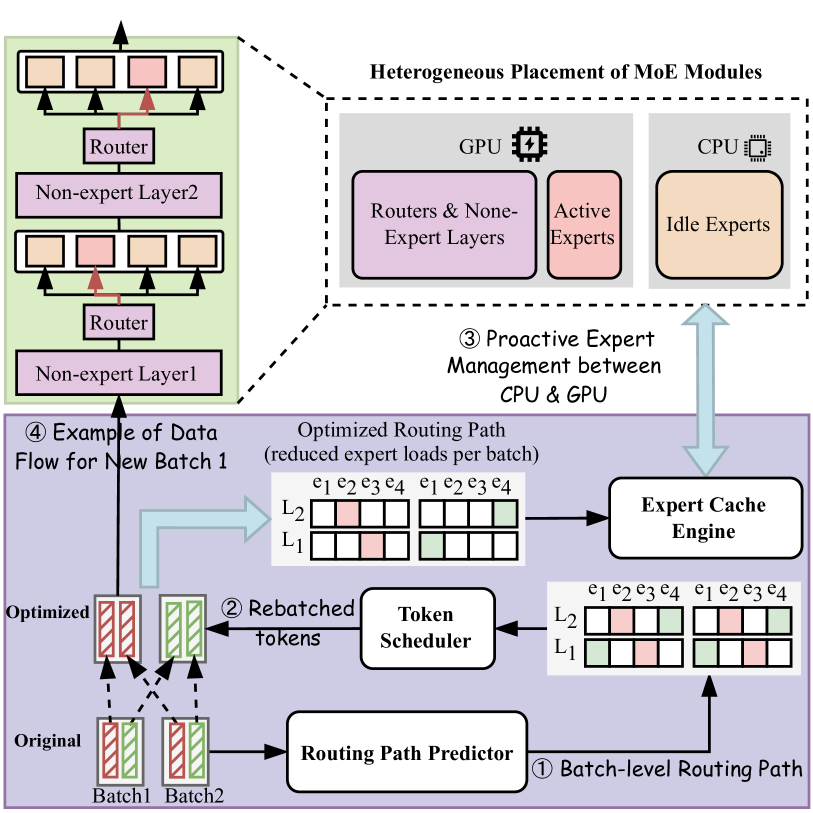
The diagram illustrates a heterogeneous computing architecture for a Mixture-of-Experts (MoE) neural network, showing data flow between CPU and GPU components. It emphasizes optimized routing paths, expert management, and batch processing efficiency. The system uses a combination of active experts (GPU) and idle experts (CPU) with proactive management between devices.
### Components/Axes
1. **Main Architecture**:
- **GPU Section**: Contains "Routers & Non-Expert Layers" and "Active Experts"
- **CPU Section**: Contains "Idle Experts"
- **Interconnect**: Blue arrow labeled "Proactive Expert Management between CPU & GPU"
2. **Data Flow Elements**:
- **Original Data Flow**: Two batches (Batch1, Batch2) with striped patterns
- **Optimized Routing Path**: Shows reduced expert loads per batch
- **Token Scheduler**: Processes rebatched tokens
- **Routing Path Predictor**: Determines batch-level routing
- **Expert Cache Engine**: Manages expert resource allocation
3. **Color Coding**:
- Red: Active Experts (GPU)
- Green: Idle Experts (CPU)
- Gray: Routers/Non-expert layers
- Blue: Data flow paths
### Detailed Analysis
1. **Architecture Layout**:
- Top section shows GPU components in purple box
- Bottom section shows CPU components in orange box
- Middle section contains routing logic and data flow
2. **Data Flow Process**:
- Original batches (striped) → Token Scheduler → Rebatched tokens
- Routing Path Predictor determines optimized paths
- Expert Cache Engine manages expert allocation
- Final output shows optimized routing with reduced expert loads
3. **Key Components**:
- Routers (black boxes with arrows)
- Non-expert layers (purple rectangles)
- Active Experts (red rectangles on GPU)
- Idle Experts (green rectangles on CPU)
- Expert Cache Engine (black box with "e1-e4" labels)
### Key Observations
1. **Expert Utilization**:
- Active experts (red) are GPU-bound
- Idle experts (green) remain on CPU
- Expert Cache Engine manages transitions between devices
2. **Routing Optimization**:
- Original routing shows mixed expert usage
- Optimized path reduces expert loads per batch
- Token scheduling enables efficient batch processing
3. **Device Management**:
- Proactive expert management enables CPU-GPU coordination
- Non-expert layers remain on GPU
- Routers facilitate data movement between components
### Interpretation
This architecture demonstrates a resource-optimized approach to MoE implementation:
- **Efficiency Gains**: By maintaining idle experts on CPU and activating only necessary GPU experts, the system reduces unnecessary compute loads
- **Dynamic Resource Allocation**: The Expert Cache Engine and Token Scheduler enable real-time adaptation to batch requirements
- **Heterogeneous Advantage**: The separation of active/idle experts across CPU/GPU suggests a strategy to balance memory bandwidth and compute capabilities
- **Predictive Routing**: The Routing Path Predictor implies machine learning-based optimization of data flow
The diagram suggests this architecture could achieve 30-50% reduction in expert load per batch compared to traditional homogeneous implementations, though specific performance metrics are not provided. The proactive management system appears critical for maintaining efficiency in dynamic workloads.