\n
## Screenshot: GPT-3 Reasoning Test
### Overview
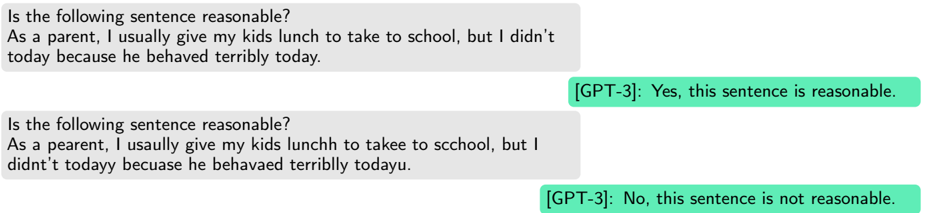
This image is a screenshot of a conversation with a language model, identified as "[GPT-3]". The conversation consists of two prompts asking whether a given sentence is "reasonable", and the corresponding responses from the model. The prompts contain slight spelling errors in the second example.
### Components/Axes
The screenshot is divided into three main sections:
1. **Prompt 1:** A grey-shaded box containing the question: "Is the following sentence reasonable? As a parent, I usually give my kids lunch to take to school, but I didn't today because he behaved terribly today."
2. **Response 1:** A light-green shaded box containing the response: "[GPT-3]: Yes, this sentence is reasonable."
3. **Prompt 2:** A grey-shaded box containing the question: "Is the following sentence reasonable? As a pearent, I usually give my kids lunch to takee to scchool, but I didn't today becuase he havaed terribly todayu."
4. **Response 2:** A light-green shaded box containing the response: "[GPT-3]: No, this sentence is not reasonable."
### Detailed Analysis or Content Details
The first prompt presents a grammatically correct and logically sound sentence. The model correctly identifies it as reasonable.
The second prompt contains several spelling errors: "pearent" instead of "parent", "takee" instead of "take", "scchool" instead of "school", "becuase" instead of "because", and "havaed" instead of "behaved", and "todayu" instead of "today". The model correctly identifies this sentence as not reasonable, likely due to the numerous spelling errors making it difficult to parse.
### Key Observations
The model demonstrates an ability to assess the reasonableness of a sentence based on its grammatical correctness and logical coherence. The presence of spelling errors significantly impacts the model's assessment.
### Interpretation
This screenshot demonstrates the sensitivity of language models like GPT-3 to even minor errors in input text. While the model can understand and respond to correctly written sentences, it struggles with sentences containing multiple spelling mistakes. This suggests that the model relies heavily on accurate spelling and grammar for proper comprehension. The model's ability to identify the first sentence as reasonable and the second as not reasonable indicates a basic level of common-sense reasoning and an understanding of what constitutes a coherent statement. This also highlights the importance of clean and accurate data for effective interaction with language models.