\n
## Diagram: Functional Programming Illustration
### Overview
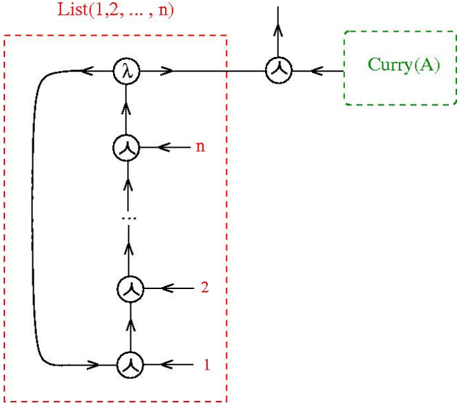
The image depicts a diagram illustrating a functional programming concept, likely related to currying and list processing. It shows a series of lambda functions chained together, with input from a list and output to a curried function. The diagram is enclosed in a dashed red rectangle, with a green dashed rectangle highlighting a separate component.
### Components/Axes
The diagram consists of the following components:
* **List(1,2,...,n):** A label indicating an input list containing elements from 1 to n. This is positioned to the left of the dashed red rectangle.
* **Lambda Functions (λ):** A series of circular nodes labeled with the Greek letter lambda (λ), representing anonymous functions. These are arranged vertically within the dashed red rectangle.
* **Numbers (1, 2, ..., n):** Labels indicating the position of each lambda function in the chain, positioned to the right of each lambda node.
* **Curry(A):** A label indicating a curried function, enclosed in a green dashed rectangle on the right side of the diagram.
* **Arrows:** Arrows indicating the flow of data between the list, lambda functions, and the curried function.
### Detailed Analysis / Content Details
The diagram shows a sequence of lambda functions applied to a list. The list `List(1,2,...,n)` is the initial input. The first element of the list (1) is fed into the first lambda function (λ). The output of this lambda function is then fed into the next lambda function (λ), and so on, until the nth element of the list is processed. The output of the final lambda function is then passed as input to the `Curry(A)` function.
The lambda functions are arranged in a vertical chain, with each function taking the output of the previous function as its input. The numbers 1 through n indicate the order in which the elements of the list are processed by the lambda functions.
### Key Observations
The diagram illustrates a functional programming technique where a list of values is transformed by applying a series of functions sequentially. The `Curry(A)` function suggests that the final result of the lambda chain is then used as an argument to a curried function. The diagram emphasizes the flow of data and the composition of functions.
### Interpretation
This diagram likely demonstrates the application of a function to each element of a list, followed by the application of a curried function to the result. This is a common pattern in functional programming, where functions are treated as first-class citizens and can be passed as arguments to other functions. The currying aspect suggests that the `Curry(A)` function is a function that takes multiple arguments, but is called with only one argument at a time, returning a new function that takes the remaining arguments.
The diagram is a visual representation of a functional pipeline, where data flows through a series of transformations. The use of lambda functions suggests that these transformations are simple and concise. The overall purpose of the diagram is to illustrate the power and flexibility of functional programming techniques. The diagram does not contain any numerical data, but rather focuses on the conceptual flow of data and the composition of functions.