## Flowchart: List Processing to Curry(A) Function
### Overview
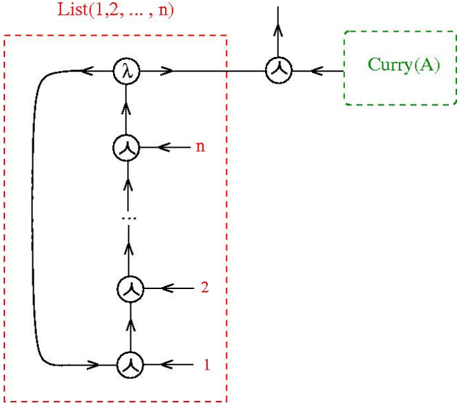
The diagram illustrates a computational process where a list of elements (List(1, 2, ..., n)) is transformed through a series of operations (denoted by λ symbols) into numerical outputs (1, 2, ..., n), which are then aggregated into a final output labeled "Curry(A)". The flow is directional, with arrows indicating sequential dependencies.
### Components/Axes
- **Left Panel (List(1, 2, ..., n))**: A vertical list of elements labeled 1 to n, enclosed in a red dashed box.
- **Central Nodes (λ symbols)**: Five identical circular nodes labeled λ, arranged vertically. Each λ node is connected to:
- A bidirectional arrow from the list (top-to-bottom flow).
- A unidirectional arrow to a numerical output (1, 2, ..., n).
- **Right Panel (Curry(A))**: A green dashed box labeled "Curry(A)", connected to the top λ node via a unidirectional arrow.
### Detailed Analysis
1. **List(1, 2, ..., n)**:
- Positioned on the left, spanning vertically from top to bottom.
- Elements are explicitly labeled 1, 2, ..., n, with ellipsis (...) indicating continuation.
- Spatial grounding: Top of the list aligns with the top λ node; bottom aligns with the bottom λ node.
2. **λ Nodes**:
- Five identical nodes labeled λ, arranged vertically between the list and numerical outputs.
- Each λ node has:
- A bidirectional arrow from the list (input).
- A unidirectional arrow to a numerical output (output).
- Spatial grounding: λ nodes are equidistant vertically, with the top λ connected to "Curry(A)".
3. **Numerical Outputs (1, 2, ..., n)**:
- Positioned to the right of the λ nodes, aligned horizontally.
- Labels increase from 1 (bottom) to n (top), matching the list's order.
- Spatial grounding: Bottom λ node connects to "1"; top λ node connects to "n".
4. **Curry(A)**:
- Located in the top-right corner, outside the red dashed box.
- Connected only to the top λ node via a unidirectional arrow.
### Key Observations
- **Flow Direction**: Data flows from the list → λ nodes → numerical outputs → Curry(A).
- **Symmetry**: The λ nodes and numerical outputs mirror the list's structure (1 to n).
- **Curry(A) Dependency**: Only the top λ node contributes to Curry(A), suggesting a hierarchical aggregation.
### Interpretation
This diagram represents a **functional transformation pipeline**:
1. **List Processing**: Each element in List(1, 2, ..., n) is processed by a λ function (likely a lambda abstraction in programming), producing outputs 1 to n. The bidirectional arrows imply the λ operations may depend on both the input list and the output values.
2. **Currying Mechanism**: The final step, "Curry(A)", suggests the application of currying—a technique in functional programming where a function that takes multiple arguments is transformed into a sequence of functions, each taking a single argument. Here, the top λ node's output (n) may serve as the final argument to Curry(A), while lower outputs (1, 2, ..., n-1) are intermediate results.
3. **Mathematical/Computational Context**: The use of λ and currying aligns with lambda calculus and functional programming paradigms. The numerical outputs could represent indices, transformed values, or intermediate states in a recursive or iterative process.
### Notable Patterns
- **Hierarchical Aggregation**: The top λ node's exclusive connection to Curry(A) implies a prioritization or summarization of the highest-indexed element (n).
- **Bidirectional Arrows**: The λ nodes' two-way connection to the list suggests feedback loops or mutual dependencies in the transformation logic.
This diagram abstracts a computational workflow where list elements are individually transformed, aggregated, and passed to a higher-order function (Curry(A)), exemplifying principles of functional programming and mathematical abstraction.