## Diagram: Symbolic Knowledge Injection into LLMs
### Overview
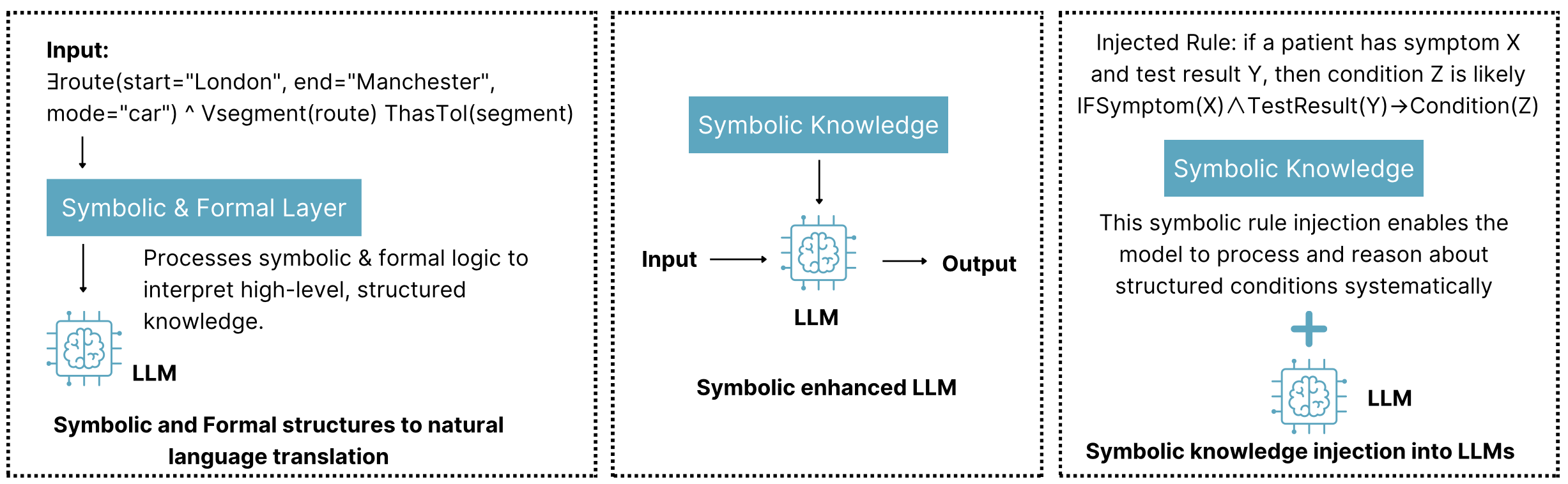
The image presents a diagram illustrating the process of injecting symbolic knowledge into Large Language Models (LLMs). It is divided into three sections, each demonstrating a different aspect of this process. The first section shows the initial input and its transformation through a symbolic and formal layer. The second section depicts the LLM's processing of symbolic knowledge. The third section illustrates the injection of symbolic rules into the LLM.
### Components/Axes
**Section 1 (Left): Input and Symbolic Layer**
* **Input:** Contains the symbolic representation of a route planning query: `∃route(start="London", end="Manchester", mode="car") ^ ∀segment(route) ∃hasTol(segment)`.
* **Symbolic & Formal Layer:** A teal rectangle representing a layer that processes symbolic and formal logic.
* **Description:** "Processes symbolic & formal logic to interpret high-level, structured knowledge."
* **LLM:** An icon representing a Large Language Model.
* **Description:** "Symbolic and Formal structures to natural language translation"
* Arrows indicate the flow of information from the Input to the Symbolic & Formal Layer, and then to the LLM.
**Section 2 (Center): Symbolic Knowledge Processing**
* **Symbolic Knowledge:** A teal rectangle representing symbolic knowledge.
* **Input:** Label indicating the input to the LLM.
* **LLM:** An icon representing a Large Language Model.
* **Output:** Label indicating the output from the LLM.
* **Description:** "Symbolic enhanced LLM"
* Arrows indicate the flow of information from the Input to the LLM, and then to the Output.
**Section 3 (Right): Symbolic Rule Injection**
* **Injected Rule:** "If a patient has symptom X and test result Y, then condition Z is likely. IF Symptom(X) ^ TestResult(Y) -> Condition(Z)"
* **Symbolic Knowledge:** A teal rectangle representing symbolic knowledge.
* **Description:** "This symbolic rule injection enables the model to process and reason about structured conditions systematically."
* **LLM:** An icon representing a Large Language Model.
* **Description:** "Symbolic knowledge injection into LLMs"
* A plus sign (+) indicates the addition of symbolic knowledge to the LLM.
### Detailed Analysis or Content Details
**Section 1 (Left):**
* The input is a symbolic representation of a route query, specifying the start and end locations as "London" and "Manchester" respectively, and the mode of transport as "car". It also includes a universal quantifier for all segments of the route, asserting that each segment has a toll.
* The Symbolic & Formal Layer processes this symbolic input.
* The LLM translates the symbolic and formal structures into natural language.
**Section 2 (Center):**
* Symbolic knowledge is fed as input to the LLM.
* The LLM processes this knowledge and generates an output.
* The resulting LLM is described as "Symbolic enhanced LLM".
**Section 3 (Right):**
* An injected rule is presented, which is a conditional statement relating symptoms, test results, and conditions.
* This rule is injected into the LLM, enabling it to reason about structured conditions systematically.
### Key Observations
* The diagram illustrates a multi-stage process of integrating symbolic knowledge with LLMs.
* The process involves transforming symbolic inputs, processing them through a symbolic layer, and injecting symbolic rules into the LLM.
* The diagram highlights the potential for enhancing LLMs with symbolic reasoning capabilities.
### Interpretation
The diagram demonstrates a method for augmenting LLMs with symbolic knowledge. By processing symbolic inputs and injecting symbolic rules, the LLM can gain the ability to reason about structured conditions in a more systematic and interpretable way. This approach combines the strengths of symbolic AI (reasoning, interpretability) with the strengths of neural networks (pattern recognition, generalization). The example of the injected rule shows how domain-specific knowledge can be encoded and integrated into the LLM, potentially improving its performance in specific tasks such as medical diagnosis. The diagram suggests a move towards more hybrid AI systems that leverage both symbolic and connectionist approaches.