\n
## Diagram: Symbolic Knowledge Injection into LLMs
### Overview
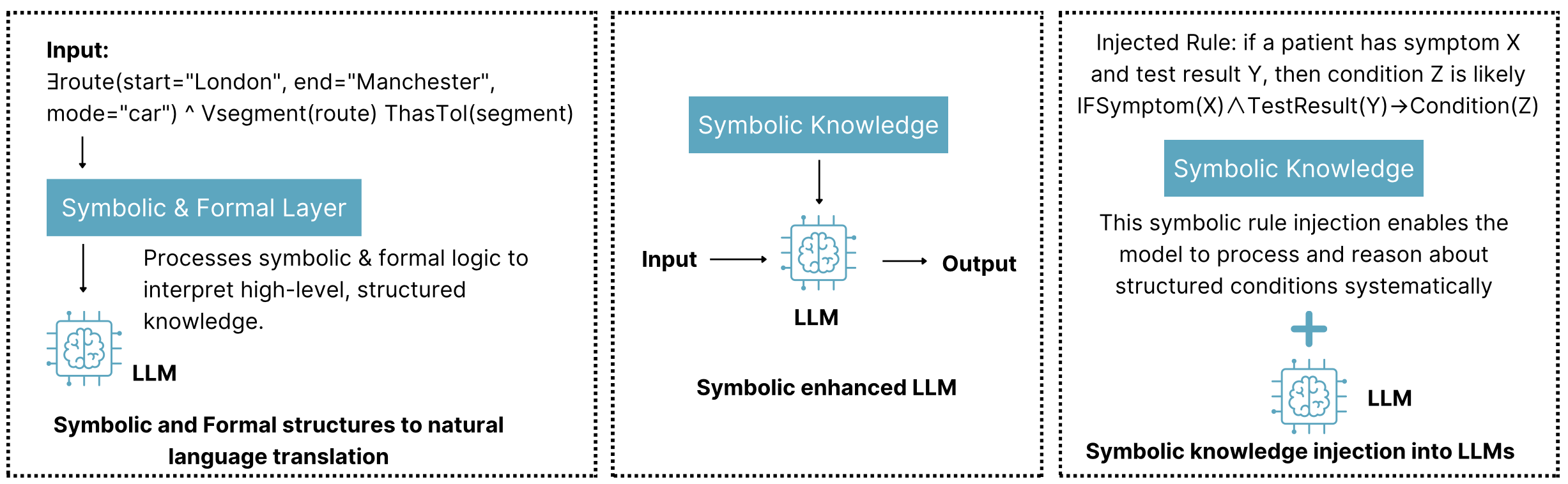
The image is a diagram illustrating a process of injecting symbolic knowledge into Large Language Models (LLMs). It depicts three distinct stages: an initial input stage, a symbolic & formal layer, and a symbolic enhanced LLM stage. The diagram uses boxes with rounded corners to represent processes and arrows to indicate flow.
### Components/Axes
The diagram consists of three main sections, each enclosed within a dashed-line rectangle. Each section has a title and descriptive text. The central component in each section is a stylized representation of an LLM (a cube with interconnected nodes). Arrows indicate the flow of information.
### Detailed Analysis or Content Details
**Section 1: Input & Symbolic Formal Layer**
* **Title:** Input: `∃route(start="London", end="Manchester", mode="car") ^ Vsegment(route) ThasTol(segment)`
* **Description:** Processes symbolic & formal logic to interpret high-level, structured knowledge.
* **LLM Representation:** A cube with interconnected nodes.
* **Output:** Symbolic and Formal structures to natural language translation.
**Section 2: Symbolic Knowledge & LLM**
* **Title:** Symbolic Knowledge
* **Description:** An arrow points from "Symbolic Knowledge" to an "Input" box, which then feeds into an LLM. The LLM then produces an "Output".
* **LLM Representation:** A cube with interconnected nodes.
* **Output:** Symbolic enhanced LLM
**Section 3: Injected Rule & Symbolic Knowledge Injection**
* **Title:** Injected Rule: if a patient has symptom X and test result Y, then condition Z is likely `IfSymptom(X) ∧ TestResult(Y) → Condition(Z)`
* **Description:** Symbolic Knowledge. This symbolic rule injection enables the model to process and reason about structured conditions systematically.
* **LLM Representation:** A cube with interconnected nodes, with a "+" symbol indicating addition.
* **Output:** Symbolic knowledge injection into LLMs.
### Key Observations
The diagram highlights a process of augmenting LLMs with symbolic knowledge. The initial input is a formal logical statement. This statement is processed by a symbolic & formal layer, which then translates it into a format understandable by the LLM. The final stage involves injecting a rule (expressed in logical form) into the LLM, enhancing its reasoning capabilities. The use of the "+" symbol in the final stage suggests an additive process of knowledge integration.
### Interpretation
The diagram illustrates a hybrid approach to AI, combining the strengths of symbolic reasoning (precise, interpretable) with the capabilities of LLMs (natural language understanding, generation). The diagram suggests that by injecting symbolic knowledge into LLMs, we can overcome some of the limitations of LLMs, such as their tendency to generate factually incorrect or illogical responses. The process aims to create more robust and reliable AI systems capable of reasoning about complex, structured information. The diagram emphasizes the importance of formalizing knowledge and translating it into a format that LLMs can effectively utilize. The injected rule example demonstrates a specific application in the medical domain, suggesting the potential for using this approach to improve diagnostic accuracy or treatment planning.