## Key Distribution Diagram: 2 Buckets vs. 8 Buckets
### Overview
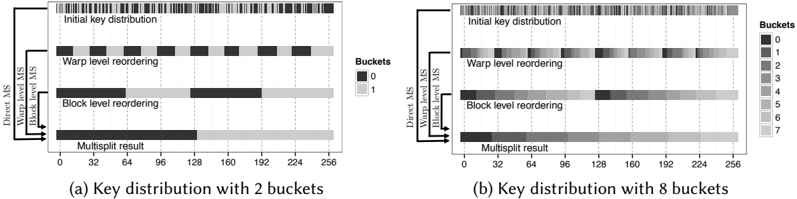
The image presents two diagrams illustrating key distribution during a multi-split process. Diagram (a) shows the distribution with 2 buckets, while diagram (b) shows the distribution with 8 buckets. Each diagram depicts the initial key distribution, the reordering at warp and block levels, and the final multi-split result. The diagrams use grayscale to represent different buckets.
### Components/Axes
**Diagram (a): Key distribution with 2 buckets**
* **Title:** (a) Key distribution with 2 buckets
* **X-axis:** Numerical scale from 0 to 256, with markers at 0, 32, 64, 96, 128, 160, 192, 224, and 256.
* **Y-axis:** Implicitly represents the stages of key distribution.
* **Legend (Buckets):** Located on the right side.
* Dark gray represents bucket 0.
* Light gray represents bucket 1.
* **Stages:**
* Initial key distribution: Shows a sparse distribution of keys.
* Warp level reordering: Shows keys grouped into blocks.
* Block level reordering: Shows a more consolidated distribution.
* Multisplit result: Shows a relatively even distribution of keys across the range.
* **Arrows:** Three arrows labeled "Direct MS", "Warp level MS", and "Block level MS" point from left to right, indicating the flow of the multi-split process.
**Diagram (b): Key distribution with 8 buckets**
* **Title:** (b) Key distribution with 8 buckets
* **X-axis:** Numerical scale from 0 to 256, with markers at 0, 32, 64, 96, 128, 160, 192, 224, and 256.
* **Y-axis:** Implicitly represents the stages of key distribution.
* **Legend (Buckets):** Located on the right side.
* Darkest gray represents bucket 0.
* Progressively lighter shades of gray represent buckets 1 through 7.
* **Stages:**
* Initial key distribution: Shows a sparse distribution of keys.
* Warp level reordering: Shows keys grouped into blocks.
* Block level reordering: Shows a more consolidated distribution.
* Multisplit result: Shows a relatively even distribution of keys across the range.
* **Arrows:** Three arrows labeled "Direct MS", "Warp level MS", and "Block level MS" point from left to right, indicating the flow of the multi-split process.
### Detailed Analysis
**Diagram (a): Key distribution with 2 buckets**
* **Initial key distribution:** Keys are sparsely distributed, with more keys concentrated in the left half (0-128) than the right half (128-256).
* **Warp level reordering:** Keys are grouped into four distinct blocks. The first and third blocks are dark gray (bucket 0), while the second and fourth blocks are light gray (bucket 1).
* **Block level reordering:** The distribution is consolidated into two blocks. The left block is approximately 128 units long and is dark gray (bucket 0). The right block is approximately 128 units long and is light gray (bucket 1).
* **Multisplit result:** The keys are distributed evenly across the entire range (0-256), with the left half being dark gray (bucket 0) and the right half being light gray (bucket 1).
**Diagram (b): Key distribution with 8 buckets**
* **Initial key distribution:** Keys are sparsely distributed, with a higher concentration in the left half (0-128) than the right half (128-256).
* **Warp level reordering:** Keys are grouped into several blocks, each representing a different bucket (0-7) in grayscale.
* **Block level reordering:** The distribution is consolidated into several blocks, each representing a different bucket (0-7) in grayscale.
* **Multisplit result:** The keys are distributed evenly across the entire range (0-256), with each section representing a different bucket (0-7) in grayscale.
### Key Observations
* Both diagrams show a progression from a sparse initial key distribution to a more even distribution after the multi-split process.
* The warp and block level reordering stages show intermediate steps in consolidating and grouping keys.
* The number of buckets significantly impacts the granularity of the final key distribution. With 2 buckets, the final distribution is divided into two halves, while with 8 buckets, the final distribution is divided into eight sections.
### Interpretation
The diagrams illustrate the process of key distribution in a multi-split operation. The initial key distribution is often uneven, which can lead to performance bottlenecks. The warp and block level reordering stages aim to consolidate and group keys to improve efficiency. The multi-split result shows the final distribution of keys across the buckets.
The comparison between 2 buckets and 8 buckets highlights the trade-off between granularity and overhead. With more buckets, the distribution can be more even, but the overhead of managing more buckets increases. The choice of the number of buckets depends on the specific application and the characteristics of the data.