## Block Diagram: System Architecture with Dual Processing Blocks
### Overview
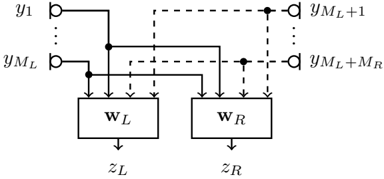
The diagram illustrates a system architecture divided into two processing blocks, **W_L** (left) and **W_R** (right), which process sequential input signals and produce outputs. The system appears modular, with distinct input ranges assigned to each block and dedicated output streams.
---
### Components/Axes
- **Blocks**:
- **W_L**: Processes inputs **y₁** to **y_M_L**.
- **W_R**: Processes inputs **y_{M_L+1}** to **y_{M_L+M_R}**.
- **Inputs**:
- Sequential signals labeled **y₁, y₂, ..., y_{M_L+M_R}**.
- Dashed lines connect intermediate inputs (**y₂, ..., y_{M_L}**) to both blocks, suggesting auxiliary or feedback connections.
- **Outputs**:
- **z_L**: Output of **W_L**.
- **z_R**: Output of **W_R**.
- **Connections**:
- Solid arrows indicate primary data flow from inputs to blocks to outputs.
- Dashed lines imply optional or secondary interactions between blocks and inputs.
---
### Detailed Analysis
- **Input Ranges**:
- **W_L** handles the first **M_L** inputs (**y₁** to **y_M_L**).
- **W_R** handles the next **M_R** inputs (**y_{M_L+1}** to **y_{M_L+M_R}**).
- **Output Structure**:
- Each block produces a single output (**z_L**, **z_R**), implying aggregation or summarization of its input range.
- **Dashed Lines**:
- Connect inputs **y₂** to **y_{M_L}** to both blocks, possibly indicating shared processing or cross-block dependencies.
---
### Key Observations
1. **Modular Design**: The system splits inputs into two distinct ranges, enabling parallel or independent processing.
2. **Output Dependency**: Outputs **z_L** and **z_R** are directly tied to their respective input ranges, suggesting deterministic processing.
3. **Dashed Connections**: The presence of dashed lines between intermediate inputs and both blocks hints at potential feedback loops or shared computational resources, though the exact mechanism is unspecified.
---
### Interpretation
This diagram represents a partitioned system where inputs are divided into left and right segments for processing. The modularity suggests scalability or fault isolation, as failures in one block may not affect the other. The dashed lines introduce ambiguity: they could represent:
- **Feedback**: Intermediate inputs influencing both blocks iteratively.
- **Auxiliary Data**: Secondary signals aiding computation in both blocks.
- **Redundancy**: Overlapping processing for reliability.
The lack of explicit labels for dashed lines leaves their purpose open to interpretation, but their placement between inputs and blocks implies they are intermediate steps or shared parameters. The system’s simplicity emphasizes clear input-output separation, prioritizing modularity over complex inter-block communication.