## Diagram: Cognitive Architecture Model
### Overview
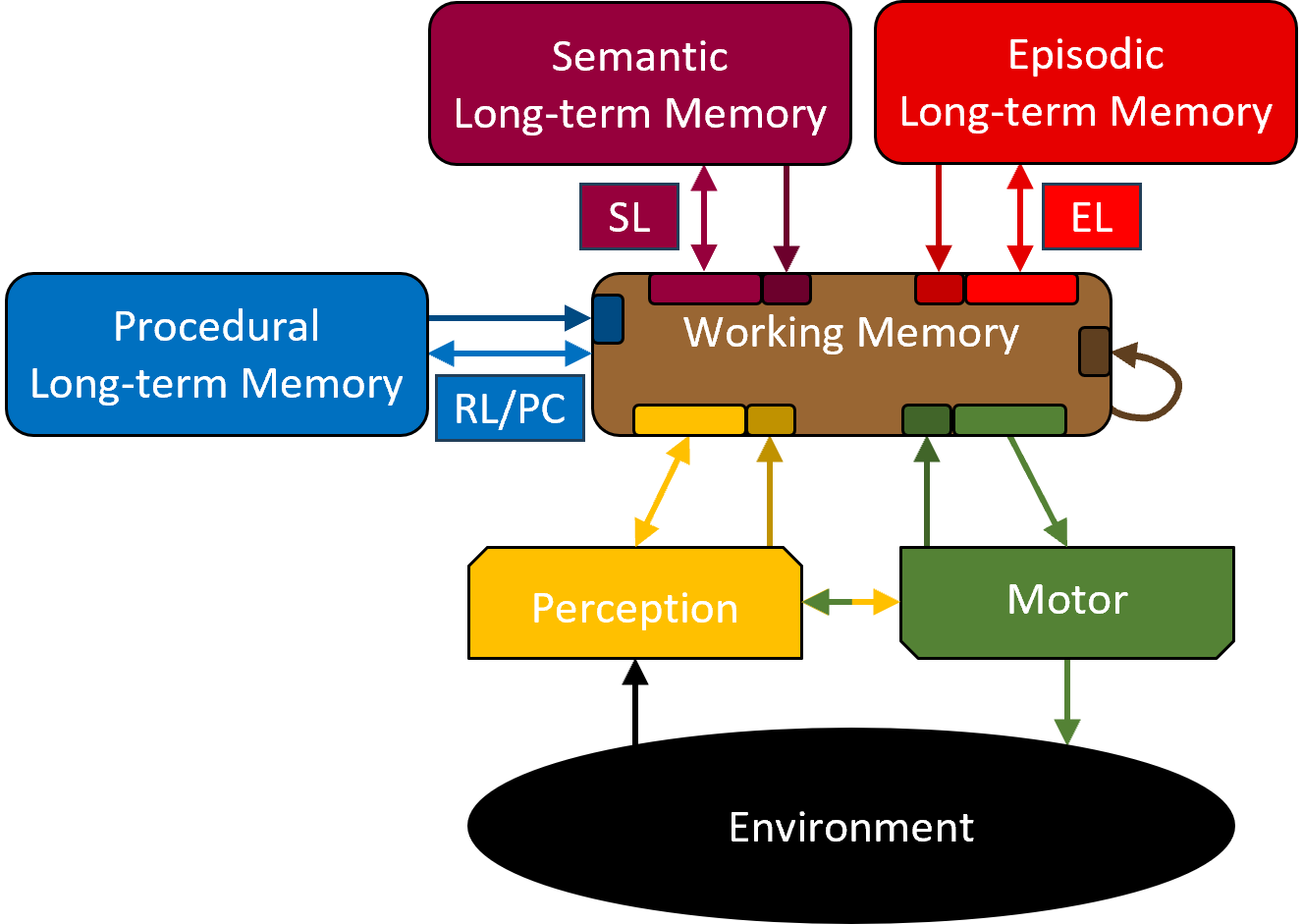
This image is a block diagram illustrating a cognitive architecture, likely representing an artificial intelligence agent or a cognitive psychology model. The diagram depicts a central "Working Memory" hub that acts as an interface between various long-term memory systems, sensory perception, motor control, and the external environment. The diagram uses color-coding to link specific memory and processing modules to corresponding interface regions within the central Working Memory block.
### Components/Axes
The diagram is composed of several distinct, color-coded functional blocks:
* **Central Hub:**
* **Working Memory:** A large, brown, horizontally oriented rectangle located in the center of the diagram. It contains smaller, colored "slots" or interface regions that correspond to the external modules. It also features a circular arrow on the right side, indicating an internal feedback loop.
* **External Modules (Clockwise from Top-Left):**
* **Semantic Long-term Memory:** A maroon rectangle located at the top-left.
* **Episodic Long-term Memory:** A red rectangle located at the top-right.
* **Motor:** A green rectangle located at the bottom-right.
* **Environment:** A large black oval located at the bottom center.
* **Perception:** A yellow rectangle located at the bottom-left.
* **Procedural Long-term Memory:** A blue rectangle located at the middle-left.
* **Interface/Connector Labels:**
* **SL:** A maroon box connecting Semantic Long-term Memory to Working Memory.
* **EL:** A red box connecting Episodic Long-term Memory to Working Memory.
* **RL/PC:** A blue box connecting Procedural Long-term Memory to Working Memory.
### Detailed Analysis
#### 1. Connectivity and Flow
The diagram utilizes arrows to denote the direction of information flow:
* **Semantic Long-term Memory (Maroon):** Connected to Working Memory via a maroon box labeled **SL**. The arrows are bidirectional, indicating a two-way exchange of information.
* **Episodic Long-term Memory (Red):** Connected to Working Memory via a red box labeled **EL**. The arrows are bidirectional.
* **Procedural Long-term Memory (Blue):** Connected to Working Memory via a blue box labeled **RL/PC**. The arrows are bidirectional.
* **Perception (Yellow):** Receives input from the **Environment** (black arrow pointing up). It has a bidirectional relationship with Working Memory (yellow arrows). It also has a bidirectional relationship with the **Motor** module (yellow/green arrow).
* **Motor (Green):** Has a bidirectional relationship with Working Memory (green arrows). It sends output to the **Environment** (green arrow pointing down).
* **Environment (Black):** Acts as the base of the system. It provides input to Perception and receives output from the Motor module.
#### 2. Spatial Grounding of Working Memory Slots
The central "Working Memory" block contains internal regions that match the colors of the external modules, suggesting specific "ports" or interface areas:
* **Top-Left (Maroon):** Corresponds to Semantic Memory.
* **Top-Right (Red):** Corresponds to Episodic Memory.
* **Bottom-Left (Yellow):** Corresponds to Perception.
* **Bottom-Right (Green):** Corresponds to Motor.
* **Far-Left (Blue):** Corresponds to Procedural Memory.
### Key Observations
* **Color-Coding Consistency:** The diagram is highly consistent. Every external module has a unique color (Maroon, Red, Blue, Yellow, Green) that is mirrored in the interface connectors and the internal slots of the Working Memory block.
* **The "RL/PC" Label:** The Procedural Long-term Memory connector is labeled "RL/PC." In the context of cognitive architectures, this likely stands for **Reinforcement Learning / Procedural Control**, indicating that this module is responsible for skill acquisition and behavioral policy.
* **Centrality of Working Memory:** All high-level cognitive functions (Semantic, Episodic, Procedural) and low-level functions (Perception, Motor) must pass through or interact with the Working Memory block.
* **Environment Isolation:** The Environment is the only component that does not have a direct connection to the Working Memory block; it is mediated entirely through the Perception and Motor modules.
### Interpretation
This diagram represents a classic **Cognitive Architecture** (similar to models like SOAR, ACT-R, or CLARION).
* **The "Blackboard" Model:** The Working Memory acts as a "blackboard" or central workspace where different cognitive processes can share information. The internal loop on the Working Memory block suggests a "focus of attention" or "rehearsal" mechanism, where information is maintained or processed iteratively.
* **Information Processing Loop:** The flow from Environment -> Perception -> Working Memory -> Motor -> Environment represents the standard "Sense-Think-Act" cycle of an intelligent agent.
* **Memory Hierarchy:** The distinction between Semantic (facts), Episodic (events), and Procedural (skills) memories suggests a system designed to handle different types of knowledge. The bidirectional arrows imply that the agent can both retrieve information from these memories and store new experiences or learned skills back into them.
* **System Purpose:** The inclusion of "RL/PC" strongly suggests this is an agent designed for autonomous learning, where the agent uses reinforcement learning to update its procedural knowledge based on the outcomes of its actions in the environment.