## Cognitive Architecture Diagram
### Overview
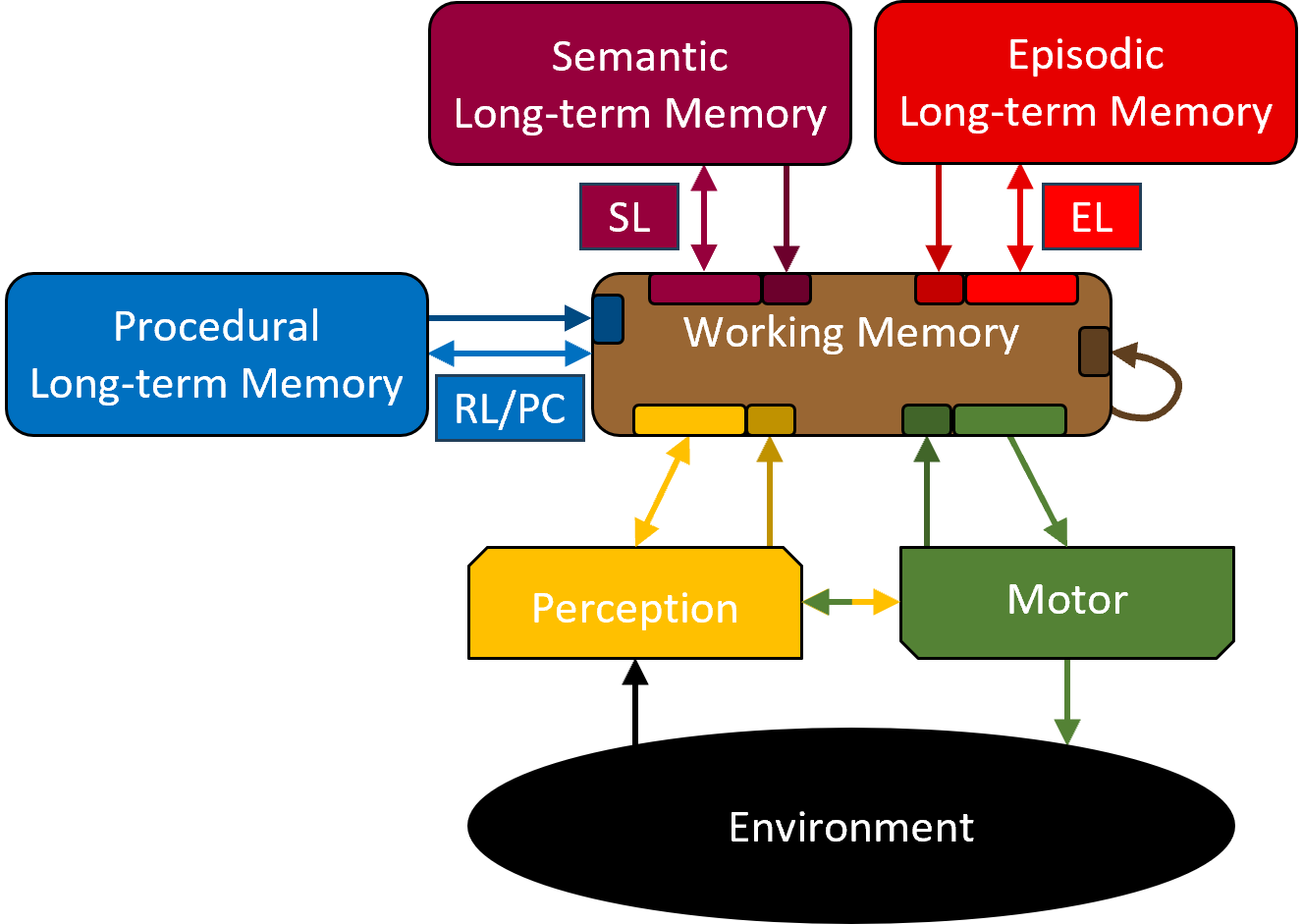
The image is a diagram illustrating a cognitive architecture, showing the flow of information between different memory systems, perception, motor control, and the environment. It depicts how information is processed and stored within a cognitive system.
### Components/Axes
* **Memory Systems:**
* Procedural Long-term Memory (Blue)
* Semantic Long-term Memory (Maroon)
* Episodic Long-term Memory (Red)
* Working Memory (Brown)
* **Perception (Yellow)**
* **Motor (Green)**
* **Environment (Black)**
* **Labels:**
* SL (Semantic Long-term Memory to Working Memory)
* EL (Episodic Long-term Memory to Working Memory)
* RL/PC (Procedural Long-term Memory to Working Memory)
### Detailed Analysis or ### Content Details
* **Procedural Long-term Memory:** A blue rounded rectangle on the left. Two blue arrows indicate bidirectional flow with the left side of the "Working Memory" block.
* **Semantic Long-term Memory:** A maroon rounded rectangle at the top-left. A maroon arrow points downward to the top of the "Working Memory" block. The label "SL" with a double arrow indicates the flow between Semantic Long-term Memory and Working Memory.
* **Episodic Long-term Memory:** A red rounded rectangle at the top-right. A red arrow points downward to the top of the "Working Memory" block. The label "EL" with a double arrow indicates the flow between Episodic Long-term Memory and Working Memory.
* **Working Memory:** A brown rounded rectangle in the center. It receives input from all three long-term memory systems. A brown curved arrow on the right side indicates a loop within Working Memory.
* **Perception:** A yellow rounded rectangle at the bottom-center. Yellow arrows indicate bidirectional flow with the bottom of the "Working Memory" block and the "Motor" block. A black arrow points upward from the "Environment" to the "Perception" block.
* **Motor:** A green rounded rectangle at the bottom-right. Green arrows indicate bidirectional flow with the bottom of the "Working Memory" block. A green arrow points downward from the "Motor" block to the "Environment".
* **Environment:** A black oval at the bottom.
### Key Observations
* The diagram emphasizes the central role of Working Memory in integrating information from different memory systems.
* Perception acts as an interface between the environment and the cognitive system.
* Motor control allows the system to interact with the environment.
* There is bidirectional flow between Working Memory and Procedural Long-term Memory, Perception, and Motor.
* There is unidirectional flow from Semantic and Episodic Long-term Memory to Working Memory.
* The loop within Working Memory suggests continuous processing and maintenance of information.
### Interpretation
The diagram illustrates a simplified model of human cognition, highlighting the interaction between different memory systems, perception, and action. It suggests that information from the environment is processed by perception, integrated with existing knowledge in long-term memory, and manipulated in working memory to guide behavior through motor control. The bidirectional arrows indicate a dynamic and interactive system where information flows in multiple directions, allowing for continuous learning and adaptation. The model emphasizes the importance of working memory as a central hub for cognitive processing.