\n
## Diagram: Cognitive Architecture Model
### Overview
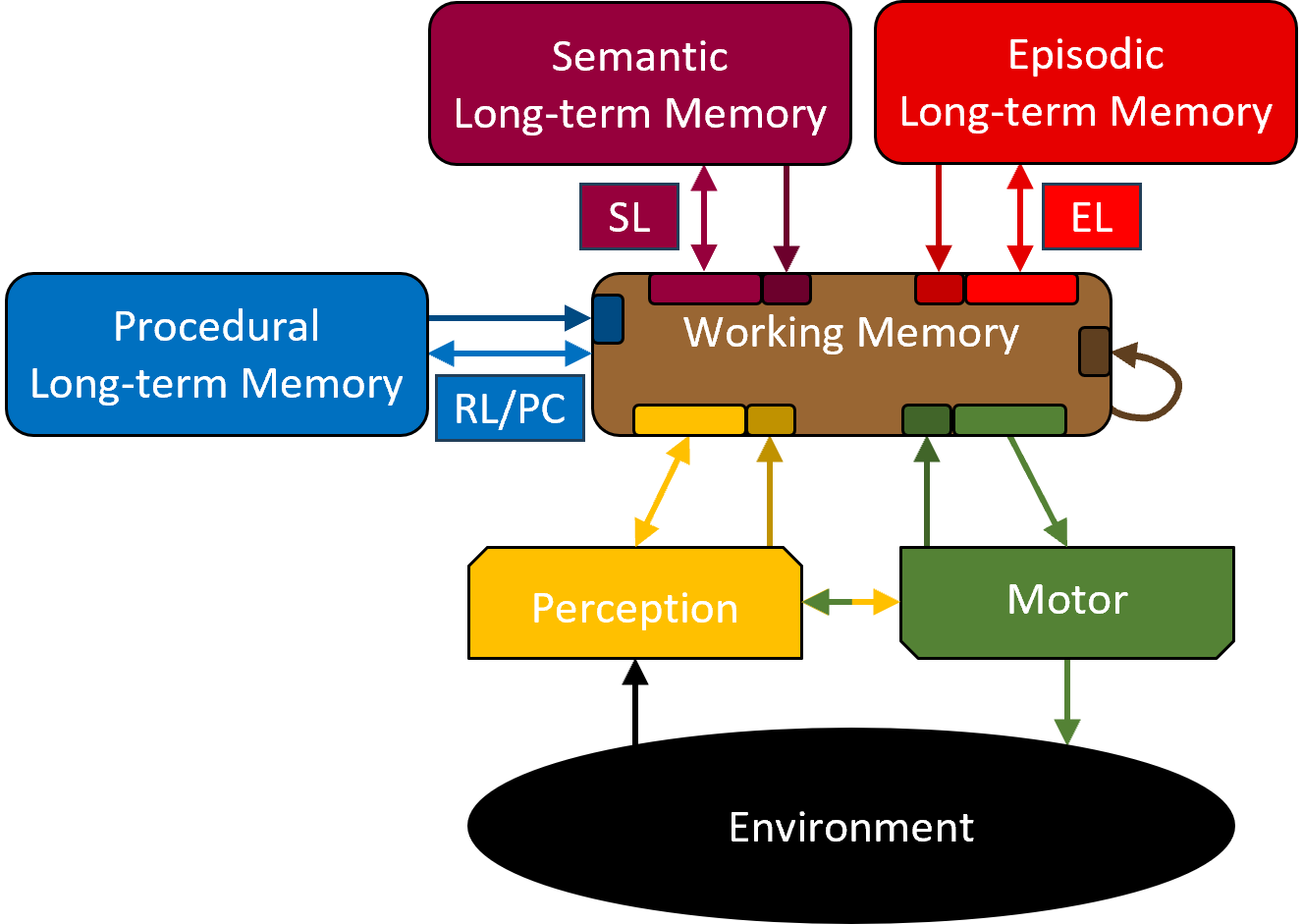
The image depicts a cognitive architecture model illustrating the interaction between different memory systems, perception, motor functions, and the environment. It's a flow diagram showing information processing within a cognitive system. The diagram uses colored boxes and arrows to represent components and the direction of information flow.
### Components/Axes
The diagram consists of the following components:
* **Environment:** A large black ellipse at the bottom.
* **Perception:** A yellow rectangle connected to the Environment via black arrows.
* **Motor:** A green rectangle connected to the Perception and the Environment.
* **Working Memory:** A central, large brown rectangle.
* **Semantic Long-term Memory:** A purple oval at the top-left.
* **Episodic Long-term Memory:** A red oval at the top-right.
* **Procedural Long-term Memory:** A blue oval at the left.
* **Arrows:** Colored arrows indicating information flow between components. These are labeled with abbreviations: SL (purple), EL (red), RL/PC (blue). There are also unlabeled yellow and green arrows.
### Detailed Analysis or Content Details
The diagram shows the following information flow:
* **Environment to Perception:** Black arrows point from the Environment to the Perception module.
* **Perception to Working Memory:** Yellow arrows point from Perception to Working Memory.
* **Working Memory to Motor:** Green arrows point from Working Memory to the Motor module.
* **Motor to Environment:** Black arrows point from the Motor module to the Environment.
* **Semantic Long-term Memory to Working Memory:** A purple arrow labeled "SL" points from Semantic Long-term Memory to Working Memory.
* **Episodic Long-term Memory to Working Memory:** A red arrow labeled "EL" points from Episodic Long-term Memory to Working Memory.
* **Procedural Long-term Memory to Working Memory:** A blue arrow labeled "RL/PC" points from Procedural Long-term Memory to Working Memory.
* **Working Memory to itself:** A curved arrow within the Working Memory box indicates recurrent processing.
There are no numerical values or scales present in the diagram. The diagram is purely representational.
### Key Observations
The diagram highlights the central role of Working Memory in integrating information from different sources: long-term memory systems (Semantic, Episodic, Procedural), perception, and motor functions. The bidirectional flow between Working Memory and long-term memory suggests a dynamic interaction where information is retrieved from and stored into long-term memory. The connection between Motor and Environment indicates the system's ability to act upon and interact with the external world.
### Interpretation
This diagram represents a simplified model of human cognitive architecture. It illustrates how different cognitive components work together to process information and generate behavior. The model emphasizes the importance of working memory as a central hub for cognitive processing. The flow of information from the environment through perception, to working memory, and then to motor output suggests a cycle of perception-action. The connections to long-term memory indicate that past experiences and knowledge influence current processing.
The abbreviations "SL", "EL", and "RL/PC" likely stand for Semantic Long-term Memory, Episodic Long-term Memory, and Reinforcement Learning/Procedural Component respectively. The diagram is a high-level representation and does not specify the details of the processes occurring within each component. It's a conceptual model rather than a precise computational model. The absence of quantitative data suggests that the diagram is intended to convey a qualitative understanding of cognitive processes.