## Diagram: Human Memory System Architecture
### Overview
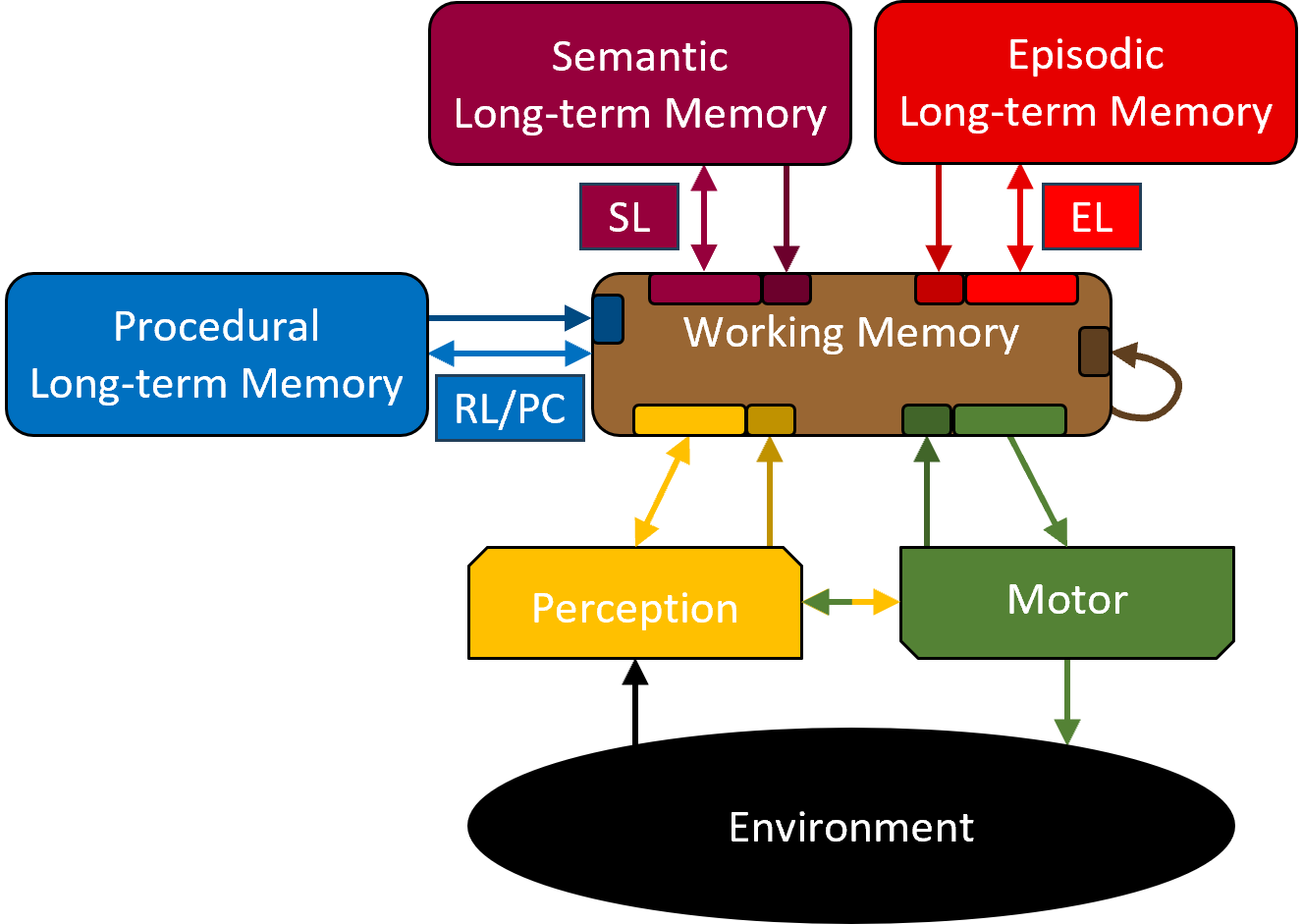
The diagram illustrates the hierarchical and interactive structure of human memory systems, showing relationships between long-term memory types (semantic, episodic, procedural), working memory, perception, motor functions, and environmental interactions. Arrows indicate bidirectional information flow and processing pathways.
### Components/Axes
1. **Memory Systems**:
- **Semantic Long-term Memory** (purple block)
- **Episodic Long-term Memory** (red block)
- **Procedural Long-term Memory** (blue block)
- **Working Memory** (brown central hub)
2. **Processors**:
- **SL** (Semantic Learning) - purple arrow connecting Semantic Memory to Working Memory
- **EL** (Episodic Learning) - red arrow connecting Episodic Memory to Working Memory
- **RL/PC** (Retrieval/Processing) - blue arrows connecting Procedural Memory to Working Memory
3. **Peripheral Systems**:
- **Perception** (yellow block) - input from Environment
- **Motor** (green block) - output to Environment
4. **Environment** (black oval base)
### Detailed Analysis
- **Working Memory** acts as a central processing unit, receiving input from all long-term memory systems and the Environment via Perception.
- **Semantic Memory** (facts/knowledge) and **Episodic Memory** (personal experiences) feed into Working Memory through dedicated learning pathways (SL/EL).
- **Procedural Memory** (skills/habits) interacts with Working Memory through bidirectional RL/PC pathways, suggesting active skill refinement.
- **Perception** receives direct input from the Environment, while **Motor** outputs to it, creating a closed-loop system.
- Color coding emphasizes functional grouping: purple/red for declarative memories, blue for procedural, and green/yellow for action-perception interfaces.
### Key Observations
1. **Central Role of Working Memory**: Positioned as the neural hub integrating all memory types and environmental interactions.
2. **Bidirectional Learning**: Arrows between long-term memories and Working Memory indicate continuous updating and consolidation.
3. **Environmental Coupling**: Perception and Motor form a sensory-motor loop grounded in the Environment, separate from core memory systems.
4. **Modular Specialization**: Each long-term memory type has dedicated pathways to Working Memory, suggesting specialized processing.
### Interpretation
This model demonstrates how human cognition maintains a dynamic equilibrium between stored knowledge (long-term memories) and real-time processing (Working Memory). The bidirectional arrows between memory systems suggest that recalling information (e.g., retrieving a procedural skill) actively modifies Working Memory contents, which in turn may update long-term storage through learning mechanisms. The separation of Perception/Motor from core memory systems implies that while environmental interaction drives memory formation, the core memory architecture operates as a semi-autonomous processing unit. The diagram aligns with contemporary cognitive science models emphasizing working memory's role in consciousness and executive function, while highlighting the distinction between declarative (semantic/episodic) and non-declarative (procedural) memory systems.