TECHNICAL ASSET FINGERPRINT
9e12208b7160ed08703dfa2d
Click to view fullscreen
Press ESC or click to close
FOUND IN PAPERS
EXPERT: gemini-2.0-flash VERSION 1
RUNTIME: nugit/gemini/gemini-2.0-flash
INTEL_VERIFIED
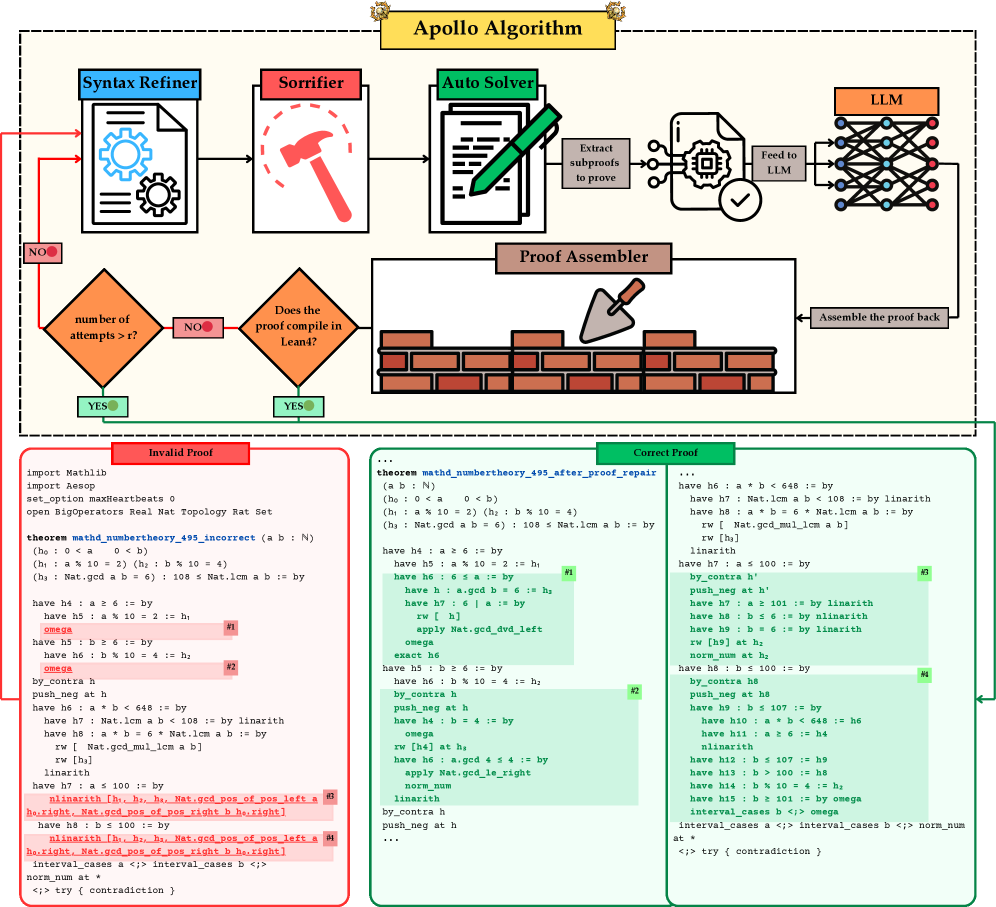
## Algorithm Diagram: Apollo Algorithm
### Overview
The image presents a flowchart illustrating the Apollo Algorithm, a process for automated theorem proving and repair. The algorithm takes a mathematical theorem as input, attempts to prove it, and if the initial proof is invalid, it refines the theorem and attempts to prove it again. The process involves several stages, including syntax refinement, sorrification, automated solving, and proof assembly, leveraging a Large Language Model (LLM).
### Components/Axes
The diagram consists of the following key components:
1. **Header**: "Apollo Algorithm" title at the top.
2. **Syntax Refiner**: A module represented by a gear icon.
3. **Sorrifier**: A module represented by a hammer icon.
4. **Auto Solver**: A module represented by a document with a pen icon.
5. **LLM**: A module represented by a neural network diagram.
6. **Proof Assembler**: A module represented by a bricklaying trowel icon.
7. **Decision Nodes**: Two diamond-shaped nodes labeled "number of attempts > r?" and "Does the proof compile in Lean4?".
8. **Proof Blocks**: Two rectangular blocks, one labeled "Invalid Proof" (red background) and the other "Correct Proof" (green background), containing code snippets.
9. **Flow Arrows**: Arrows indicating the direction of the process flow.
10. **Yes/No Labels**: Labels indicating the direction of flow based on the decision nodes.
### Detailed Analysis or Content Details
**1. Flow of the Algorithm:**
* The algorithm starts with the "Syntax Refiner" module.
* The output of the "Syntax Refiner" goes to the "Sorrifier" module.
* The output of the "Sorrifier" goes to the "Auto Solver" module.
* The "Auto Solver" extracts subproofs to prove and feeds them to the "LLM".
* The "LLM" processes the subproofs.
* The "Proof Assembler" assembles the proof back.
* A decision node checks "Does the proof compile in Lean4?".
* If "NO", the algorithm checks "number of attempts > r?".
* If "NO", the algorithm loops back to the "Syntax Refiner".
* If "YES", the algorithm leads to the "Invalid Proof" block.
* If "YES", the algorithm leads to the "Correct Proof" block.
**2. Code Snippets:**
* **Invalid Proof (Red Block):**
* `import Mathlib`
* `import Aesop`
* `set_option maxHeartbeats 0`
* `open BigOperators Real Nat Topology Rat Set`
* `theorem mathd_numbertheory_495_incorrect (a b : N)`
* `(h₀ : 0 < a 0 < b)`
* `(h₁ : a % 10 = 2) (h₂ : b % 10 = 4)`
* `(h₃ : Nat.gcd a b = 6) : 108 ≤ Nat.lcm a b := by`
* `have h4 : a ≥ 6 := by`
* `have h5 : a % 10 = 2 := h₁`
* `omega`
* `have h5 : b ≥ 6 := by`
* `have h6 : b % 10 = 4 := h₂`
* `omega`
* `by_contra h`
* `push_neg at h`
* `have h6 : a * b < 648 := by`
* `have h7 : Nat.lcm a b < 108 := by linarith`
* `have h8 : a * b = 6 * Nat.lcm a b := by`
* `rw [Nat.gcd_mul_lcm a b]`
* `rw [h₃]`
* `linarith`
* `have h7 : a ≤ 100 := by`
* `nlinarith [h₃, h₁, h₂, Nat.gcd_pos_of_pos_left a h₀.right, Nat.gcd_pos_of_pos_right b h₀.right]`
* `have h8 : b ≤ 100 := by`
* `nlinarith [h₃, h₁, h₂, Nat.gcd_pos_of_pos_left a h₀.right, Nat.gcd_pos_of_pos_right b h₀.right]`
* `interval_cases a <;> interval_cases b <;>`
* `norm_num at *`
* `<;> try { contradiction }`
* **Correct Proof (Green Block):**
* `theorem mathd_numbertheory_495_after_proof_repair (a b : N)`
* `(h₀ : 0 < a 0 < b)`
* `(h₁ : a % 10 = 2) (h₂ : b % 10 = 4)`
* `(h₃ : Nat.gcd a b = 6) : 108 ≤ Nat.lcm a b := by`
* `have h4 : a ≥ 6 := by`
* `have h5 : a % 10 = 2 := h₁`
* `have h6 : 6 ≤ a := by`
* `have h : Nat.gcd a b = 6 := h₃`
* `have h7 : 6 | a := by`
* `rw [h]`
* `apply Nat.gcd_dvd_left`
* `omega`
* `exact h6`
* `have h5 : b ≥ 6 := by`
* `have h6 : b % 10 = 4 := h₂`
* `by_contra h`
* `push_neg at h`
* `have h4 : b < 4 := by`
* `omega`
* `rw [h4] at h₃`
* `have h6 : a.gcd 4 ≤ 4 := by`
* `apply Nat.gcd_le_right`
* `norm_num`
* `linarith`
* `by_contra h`
* `push_neg at h`
* `have h6 : a * b < 648 := by`
* `have h7 : Nat.lcm a b < 108 := by linarith`
* `have h8 : a * b = 6 * Nat.lcm a b := by`
* `rw [Nat.gcd_mul_lcm a b]`
* `rw [h₃]`
* `linarith`
* `have h7 : a ≤ 100 := by`
* `by_contra h'`
* `push_neg at h'`
* `have h7 : a ≥ 101 := by linarith`
* `have h8 : b ≤ 6 := by nlinarith`
* `have h9 : b = 6 := by linarith`
* `norm_num at h₂`
* `rw [h9] at h₂`
* `have h8 : b ≤ 100 := by`
* `by_contra h₈`
* `push_neg at h₈`
* `have h9 : b ≤ 107 := by`
* `have h10 : a * b < 648 := h6`
* `have h11 : 2 = 6 := h4`
* `nlinarith`
* `have h12 : b ≤ 107 := h9`
* `have h13 : b ≤ 100 := h8`
* `have h14 : b % 10 = 4 := h₂`
* `have h15 : b ≥ 101 := by omega`
* `interval_cases b <;> omega`
* `interval_cases a <;> interval_cases b <;> norm_num at *`
* `<;> try { contradiction }`
### Key Observations
* The algorithm iteratively refines and attempts to prove a theorem until it either succeeds or exceeds the maximum number of attempts.
* The "Invalid Proof" block represents a failed proof attempt, while the "Correct Proof" block represents a successful proof.
* The code snippets in the "Invalid Proof" and "Correct Proof" blocks show the steps involved in the proof process, including importing libraries, defining theorems, and applying logical rules.
* The algorithm uses a Large Language Model (LLM) to assist in the proof process.
### Interpretation
The Apollo Algorithm is an automated system designed to prove and repair mathematical theorems. It combines traditional theorem proving techniques with the power of Large Language Models (LLMs). The algorithm's iterative nature allows it to refine theorems and proofs until a valid proof is found or the maximum number of attempts is reached. The use of an LLM suggests that the algorithm can leverage machine learning to improve its proof-finding capabilities. The "Invalid Proof" and "Correct Proof" blocks provide insights into the specific steps and logical rules used in the proof process, highlighting the algorithm's ability to reason and manipulate mathematical expressions. The algorithm's success depends on the effectiveness of the syntax refiner, sorrifier, auto solver, and the LLM in generating and validating proof steps.
DECODING INTELLIGENCE...