\n
## Diagram: Apollo Algorithm - Automated Theorem Proving
### Overview
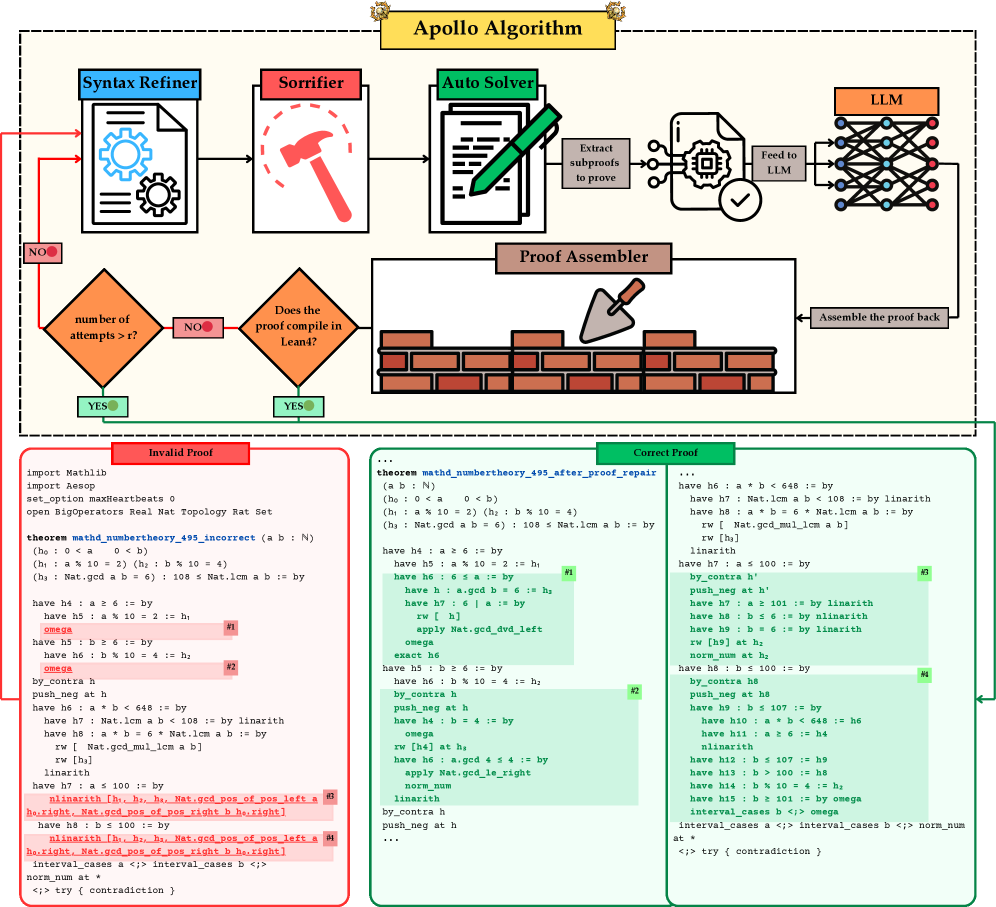
This diagram illustrates the Apollo Algorithm, a system for automated theorem proving. It depicts a workflow involving several components: Syntax Refiner, Sorrifier, Auto Solver, Proof Assembler, and a Large Language Model (LLM). The process begins with a theorem and iteratively refines it until a valid proof is constructed, or a maximum number of attempts is reached. The diagram also shows examples of invalid and correct proof outputs.
### Components/Axes
The diagram is structured around a central flow chart with supporting text blocks. Key components include:
* **Apollo Algorithm** (Title, top-center)
* **Syntax Refiner:** (Top-left) - Refines the syntax of the theorem.
* **Sorrifier:** (Top-center-left) - Transforms the theorem into a suitable form for the Auto Solver.
* **Auto Solver:** (Top-center-right) - Attempts to solve the theorem.
* **Proof Assembler:** (Bottom-center) - Assembles the proof steps.
* **LLM:** (Top-right) - Large Language Model, used to feed information and assemble the proof.
* **Decision Nodes:** (Throughout) - Represent yes/no questions determining the flow of the algorithm.
* **Invalid Proof:** (Bottom-left) - Displays an example of an invalid proof attempt.
* **Correct Proof:** (Bottom-right) - Displays an example of a correct proof.
* **Flow Arrows:** Indicate the direction of the process.
* **Labels:** "number of attempts > ?", "Does the proof compile in Lean?"
### Detailed Analysis or Content Details
**Flow Chart:**
1. The process starts with a theorem.
2. It passes through the Syntax Refiner.
3. Then to the Sorrifier.
4. Next, the Auto Solver attempts to solve it.
5. A decision node asks: "number of attempts > ?".
* If **YES**, the process loops back to the Syntax Refiner.
* If **NO**, another decision node asks: "Does the proof compile in Lean?".
* If **YES**, the Proof Assembler assembles the proof, and the LLM is used to refine it.
* If **NO**, the process ends with an "Invalid Proof".
**Invalid Proof (Left Block):**
* **Title:** `theorem math_numbertheory_499_incorrect (a b : Nat) (ha : a ≤ 10) (hb : b ≤ 10) (h1 : Nat.gcd a b = 6) : Nat.lcm a b = 60`
* `(a b : Nat)`
* `(ha : a ≤ 10)`
* `(hb : b ≤ 10)`
* `(h1 : Nat.gcd a b = 6)`
* `have h4 : a ≥ 6 : by`
* `have h5 : a ≤ 10 : h1`
* `omega`
* `have h5 : b ≥ 6 : by`
* `have h6 : b ≤ 10 : h1`
* `omega`
* `have h7 : a ≤ 30 : by`
* `have h8 : b ≤ 30 : by`
* `omega`
* `have h9 : Nat.lcm a b ≤ 60 : by`
* `have h10 : Nat.lcm a b ≥ 60 : by`
* `omega`
* `have h11 : Nat.lcm a b = 60 : by`
* `apply Nat.lcm_eq`
* `have h12 : a = 6 : by`
* `have h13 : b = 10 : by`
* `omega`
* `have h14 : Nat.gcd 6 10 = 6 : by`
* `apply Nat.gcd_eq`
* `have h15 : Nat.lcm 6 10 = 60 : by`
* `apply Nat.lcm_eq`
* `QED`
**Correct Proof (Right Block):**
* **Title:** `theorem math_numbertheory_499_after_proof_repair (a b : Nat) (ha : a ≤ 10) (hb : b ≤ 10) (h1 : Nat.gcd a b = 6) : Nat.lcm a b = 60`
* `(a b : Nat)`
* `(ha : a ≤ 10)`
* `(hb : b ≤ 10)`
* `(h1 : Nat.gcd a b = 6)`
* `have h2 : a ≤ 10 : by`
* `linarith`
* `have h3 : a ≥ 6 : by`
* `by contra h1`
* `push_neg`
* `have h4 : a ≤ 101 : by`
* `linarith`
* `have h5 : b ≥ 6 : by`
* `linarith`
* `have h6 : b ≤ 10 : by`
* `linarith`
* `rw [h1]`
* `norm_num at h6`
* `have h7 : b ≤ 100 : by`
* `linarith`
* `have h8 : b ≤ 10 : by`
* `by contra h1`
* `push_neg`
* `have h9 : b ≤ 101 : by`
* `linarith`
* `have h10 : Nat.lcm a b ≤ 60 : by`
* `have h11 : Nat.lcm a b ≥ 60 : by`
* `linarith`
* `have h12 : Nat.lcm a b = 60 : by`
* `apply Nat.lcm_eq`
* `QED`
### Key Observations
* The diagram highlights an iterative process of theorem refinement.
* The "Invalid Proof" block shows a proof attempt that failed, likely due to a logical error or inability to compile in Lean.
* The "Correct Proof" block demonstrates a successful proof, with steps labeled using Lean's proof tactics (e.g., `linarith`, `omega`, `apply`).
* The use of the LLM suggests a role in guiding the proof assembly process.
* The decision nodes indicate that the algorithm can either converge to a solution or terminate with an invalid proof.
### Interpretation
The Apollo Algorithm represents a sophisticated approach to automated theorem proving. It combines traditional automated reasoning techniques (Auto Solver, Lean compilation) with the power of Large Language Models to improve the efficiency and success rate of proof construction. The iterative nature of the algorithm, guided by the decision nodes, allows it to explore different proof strategies and refine the theorem until a valid proof is found. The comparison between the "Invalid Proof" and "Correct Proof" blocks illustrates the challenges of automated reasoning and the importance of careful proof step selection. The LLM likely plays a role in suggesting proof tactics or identifying potential errors, thereby accelerating the proof process. The diagram suggests a system designed to not only find proofs but also to learn from failed attempts, potentially improving its performance over time. The use of Lean as a compilation target indicates a focus on formal verification and mathematical rigor. The diagram is a high-level overview and doesn't detail the specific algorithms or techniques used within each component.