\n
## Charts: Speech Reception Thresholds (SRT)
### Overview
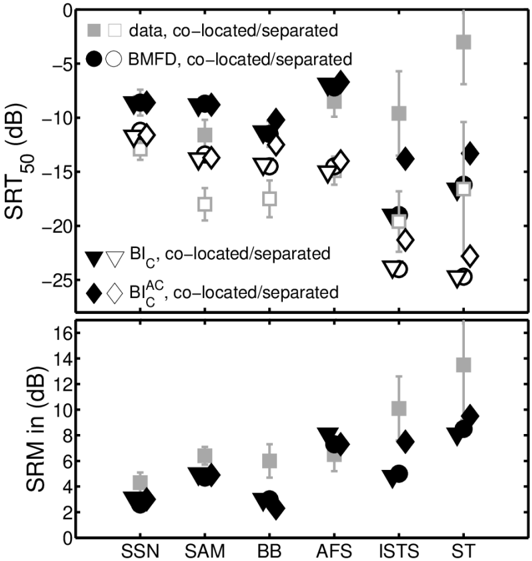
The image contains two separate charts displaying Speech Reception Thresholds (SRT) in decibels (dB) under different conditions. The top chart shows SRT50 values, while the bottom chart shows SRT in dB. Both charts compare different hearing aid processing strategies across several acoustic conditions. Error bars are present in both charts, indicating variability in the data.
### Components/Axes
**Top Chart:**
* **Y-axis:** SRT50 (dB), ranging from -25 dB to 0 dB.
* **X-axis:** Labeled with acoustic conditions: SSN, SAM, BB, AFS, ISTS, ST.
* **Legend:** Located in the top-left corner.
* Light gray squares: "data, co-located/separated"
* Light gray circles: "BMFD, co-located/separated"
* White triangles: "BIc, co-located/separated"
* Black diamonds: "BIAC, co-located/separated"
**Bottom Chart:**
* **Y-axis:** SRT in (dB), ranging from 0 dB to 16 dB.
* **X-axis:** Labeled with acoustic conditions: SSN, SAM, BB, AFS, ISTS, ST.
* **Legend:** The legend is represented by the shape of the data points.
* Black squares: "SSN"
* Black circles: "SAM"
* Black triangles: "BB"
* Black diamonds: "AFS"
* Black pentagons: "ISTS"
* Black hexagons: "ST"
### Detailed Analysis or Content Details
**Top Chart (SRT50):**
* **SSN:**
* Data: Approximately -10 dB with an error bar ranging from -13 dB to -7 dB.
* BMFD: Approximately -11 dB with an error bar ranging from -14 dB to -8 dB.
* BIc: Approximately -16 dB with an error bar ranging from -19 dB to -13 dB.
* BIAC: Approximately -17 dB with an error bar ranging from -20 dB to -14 dB.
* **SAM:**
* Data: Approximately -16 dB with an error bar ranging from -19 dB to -13 dB.
* BMFD: Approximately -13 dB with an error bar ranging from -16 dB to -10 dB.
* BIc: Approximately -18 dB with an error bar ranging from -21 dB to -15 dB.
* BIAC: Approximately -20 dB with an error bar ranging from -23 dB to -17 dB.
* **BB:**
* Data: Approximately -16 dB with an error bar ranging from -19 dB to -13 dB.
* BMFD: Approximately -12 dB with an error bar ranging from -15 dB to -9 dB.
* BIc: Approximately -18 dB with an error bar ranging from -21 dB to -15 dB.
* BIAC: Approximately -22 dB with an error bar ranging from -25 dB to -19 dB.
* **AFS:**
* Data: Approximately -10 dB with an error bar ranging from -13 dB to -7 dB.
* BMFD: Approximately -6 dB with an error bar ranging from -9 dB to -3 dB.
* BIc: Approximately -14 dB with an error bar ranging from -17 dB to -11 dB.
* BIAC: Approximately -17 dB with an error bar ranging from -20 dB to -14 dB.
* **ISTS:**
* Data: Approximately -12 dB with an error bar ranging from -15 dB to -9 dB.
* BMFD: Approximately -8 dB with an error bar ranging from -11 dB to -5 dB.
* BIc: Approximately -16 dB with an error bar ranging from -19 dB to -13 dB.
* BIAC: Approximately -21 dB with an error bar ranging from -24 dB to -18 dB.
* **ST:**
* Data: Approximately -5 dB with an error bar ranging from -8 dB to -2 dB.
* BMFD: Approximately -2 dB with an error bar ranging from -5 dB to 1 dB.
* BIc: Approximately -12 dB with an error bar ranging from -15 dB to -9 dB.
* BIAC: Approximately -15 dB with an error bar ranging from -18 dB to -12 dB.
**Bottom Chart (SRT in dB):**
* **SSN:** Approximately 6 dB with an error bar ranging from 5 dB to 7 dB.
* **SAM:** Approximately 5 dB with an error bar ranging from 4 dB to 6 dB.
* **BB:** Approximately 5 dB with an error bar ranging from 4 dB to 6 dB.
* **AFS:** Approximately 7 dB with an error bar ranging from 6 dB to 8 dB.
* **ISTS:** Approximately 8 dB with an error bar ranging from 7 dB to 9 dB.
* **ST:** Approximately 10 dB with an error bar ranging from 9 dB to 11 dB.
### Key Observations
* In the top chart (SRT50), BIAC consistently shows the lowest (most negative) values across all conditions, indicating the best performance. Data and BMFD generally perform similarly, with values slightly higher than BIAC.
* In the bottom chart (SRT in dB), the SRT values increase across the acoustic conditions from SSN to ST, suggesting that speech understanding becomes more difficult in more challenging listening environments.
* The error bars indicate substantial variability in the data, particularly for the BIAC condition in the top chart.
### Interpretation
The data suggests that the BIAC processing strategy yields the best speech understanding performance (lowest SRT50) across various acoustic conditions. The BMFD and "data" conditions provide intermediate performance, while the BIc strategy shows the worst performance. The bottom chart demonstrates that speech understanding becomes more challenging as the acoustic environment becomes more complex (moving from SSN to ST). The large error bars suggest that individual listener variability plays a significant role in SRT measurements. The difference between the top and bottom charts likely reflects different measures of speech perception sensitivity – SRT50 represents a threshold for 50% correct detection, while the bottom chart represents the threshold for any detection. The co-located/separated designation in the legend suggests that the data was collected under conditions where the sound source and listener were either in the same location or separated, potentially influencing the results. The consistent trend of BIAC outperforming other strategies suggests a robust benefit of this approach, despite the variability in individual responses.