## Line Chart: Accuracy vs. Attack Ratio for Federated Learning Algorithms
### Overview
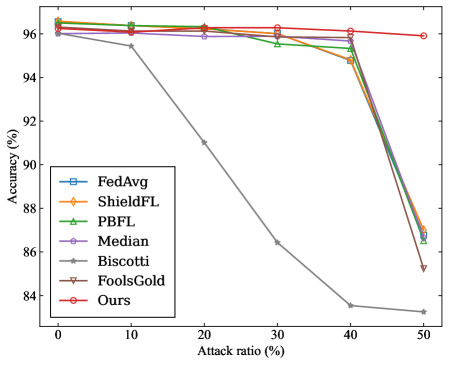
This line chart depicts the relationship between the attack ratio (percentage) and the accuracy (percentage) of several federated learning algorithms. The chart compares the performance of FedAvg, ShieldFL, PBFL, Median, Biscotti, FoolsGold, and a method labeled "Ours" under increasing attack conditions.
### Components/Axes
* **X-axis:** "Attack ratio (%)" ranging from 0 to 50, with markers at 0, 10, 20, 30, 40, and 50.
* **Y-axis:** "Accuracy (%)" ranging from approximately 84 to 97, with markers at 84, 86, 88, 90, 92, 94, 96.
* **Legend:** Located in the bottom-left corner, listing the following algorithms with corresponding line colors:
* FedAvg (Blue)
* ShieldFL (Orange)
* PBFL (Green)
* Median (Purple)
* Biscotti (Grey)
* FoolsGold (Red)
* Ours (Brown/Maroon)
### Detailed Analysis
Here's a breakdown of each line's trend and approximate data points, verified against the legend colors:
* **FedAvg (Blue):** The line starts at approximately 96.2% accuracy at 0% attack ratio and sharply declines to approximately 84.5% at 50% attack ratio. It is a nearly linear downward slope.
* (0%, 96.2%)
* (10%, 95.8%)
* (20%, 94.8%)
* (30%, 93.5%)
* (40%, 88.5%)
* (50%, 84.5%)
* **ShieldFL (Orange):** The line begins at approximately 96.1% accuracy at 0% attack ratio and gradually decreases to approximately 94.5% at 50% attack ratio.
* (0%, 96.1%)
* (10%, 95.9%)
* (20%, 95.5%)
* (30%, 95.2%)
* (40%, 94.8%)
* (50%, 94.5%)
* **PBFL (Green):** The line starts at approximately 95.8% accuracy at 0% attack ratio and declines to approximately 86.5% at 50% attack ratio.
* (0%, 95.8%)
* (10%, 95.6%)
* (20%, 94.8%)
* (30%, 94.2%)
* (40%, 90.5%)
* (50%, 86.5%)
* **Median (Purple):** The line begins at approximately 96.1% accuracy at 0% attack ratio and declines to approximately 88.5% at 50% attack ratio.
* (0%, 96.1%)
* (10%, 95.9%)
* (20%, 95.3%)
* (30%, 94.8%)
* (40%, 92.5%)
* (50%, 88.5%)
* **Biscotti (Grey):** The line starts at approximately 96.2% accuracy at 0% attack ratio and declines to approximately 94.5% at 50% attack ratio.
* (0%, 96.2%)
* (10%, 96.0%)
* (20%, 95.6%)
* (30%, 95.3%)
* (40%, 95.0%)
* (50%, 94.5%)
* **FoolsGold (Red):** The line begins at approximately 96.1% accuracy at 0% attack ratio and declines to approximately 95.0% at 50% attack ratio.
* (0%, 96.1%)
* (10%, 95.9%)
* (20%, 95.5%)
* (30%, 95.3%)
* (40%, 95.2%)
* (50%, 95.0%)
* **Ours (Brown/Maroon):** The line starts at approximately 96.2% accuracy at 0% attack ratio and remains relatively stable, declining slightly to approximately 95.8% at 50% attack ratio.
* (0%, 96.2%)
* (10%, 96.1%)
* (20%, 96.0%)
* (30%, 95.9%)
* (40%, 95.8%)
* (50%, 95.8%)
### Key Observations
* FedAvg exhibits the most significant drop in accuracy as the attack ratio increases, indicating high vulnerability.
* "Ours" demonstrates the highest resilience to attacks, maintaining a relatively stable accuracy level across all attack ratios.
* ShieldFL, Biscotti, and FoolsGold show relatively minor declines in accuracy, suggesting good robustness.
* PBFL and Median show moderate declines in accuracy.
### Interpretation
The chart demonstrates the varying levels of robustness of different federated learning algorithms against adversarial attacks. The "attack ratio" likely represents the proportion of malicious participants in the federated learning process. The results suggest that FedAvg is highly susceptible to attacks, while the proposed method ("Ours") offers significantly improved resilience. This could be due to the implementation of specific defense mechanisms within "Ours" that mitigate the impact of malicious contributions. The relatively stable performance of "Ours" indicates a potential advantage in real-world deployments where the presence of adversarial actors is a concern. The differences in performance between the algorithms highlight the importance of considering security and robustness when selecting a federated learning approach. The chart provides empirical evidence supporting the claim that "Ours" is a more secure and reliable federated learning algorithm compared to the others tested.