## Venn Diagram: Transparent AI
### Overview
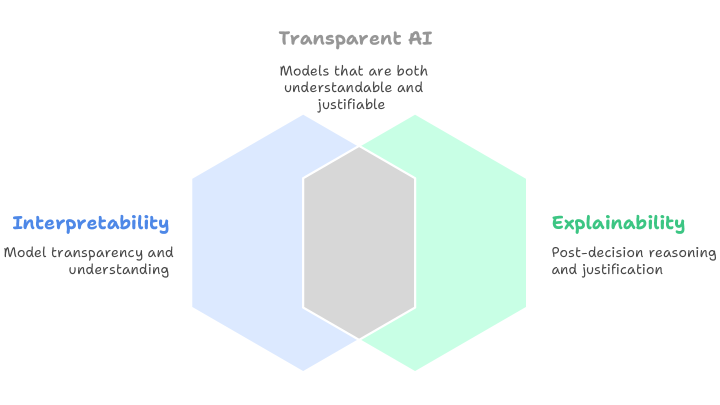
The image is a Venn diagram illustrating the relationship between **Interpretability**, **Explainability**, and **Transparent AI**. It uses three overlapping hexagons (blue, green, and gray) to represent these concepts, with textual descriptions embedded in each section. The diagram emphasizes the interplay between model transparency, post-hoc reasoning, and the ideal of "Transparent AI."
---
### Components/Axes
- **Title**: "Transparent AI" (centered at the top in gray text).
- **Subtitle**: "Models that are both understandable and justifiable" (below the title).
- **Hexagons**:
- **Left (Blue)**: Labeled "Interpretability" with the text: "Model transparency and understanding."
- **Right (Green)**: Labeled "Explainability" with the text: "Post-decision reasoning and justification."
- **Overlap (Gray)**: Represents the intersection of Interpretability and Explainability, labeled "Transparent AI."
- **Legend**: Implicitly defined by color coding (blue = Interpretability, green = Explainability, gray = Transparent AI).
---
### Detailed Analysis
1. **Interpretability (Blue Hexagon)**:
- Focuses on **model transparency and understanding**, emphasizing the need for AI systems to be inherently clear in their design and decision-making processes.
- Positioned on the left, it suggests foundational transparency as a prerequisite for broader AI accountability.
2. **Explainability (Green Hexagon)**:
- Addresses **post-decision reasoning and justification**, highlighting methods to interpret AI outputs after they are generated (e.g., LIME, SHAP).
- Positioned on the right, it represents reactive or supplementary transparency.
3. **Transparent AI (Gray Overlap)**:
- The intersection of blue and green hexagons, symbolizing the synthesis of interpretability and explainability.
- The subtitle reinforces this as the goal: models that are **both understandable** (interpretability) **and justifiable** (explainability).
---
### Key Observations
- The diagram visually prioritizes the **integration** of interpretability and explainability to achieve Transparent AI, rather than treating them as separate or competing goals.
- The use of overlapping hexagons (instead of circles) may imply a more nuanced, multi-dimensional relationship between the concepts.
- No numerical data or quantitative trends are present; the focus is on conceptual relationships.
---
### Interpretation
This diagram underscores the **holistic nature of Transparent AI**, arguing that it cannot exist as a standalone concept but requires the convergence of two critical dimensions:
1. **Interpretability**: Ensuring models are designed to be inherently transparent (e.g., via simpler architectures or inherently interpretable algorithms).
2. **Explainability**: Providing tools to retroactively justify decisions when full interpretability is impractical (e.g., in complex deep learning models).
The gray overlap (Transparent AI) acts as the **Venn diagram’s nucleus**, suggesting that true transparency in AI systems demands both proactive design choices (interpretability) and reactive analytical frameworks (explainability). The absence of numerical data implies this is a conceptual framework rather than an empirical study, likely intended for educational or strategic discussions in AI ethics and governance.