\n
## Mathematical Formulas: Dynamic Logic Rules
### Overview
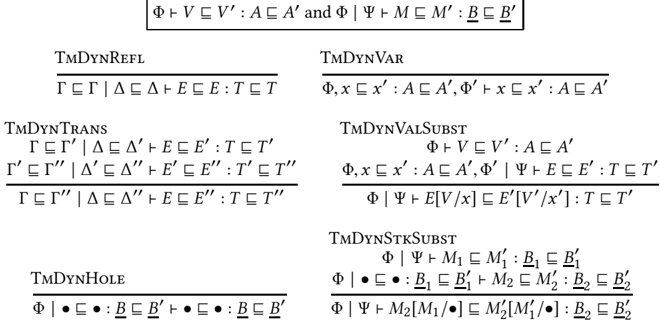
The image presents a collection of mathematical formulas, specifically rules within a dynamic logic framework. These rules are presented in a formal notation, likely used in computer science or mathematical logic. The formulas involve symbols representing variables, sets, and logical operators.
### Components/Axes
There are no axes or traditional chart components. The image consists entirely of mathematical expressions. The expressions are grouped under headings: `TMdynREFL`, `TMdynTRANS`, `TMdynHOLE`, `TMdynVAR`, `TMdynVALSUBST`, and `TMdynSTKSUBST`. Each heading appears above a set of formulas.
### Detailed Analysis or Content Details
Here's a transcription of each formula block:
**1. TMdynREFL**
```
Φ + V ⊆ V' : A ⊆ A' and Φ | Ψ + M ⊆ M' : B ⊆ B'
```
**2. TMdynTRANS**
```
Γ ⊢ Γ | Δ ⊆ Δ' + E ⊆ E' : T ⊆ T'
Γ ⊢ Γ'' | Δ' ⊆ Δ'' + E' ⊆ E'' : T' ⊆ T''
Γ ⊢ Γ'' | Δ ⊆ Δ'' + E ⊆ E'' : T ⊆ T''
```
**3. TMdynHOLE**
```
Φ | ▢ ⊆ ▢' : B ⊆ B'
```
**4. TMdynVAR**
```
Φ, x ⊆ x' : A ⊆ A', Φ' + x ⊆ x' : A ⊆ A'
Φ, x ⊆ x' : A ⊆ A', Φ' | Ψ + E ⊆ E' : T ⊆ T'
Φ | Ψ + E[V/x] ⊆ E'[V'/x'] : T ⊆ T'
```
**5. TMdynVALSUBST**
```
Φ + V ⊆ V' : A ⊆ A'
Φ, x ⊆ x' : A ⊆ A', Φ' | Ψ + E ⊆ E' : T ⊆ T'
```
**6. TMdynSTKSUBST**
```
Φ | Ψ + M₁ ⊆ M₁' : B₁ ⊆ B₁'
Φ | ▢ ⊆ ▢' : B₁ ⊆ B₁' + M₂ ⊆ M₂' : B₂ ⊆ B₂'
Φ | Ψ + M₂[M₁/▢] ⊆ M₂'[M₁'/▢] : B₂ ⊆ B₂'
```
### Key Observations
The formulas utilize a variety of symbols:
* `Φ`, `Ψ`: Likely represent logical formulas or states.
* `V`, `V'`: Possibly represent variables or sets of variables.
* `A`, `A'`: Likely represent sets or domains.
* `M`, `M'`: Potentially represent models or states.
* `B`, `B'`: Likely represent sets or domains.
* `Γ`, `Γ'`, `Γ''`: Possibly represent contexts or assumptions.
* `Δ`, `Δ'`, `Δ''`: Likely represent sets or domains.
* `E`, `E'`, `E''`: Likely represent environments or evaluations.
* `T`, `T'`, `T''`: Likely represent truth values or states.
* `x`, `x'`: Variables.
* `⊆`: Subset relation.
* `+`: Logical conjunction or addition.
* `|`: Logical disjunction or parallel composition.
* `▢`: A modal operator, possibly representing "always" or "necessarily".
* `⊢`: Turnstile symbol, indicating logical entailment.
* `[V/x]`: Substitution notation.
The formulas appear to define rules for manipulating these symbols within the dynamic logic system. The notation suggests a formal, axiomatic approach to reasoning about programs or systems.
### Interpretation
The image presents a set of inference rules for a dynamic logic. Dynamic logic is a modal logic used to reason about programs that change state. Each rule specifies how to derive new truths (represented by the left-hand side of the `⊢` symbol) from existing truths (represented by the right-hand side).
* **TMdynREFL** (Reflexivity): States that a formula is equivalent to itself, and a relation is equivalent to itself.
* **TMdynTRANS** (Transitivity): If a relation holds, and another relation holds based on the first, then a third relation holds.
* **TMdynHOLE** (Hole): Defines a relationship between a formula and a "hole" (represented by ▢).
* **TMdynVAR** (Variable): Deals with the substitution of variables within formulas.
* **TMdynVALSUBST** (Value Substitution): Deals with substituting values into formulas.
* **TMdynSTKSUBST** (Stack Substitution): Deals with substituting stacks of values into formulas.
The use of superscripts (e.g., `A'`, `B'`) suggests that the rules are operating on transformed or updated versions of the original sets or domains. The overall purpose of these rules is to provide a formal system for reasoning about the effects of programs or actions on the state of a system. The notation is highly specialized and requires a background in mathematical logic to fully understand.