## System Architecture Diagram: Proposed NEON-RVV Intrinsics Migration
### Overview
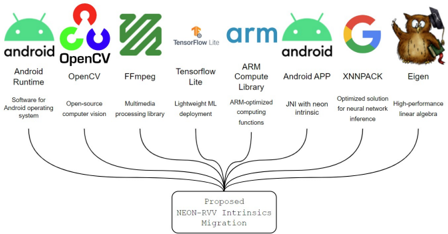
The image is a technical diagram illustrating a proposed software migration strategy. It displays eight distinct software components or libraries, each represented by its logo and a brief description, with arrows converging from all components to a single central proposal box at the bottom. The diagram's purpose is to show which existing technologies are being considered for or would be affected by a migration to NEON-RVV intrinsics.
### Components
The diagram is organized into two main regions: a top row containing eight component blocks and a bottom-center region containing the proposal box.
**Top Row Components (Left to Right):**
1. **Logo & Label:** Android (green robot logo)
* **Text:** `Android Runtime`
* **Description:** `Core component of Android operating system`
2. **Logo & Label:** OpenCV (three colored circles)
* **Text:** `OpenCV`
* **Description:** `Open-source computer vision`
3. **Logo & Label:** FFmpeg (green striped square)
* **Text:** `FFmpeg`
* **Description:** `Multimedia processing library`
4. **Logo & Label:** TensorFlow Lite (orange hexagon)
* **Text:** `Tensorflow Lite`
* **Description:** `Lightweight ML deployment`
5. **Logo & Label:** ARM (blue "arm" text)
* **Text:** `ARM Compute Library`
* **Description:** `ARM-optimized compute functions`
6. **Logo & Label:** Android (green robot logo)
* **Text:** `Android APP`
* **Description:** `Jni with neon intrinsics`
7. **Logo & Label:** Google ("G" logo)
* **Text:** `XNNPACK`
* **Description:** `Optimized solution for neural network inference`
8. **Logo & Label:** Eigen (owl logo)
* **Text:** `Eigen`
* **Description:** `High-performance linear algebra`
**Central Proposal Box (Bottom-Center):**
* **Text:** `Proposed NEON-RVV Intrinsics Migration`
**Flow/Relationships:**
* Eight distinct, solid black arrows originate from the bottom of each component block in the top row.
* All arrows converge and point directly to the top edge of the central "Proposed NEON-RVV Intrinsics Migration" box.
* This visual structure indicates that each of the eight listed components is a source, input, or subject for the proposed migration project.
### Detailed Analysis
The diagram is a conceptual map, not a data chart. Therefore, it contains no numerical data, axes, or quantitative trends. Its information is categorical and relational.
* **Component Categories:** The components span several domains:
* **Mobile OS Core:** Android Runtime.
* **Computer Vision & Multimedia:** OpenCV, FFmpeg.
* **Machine Learning Inference:** TensorFlow Lite, XNNPACK, ARM Compute Library.
* **Math Libraries:** Eigen.
* **Application Layer:** Android APP (specifically those using JNI with NEON intrinsics).
* **Migration Target:** The unifying theme is "NEON-RVV Intrinsics." NEON refers to ARM's Advanced SIMD architecture for vector processing. RVV likely refers to the RISC-V Vector Extension. The proposal suggests a project to migrate or adapt code using ARM NEON intrinsics to a new model, potentially for RISC-V compatibility or a unified intrinsic set.
### Key Observations
1. **Breadth of Impact:** The migration proposal targets a wide array of foundational libraries, from low-level math (Eigen) and OS components (Android Runtime) to high-level ML frameworks (TensorFlow Lite). This suggests a significant, cross-cutting initiative.
2. **Performance Focus:** Every component description emphasizes performance or optimization ("high-performance," "optimized solution," "ARM-optimized," "lightweight"). The migration is clearly aimed at maintaining or enhancing computational efficiency.
3. **Android Ecosystem Centrality:** Two components are explicitly Android-related (Android Runtime, Android APP), and several others (TensorFlow Lite, XNNPACK) are heavily used within Android for ML, indicating the Android ecosystem is a primary context for this migration.
4. **Visual Simplicity:** The diagram uses a simple, one-directional flow (many-to-one) to communicate a complex integration or adaptation task, making the scope immediately understandable.
### Interpretation
This diagram outlines the scope of a proposed engineering effort to transition key computational libraries from using ARM NEON intrinsics to a new model involving "RVV" (RISC-V Vector Extension) intrinsics. The Peircean investigation here reveals:
* **Sign:** The converging arrows are an indexical sign pointing to a single future action—the migration project.
* **Symbol:** The logos and technical names (NEON, RVV, JNI) are symbolic, representing specific, well-defined technologies within the software engineering community.
* **Icon:** The overall structure iconically represents consolidation and focused effort, taking disparate elements and unifying them under one initiative.
The underlying message is one of strategic alignment. The proposal likely aims to future-proof these critical libraries for a potential architectural shift (e.g., towards RISC-V processors) or to create a more portable, unified vectorization layer. The inclusion of both system-level (Android Runtime) and application-level (Android APP) components suggests the migration must be holistic, ensuring compatibility across the entire software stack. The absence of specific timelines, versions, or technical details indicates this is a high-level conceptual or planning document, meant to communicate intent and scope rather than implementation specifics.