## Diagram: Android Ecosystem Integration with NEON-RVV Intrinsics Migration
### Overview
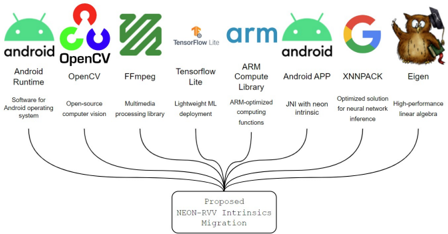
The diagram illustrates the integration of various Android tools, libraries, and frameworks into a proposed migration framework called "NEON-RVV Intrinsics Migration." It visually connects multiple components (e.g., Android Runtime, OpenCV, TensorFlow Lite) to a central concept, emphasizing their reliance on optimized computing functions for performance enhancement.
### Components/Axes
- **Key Elements**:
1. **Android Runtime**: Software for Android operating system.
2. **OpenCV**: Open-source computer vision library.
3. **FFmpeg**: Multimedia processing library.
4. **TensorFlow Lite**: Lightweight ML deployment.
5. **ARM Compute Library**: ARM-optimized computing functions.
6. **Android App**: JNI with Neon Intrinsic.
7. **XNNPACK**: Optimized solution for neural network inference.
8. **Eigen**: High-performance linear algebra.
- **Central Concept**: "Proposed NEON-RVV Intrinsics Migration" (box at the bottom center).
- **Connections**: All components are linked via black lines to the central box, indicating dependency or integration.
### Detailed Analysis
- **Labels and Descriptions**:
- Each component is labeled with its name and a brief description of its purpose (e.g., "Optimized solution for neural network inference" for XNNPACK).
- The central box explicitly states the migration goal: leveraging NEON (ARM) and RVV (RISC-V) intrinsics for computational efficiency.
- **Flow Direction**: All lines originate from the components and converge on the central box, suggesting a unidirectional migration or integration process.
### Key Observations
- **Unified Focus**: The diagram emphasizes the convergence of diverse tools (ML, multimedia, computer vision) under a single optimization strategy (NEON-RVV intrinsics).
- **Performance Emphasis**: Descriptions like "high-performance linear algebra" (Eigen) and "optimized solution" (XNNPACK) highlight the goal of computational efficiency.
- **Cross-Platform Relevance**: Mentions of ARM and RISC-V intrinsics suggest compatibility with multiple hardware architectures.
### Interpretation
The diagram represents a strategic shift toward optimizing Android ecosystem tools for hardware-specific performance gains. By migrating to NEON-RVV intrinsics, the proposed framework aims to:
1. **Enhance Speed**: Leverage SIMD (Single Instruction, Multiple Data) capabilities of NEON (ARM) and RVV (RISC-V) for parallel processing.
2. **Improve Efficiency**: Reduce computational overhead in tasks like neural network inference (XNNPACK) and multimedia processing (FFmpeg).
3. **Standardize Optimization**: Integrate ARM/RISC-V intrinsics across Android Runtime, OpenCV, and TensorFlow Lite, ensuring consistent performance across apps and libraries.
This migration likely addresses the growing demand for real-time processing in AI/ML applications, multimedia, and computer vision, aligning with trends in edge computing and hardware-software co-design.