## Spectrogram and Attention Rollout Visualization
### Overview
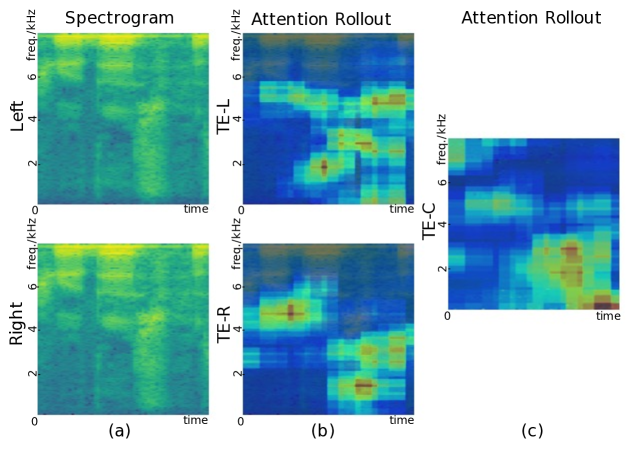
The image presents a comparative analysis of spectrograms and attention rollouts for audio data. It consists of three sections: (a) Spectrograms for the left and right audio channels, (b) Attention rollouts corresponding to TE-L and TE-R, and (c) Attention rollout for TE-C. The spectrograms display frequency content over time, while the attention rollouts visualize the model's focus on different frequency bands over time.
### Components/Axes
* **Section (a): Spectrogram**
* **Top Subplot:** Labeled "Left". Represents the spectrogram of the left audio channel.
* Y-axis: "freq./kHz" ranging from 0 to 6 kHz.
* X-axis: "time".
* **Bottom Subplot:** Labeled "Right". Represents the spectrogram of the right audio channel.
* Y-axis: "freq./kHz" ranging from 0 to 6 kHz.
* X-axis: "time".
* **Section (b): Attention Rollout**
* **Top Subplot:** Labeled "TE-L". Represents the attention rollout for TE-L.
* Y-axis: "freq./kHz" ranging from 0 to 6 kHz.
* X-axis: "time".
* **Bottom Subplot:** Labeled "TE-R". Represents the attention rollout for TE-R.
* Y-axis: "freq./kHz" ranging from 0 to 6 kHz.
* X-axis: "time".
* **Section (c): Attention Rollout**
* Single Subplot: Labeled "TE-C". Represents the attention rollout for TE-C.
* Y-axis: "freq./kHz" ranging from 0 to approximately 4 kHz.
* X-axis: "time".
### Detailed Analysis or ### Content Details
* **Spectrograms (Section a):**
* The spectrograms for both left and right channels show similar patterns. There are distinct horizontal bands indicating prominent frequencies over time. The intensity of the color (ranging from blue to yellow/green) represents the amplitude or energy at each frequency.
* Both spectrograms show activity across the entire frequency range (0-6 kHz), with concentrations in the lower to mid frequencies.
* **Attention Rollouts (Sections b and c):**
* The attention rollouts (TE-L, TE-R, and TE-C) highlight the regions of the spectrogram that the model is focusing on. Warmer colors (yellow/orange) indicate higher attention, while cooler colors (blue) indicate lower attention.
* TE-L and TE-R show distinct attention patterns, with concentrated attention around specific frequency bands and time intervals.
* TE-C has a smaller frequency range (0-4 kHz) and shows a different attention pattern compared to TE-L and TE-R.
### Key Observations
* The spectrograms provide a visual representation of the audio signal's frequency content, while the attention rollouts show which parts of the spectrogram the model is attending to.
* The attention patterns differ between TE-L, TE-R, and TE-C, suggesting that these components focus on different aspects of the audio signal.
* The attention rollouts are more sparse than the spectrograms, indicating that the model is selectively attending to specific frequency bands and time intervals.
### Interpretation
The image illustrates how a model processes audio data by visualizing both the raw audio signal (spectrograms) and the model's attention mechanisms (attention rollouts). The differences in attention patterns between TE-L, TE-R, and TE-C suggest that these components may be responsible for extracting different features from the audio signal. This type of visualization is useful for understanding and debugging the behavior of audio processing models, as it provides insights into which parts of the input signal are most important for the model's decision-making process. The attention rollouts help to interpret the model's internal workings and can be used to improve its performance by guiding its attention to relevant features.