\n
## Line Chart: Step vs. Measured Value
### Overview
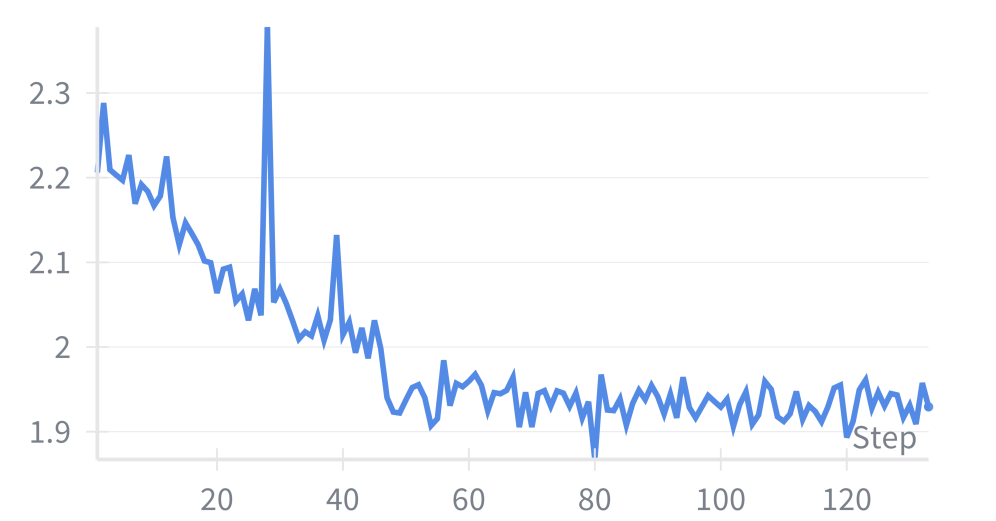
The image displays a single-series line chart plotting a measured value against a "Step" metric. The chart shows an overall downward trend with significant volatility in the early steps, followed by a period of stabilization with minor fluctuations. The data suggests a process that improves (decreases in value) over time or iterations, with notable instability at the beginning.
### Components/Axes
* **Chart Type:** Single line chart.
* **X-Axis (Horizontal):**
* **Label:** "Step" (located at the bottom-right of the axis).
* **Scale:** Linear scale from approximately 0 to 130.
* **Major Tick Marks:** Labeled at 20, 40, 60, 80, 100, 120.
* **Y-Axis (Vertical):**
* **Label:** None explicitly stated. The axis represents a numerical value.
* **Scale:** Linear scale from approximately 1.85 to 2.35.
* **Major Tick Marks:** Labeled at 1.9, 2, 2.1, 2.2, 2.3.
* **Data Series:**
* A single, continuous blue line.
* **Legend:** No legend is present, as there is only one data series.
* **Other Elements:** Light gray horizontal grid lines are present at each major y-axis tick (1.9, 2.0, 2.1, 2.2, 2.3).
### Detailed Analysis
**Trend Verification:** The blue line exhibits a general downward slope from left to right. The trend is not smooth; it is characterized by high-frequency noise and several prominent spikes, particularly in the first third of the chart.
**Key Data Points & Approximate Values:**
* **Start (Step ~0):** The line begins at a high point, approximately **2.28**.
* **Initial Volatility (Steps 0-30):** The value fluctuates sharply between ~2.15 and ~2.25.
* **Major Spike (Step ~28):** A very sharp, narrow peak reaches the highest point on the chart, approximately **2.34**.
* **Secondary Spike (Step ~38):** Another notable, but smaller, peak reaches approximately **2.13**.
* **Transition Zone (Steps 40-60):** The line shows a more consistent downward trend, moving from ~2.05 to ~1.92, though still with significant noise.
* **Stabilization Zone (Steps 60-130):** The line enters a relatively stable regime, oscillating within a narrow band. The value fluctuates primarily between **1.90 and 1.96**.
* **Lowest Point (Step ~80):** The line dips to its minimum value, approximately **1.87**.
* **End (Step ~130):** The line ends at a value of approximately **1.93**.
### Key Observations
1. **Two-Phase Behavior:** The data clearly separates into an initial high-volatility, decaying phase (Steps 0-60) and a later low-volatility, stable phase (Steps 60-130).
2. **Significant Outlier:** The spike at Step ~28 is a major anomaly, representing a sudden, large increase in the measured value before the downward trend resumes.
3. **Convergence:** After Step 60, the data series appears to converge around a value of approximately **1.93 ± 0.03**.
4. **Noise Level:** The signal contains substantial high-frequency noise throughout, which diminishes in amplitude but does not disappear in the stable phase.
### Interpretation
This chart likely represents the output of an iterative process, such as a machine learning model's loss function during training, a system's error rate over time, or a optimization metric. The "Step" axis corresponds to training iterations, epochs, or time intervals.
* **What the data suggests:** The process is successfully optimizing, as evidenced by the overall decrease in the measured value. The initial high values and volatility indicate a period of rapid adjustment or learning. The major spike could represent a problematic batch of data, an unstable learning rate, or a deliberate exploration step in an optimization algorithm.
* **How elements relate:** The x-axis (Step) is the independent variable driving change. The y-axis is the dependent performance metric. The downward trend confirms the process is moving toward a more optimal state (lower value). The stabilization after Step 60 suggests the process has reached a plateau or a local minimum, where further steps yield only minor improvements or random fluctuations around an equilibrium.
* **Notable Anomalies:** The spike at Step ~28 is the most critical anomaly. In a training context, this might warrant investigation into the data or hyperparameters used at that step. The persistent noise in the stable phase indicates that the process has inherent randomness or that the measurement is sensitive to small variations.