## Diagram: Concentric Layer Model with External Interaction
### Overview
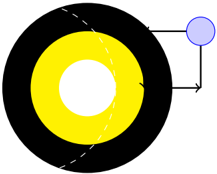
The image displays a schematic diagram consisting of three concentric circular layers and an external element connected via lines. The diagram appears to be a conceptual model, possibly representing a system with internal layers and an external agent or interface. There is no textual information, labels, or numerical data present in the image.
### Components/Axes
* **Central Structure:** Three concentric circles centered in the frame.
* **Outer Ring:** A thick, solid black ring.
* **Middle Ring:** A solid, bright yellow ring inside the black ring.
* **Inner Core:** A solid white circle at the very center.
* **External Element:** A small, light blue circle positioned to the right of the central structure.
* **Connecting Lines:**
* A solid black line connects the blue circle to the outer black ring.
* A solid black line connects the blue circle to the middle yellow ring.
* A dashed black line connects the blue circle to the inner white core.
* **Additional Marking:** A dashed white line cuts diagonally across the outer black ring, from the top-left to the bottom-right.
### Detailed Analysis
* **Spatial Grounding:** The central concentric circles occupy the majority of the image space. The small blue circle is located in the right-hand portion of the frame, approximately midway vertically.
* **Component Isolation:**
* **Header/Top Region:** Contains the top portion of the black ring and the start of the diagonal dashed line.
* **Main Chart/Center Region:** Contains the full concentric circle structure and the blue circle with its connecting lines.
* **Footer/Bottom Region:** Contains the bottom portion of the black ring and the end of the diagonal dashed line.
* **Connection Analysis:** The blue circle has three distinct connections to the central model:
1. A **solid line** to the **outermost (black) layer**.
2. A **solid line** to the **middle (yellow) layer**.
3. A **dashed line** to the **innermost (white) core**.
* **Visual Trend/Flow:** The diagram suggests a flow or relationship from the external element (blue circle) inward to the core of the central structure, with the connection type (solid vs. dashed) potentially indicating different modes or strengths of interaction.
### Key Observations
1. **Layer Hierarchy:** The concentric circles establish a clear inside-outside hierarchy: Core (white) -> Middle Layer (yellow) -> Outer Boundary (black).
2. **Connection Differentiation:** The use of solid vs. dashed lines for connections from the same external source is a significant visual distinction, implying a qualitative difference in the relationship to each layer.
3. **Diagonal Mark:** The dashed white line on the black ring is an isolated element not connected to the blue circle. It may represent a division, a path, or a specific feature within the outer layer.
4. **Color Coding:** The colors (black, yellow, white, light blue) are distinct and likely carry symbolic meaning within the context of the model (e.g., barrier, active zone, neutral core, external agent).
### Interpretation
This diagram is a **Peircean representation of a system with an external interface**. It models a structured entity (the concentric circles) being acted upon or interacting with an external agent (the blue circle).
* **What it suggests:** The data suggests a system where an external entity has direct, solid-line access to both the protective outer boundary and the active middle layer, but only indirect or mediated (dashed-line) access to the central core. This could model concepts like:
* A **security model** where an attacker (blue) has breached the perimeter (black) and compromised a subsystem (yellow) but has not yet reached the critical asset (white).
* A **biological cell** where a molecule (blue) interacts with the cell wall (black) and cytoplasm (yellow) but not directly with the nucleus (white).
* A **software architecture** where a user (blue) interacts with the API layer (black) and business logic (yellow) but not directly with the database (white).
* **Relationships:** The primary relationship is one of **interaction and penetration** from the external to the internal. The concentric circles relate to each other as nested containers or layers of increasing importance or protection.
* **Anomalies/Notable Points:** The diagonal dashed line on the outer ring is an anomaly. It is not connected to the main interaction flow and may represent a pre-existing condition, a vulnerability, or a separate process occurring within the outer layer itself. The lack of any text or legend is also notable, indicating this is likely a generic conceptual model meant to be explained in accompanying text.