# Technical Document Extraction: RAG (Retrieval-Augmented Generation) Overview
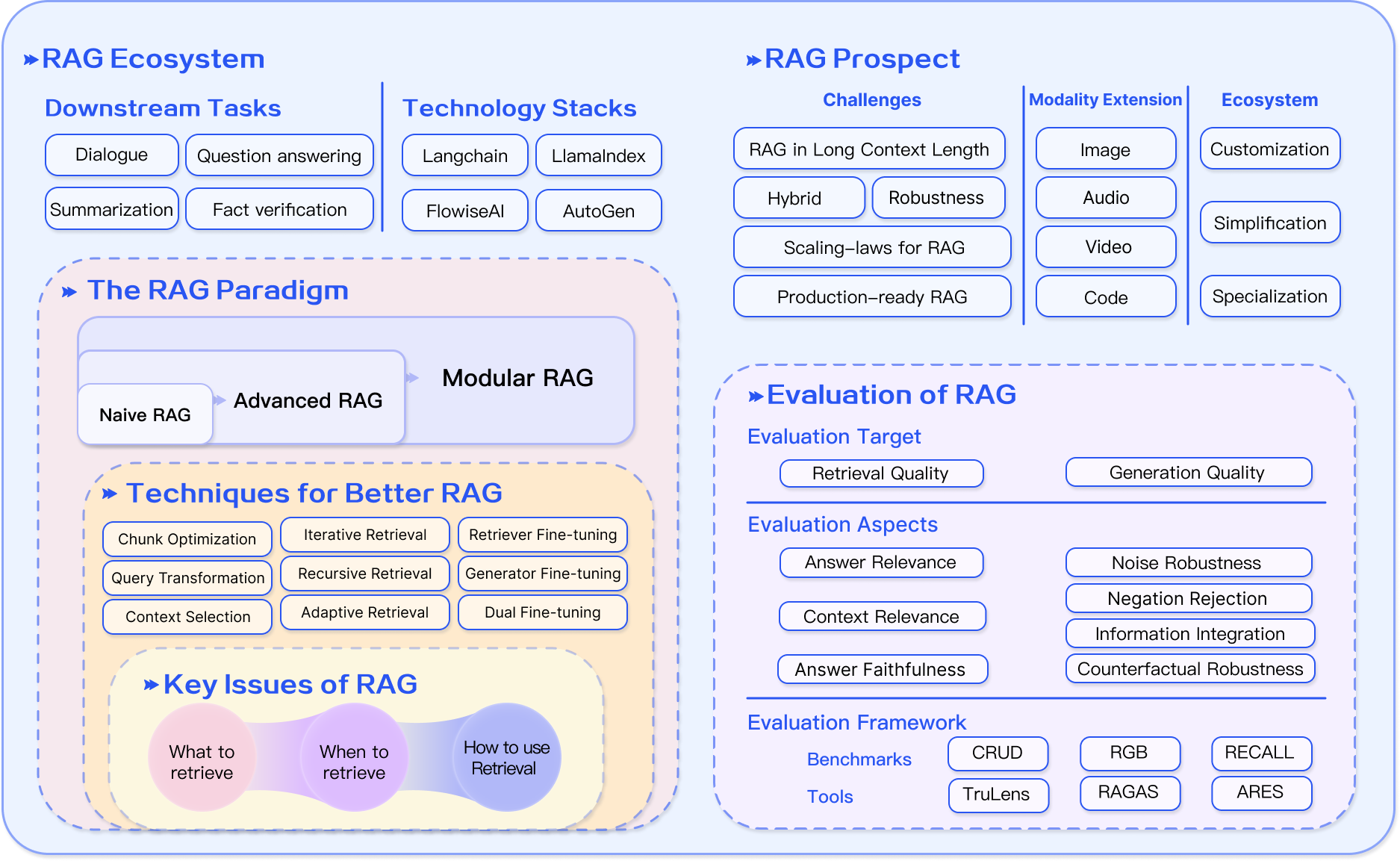
This document provides a comprehensive extraction of the information contained in the provided infographic regarding the Retrieval-Augmented Generation (RAG) ecosystem, paradigm, prospects, and evaluation.
---
## 1. RAG Ecosystem (Top Left Section)
This section categorizes the practical applications and the software infrastructure supporting RAG.
### Downstream Tasks
* **Dialogue**: Interactive conversational agents.
* **Question answering**: Providing direct answers to user queries.
* **Summarization**: Condensing long documents into shorter versions.
* **Fact verification**: Validating the truthfulness of claims against a knowledge base.
### Technology Stacks
* **Langchain**: Framework for developing applications powered by language models.
* **LlamaIndex**: Data framework for LLM applications to connect custom data sources.
* **FlowiseAI**: Low-code tool for building customized LLM flows.
* **AutoGen**: Framework for enabling LLM workflows using multiple agents.
---
## 2. The RAG Paradigm (Middle Left Section)
This nested section describes the evolution and technical components of RAG systems.
### Evolution of RAG
The diagram shows a progression (indicated by arrows) within a "Modular RAG" container:
1. **Naive RAG**: The foundational approach.
2. **Advanced RAG**: An evolution of the naive approach with more sophisticated processing.
3. **Modular RAG**: The overarching framework that encompasses the previous two, suggesting a plug-and-play architecture.
### Techniques for Better RAG
A list of specific technical optimizations:
* **Chunk Optimization**: Refining how data is split for indexing.
* **Query Transformation**: Modifying user queries to improve retrieval.
* **Context Selection**: Filtering retrieved information for relevance.
* **Iterative Retrieval**: Performing multiple rounds of retrieval.
* **Recursive Retrieval**: Drilling down into data structures for better context.
* **Adaptive Retrieval**: Dynamically adjusting retrieval strategies.
* **Retriever Fine-tuning**: Training the retrieval model on specific data.
* **Generator Fine-tuning**: Training the LLM to better utilize retrieved context.
* **Dual Fine-tuning**: Optimizing both the retriever and the generator simultaneously.
### Key Issues of RAG
Represented as three interconnected nodes:
1. **What to retrieve**: Identifying the correct data sources and segments.
2. **When to retrieve**: Determining the optimal timing for retrieval in a workflow.
3. **How to use Retrieval**: Integrating the retrieved information into the generation process.
---
## 3. RAG Prospect (Top Right Section)
This section outlines the future directions and current hurdles in the field.
### Challenges
* **RAG in Long Context Length**: Handling very large input windows.
* **Hybrid**: Combining different retrieval or generation methods.
* **Robustness**: Ensuring consistent performance across various inputs.
* **Scaling-laws for RAG**: Understanding how performance scales with data and model size.
* **Production-ready RAG**: Moving from experimental setups to stable, scalable deployments.
### Modality Extension
Extending RAG beyond text to include:
* **Image**
* **Audio**
* **Video**
* **Code**
### Ecosystem (Future Trends)
* **Customization**: Tailoring RAG to specific user needs.
* **Simplification**: Making RAG systems easier to build and deploy.
* **Specialization**: Developing RAG for niche domains or specific industries.
---
## 4. Evaluation of RAG (Bottom Right Section)
This section details how RAG systems are measured and validated.
### Evaluation Target
* **Retrieval Quality**: How well the system finds relevant information.
* **Generation Quality**: How well the system produces the final output.
### Evaluation Aspects
* **Answer Relevance**: Does the answer address the query?
* **Context Relevance**: Is the retrieved context actually useful?
* **Answer Faithfulness**: Is the answer grounded in the retrieved context (avoiding hallucinations)?
* **Noise Robustness**: Can the system handle irrelevant information in the context?
* **Negation Rejection**: Can the system correctly identify when information is not present?
* **Information Integration**: Can the system synthesize information from multiple sources?
* **Counterfactual Robustness**: How the system handles false or misleading information.
### Evaluation Framework
Categorized into Benchmarks and Tools:
* **Benchmarks**:
* **CRUD**
* **RGB**
* **RECALL**
* **Tools**:
* **TruLens**
* **RAGAS**
* **ARES**