TECHNICAL ASSET FINGERPRINT
9fd40918a3bded09252cad70
Click to view fullscreen
Press ESC or click to close
FOUND IN PAPERS
EXPERT: gemini-2.0-flash VERSION 1
RUNTIME: nugit/gemini/gemini-2.0-flash
INTEL_VERIFIED
## Type Theory Inference Rules
### Overview
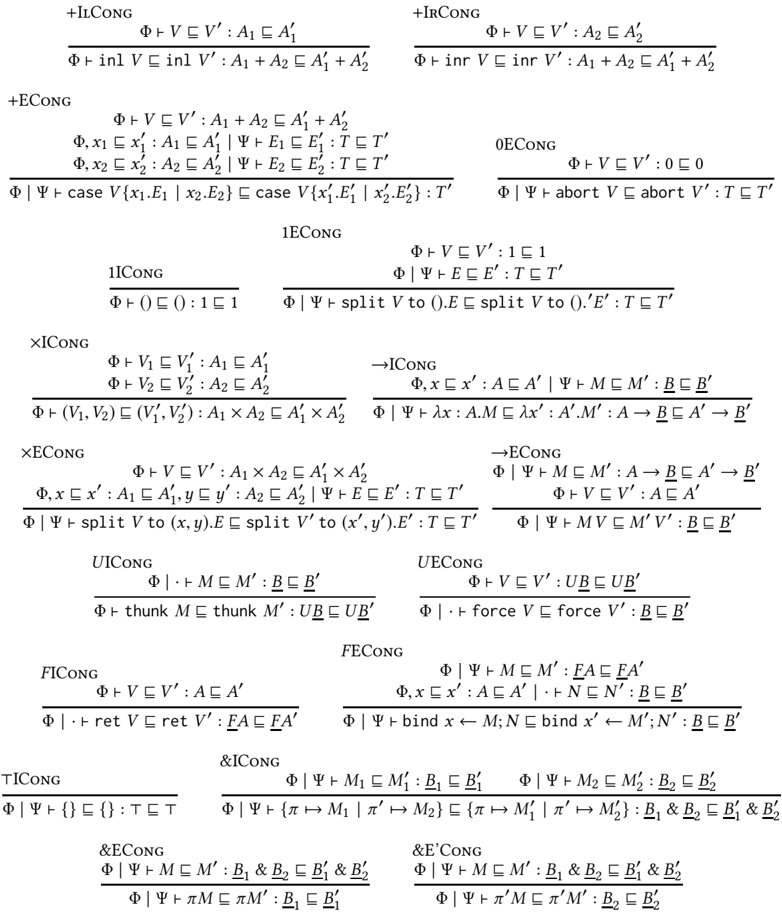
The image presents a collection of inference rules, likely related to type theory or programming language semantics. Each rule defines a condition under which a certain judgment (statement) can be derived. The rules cover various constructs, including sums, products, functions, thunks, and records.
### Components/Axes
Each rule is structured as follows:
- **Name:** A short identifier for the rule (e.g., "+ILCONG", "XICONG").
- **Premises:** Conditions that must be true for the rule to apply. These are written above a horizontal line.
- **Conclusion:** The judgment that can be derived if the premises are true. This is written below the horizontal line.
- **Judgments:** These typically have the form "Φ ⊢ V ⊑ V': A ⊑ A'", where:
- Φ represents a typing context.
- V and V' are values or expressions.
- A and A' are types.
- ⊑ denotes a subtyping relation.
- ⊢ denotes derivability.
### Detailed Analysis or Content Details
Here's a breakdown of each rule, transcribing the text and providing a brief explanation:
**Row 1**
* **+ILCONG**
* Premise: Φ ⊢ V ⊑ V': A₁ ⊑ A₁'
* Conclusion: Φ ⊢ inl V ⊑ inl V': A₁ + A₂ ⊑ A₁' + A₂'
* Interpretation: If V is a subtype of V' with type A₁ a subtype of A₁', then inl V is a subtype of inl V' with type A₁ + A₂ a subtype of A₁' + A₂'. This rule handles the left injection of a sum type.
* **+IRCONG**
* Premise: Φ ⊢ V ⊑ V': A₂ ⊑ A₂'
* Conclusion: Φ ⊢ inr V ⊑ inr V': A₁ + A₂ ⊑ A₁' + A₂'
* Interpretation: If V is a subtype of V' with type A₂ a subtype of A₂', then inr V is a subtype of inr V' with type A₁ + A₂ a subtype of A₁' + A₂'. This rule handles the right injection of a sum type.
**Row 2**
* **+ECONG**
* Premises:
* Φ ⊢ V ⊑ V': A₁ + A₂ ⊑ A₁' + A₂'
* Φ, x₁ ⊑ x₁': A₁ ⊑ A₁' ⊢ E₁ ⊑ E₁': T ⊑ T'
* Φ, x₂ ⊑ x₂': A₂ ⊑ A₂' ⊢ E₂ ⊑ E₂': T ⊑ T'
* Conclusion: Φ ⊢ case V {x₁.E₁ | x₂.E₂} ⊑ case V' {x₁'.E₁' | x₂'.E₂'}: T'
* Interpretation: This rule handles the case expression for sum types. It states that if V is a subtype of V', and the branches E₁ and E₂ are subtypes of E₁' and E₂' respectively, then the case expression is well-typed.
* **0ECONG**
* Premise: Φ ⊢ V ⊑ V': 0 ⊑ 0
* Conclusion: Φ ⊢ abort V ⊑ abort V': T ⊑ T'
* Interpretation: This rule deals with the `abort` expression, which likely represents a non-returning computation.
**Row 3**
* **1ICONG**
* Conclusion: Φ ⊢ () ⊑ (): 1 ⊑ 1
* Interpretation: This rule states that the unit value () is a subtype of itself, with type 1 being a subtype of itself.
* **1ECONG**
* Premise: Φ ⊢ V ⊑ V': 1 ⊑ 1
* Premise: Φ ⊢ E ⊑ E': T ⊑ T'
* Conclusion: Φ ⊢ split V to ().E ⊑ split V' to ().E': T ⊑ T'
* Interpretation: This rule handles the `split` expression for the unit type.
**Row 4**
* **XICONG**
* Premises:
* Φ ⊢ V₁ ⊑ V₁': A₁ ⊑ A₁'
* Φ ⊢ V₂ ⊑ V₂': A₂ ⊑ A₂'
* Conclusion: Φ ⊢ (V₁, V₂) ⊑ (V₁', V₂'): A₁ × A₂ ⊑ A₁' × A₂'
* Interpretation: If V₁ is a subtype of V₁' and V₂ is a subtype of V₂', then the pair (V₁, V₂) is a subtype of (V₁', V₂'). This rule handles the introduction of product types.
* **→ICONG**
* Premise: Φ, x ⊑ x': A ⊑ A' ⊢ M ⊑ M': B ⊑ B'
* Conclusion: Φ ⊢ λx:A.M ⊑ λx':A'.M': A → B ⊑ A' → B'
* Interpretation: This rule handles lambda abstraction. If M is a subtype of M' under the assumption that x is a subtype of x', then the lambda abstraction λx:A.M is a subtype of λx':A'.M'.
**Row 5**
* **XECONG**
* Premises:
* Φ ⊢ V ⊑ V': A₁ × A₂ ⊑ A₁' × A₂'
* Φ, x ⊑ x': A₁ ⊑ A₁', y ⊑ y': A₂ ⊑ A₂' ⊢ E ⊑ E': T ⊑ T'
* Conclusion: Φ ⊢ split V to (x, y).E ⊑ split V' to (x', y').E': T ⊑ T'
* Interpretation: This rule handles the `split` expression for product types.
* **→ECONG**
* Premises:
* Φ ⊢ M ⊑ M': A → B ⊑ A' → B'
* Φ ⊢ V ⊑ V': A ⊑ A'
* Conclusion: Φ ⊢ M V ⊑ M' V': B ⊑ B'
* Interpretation: This rule handles function application. If M is a subtype of M' and V is a subtype of V', then M V is a subtype of M' V'.
**Row 6**
* **UICONG**
* Premise: Φ ⊢ M ⊑ M': B ⊑ B'
* Conclusion: Φ ⊢ thunk M ⊑ thunk M': UB ⊑ UB'
* Interpretation: This rule handles the introduction of thunks (delayed computations).
* **UECONG**
* Premise: Φ ⊢ V ⊑ V': UB ⊑ UB'
* Conclusion: Φ ⊢ force V ⊑ force V': B ⊑ B'
* Interpretation: This rule handles the `force` operation on thunks, evaluating the delayed computation.
**Row 7**
* **FICONG**
* Premise: Φ ⊢ V ⊑ V': A ⊑ A'
* Conclusion: Φ ⊢ ret V ⊑ ret V': FA ⊑ FA'
* Interpretation: This rule handles the `ret` operation, likely related to a monadic type (F).
* **FECONG**
* Premises:
* Φ ⊢ M ⊑ M': FA ⊑ FA'
* Φ, x ⊑ x': A ⊑ A' ⊢ N ⊑ N': B ⊑ B'
* Conclusion: Φ ⊢ bind x ← M; N ⊑ bind x' ← M'; N': B ⊑ B'
* Interpretation: This rule handles the `bind` operation, likely related to a monadic type (F).
**Row 8**
* **TICONG**
* Conclusion: Φ ⊢ {} ⊑ {}: T ⊑ T
* Interpretation: This rule states that the empty record {} is a subtype of itself, with type T being a subtype of itself.
* **&ICONG**
* Premises:
* Φ ⊢ M₁ ⊑ M₁': B₁ ⊑ B₁'
* Φ ⊢ M₂ ⊑ M₂': B₂ ⊑ B₂'
* Conclusion: Φ ⊢ {π → M₁ | π' → M₂} ⊑ {π → M₁' | π' → M₂'}: B₁ & B₂ ⊑ B₁' & B₂'
* Interpretation: This rule handles record extension.
**Row 9**
* **&ECONG**
* Premise: Φ ⊢ M ⊑ M': B₁ & B₂ ⊑ B₁' & B₂'
* Conclusion: Φ ⊢ πM ⊑ πM': B₁ ⊑ B₁'
* Interpretation: This rule handles record field access.
* **&E'CONG**
* Premise: Φ ⊢ M ⊑ M': B₁ & B₂ ⊑ B₁' & B₂'
* Conclusion: Φ ⊢ π'M ⊑ π'M': B₂ ⊑ B₂'
* Interpretation: This rule handles record field access.
### Key Observations
* The rules define a subtyping relation (⊑) between values and types.
* The rules cover common type theory constructs like sums, products, functions, and records.
* The rules appear to be part of a formal system for verifying the correctness of programs.
* The presence of "thunk" and "force" suggests a system that supports lazy evaluation.
* The presence of "ret" and "bind" suggests a system that incorporates monadic types.
### Interpretation
The inference rules define a type system that ensures type safety and allows for subtyping. The rules specify how to derive judgments about the relationships between values, expressions, and types. The system likely aims to prevent runtime errors by ensuring that programs adhere to the specified type constraints. The inclusion of features like thunks and monads suggests a sophisticated type system capable of handling advanced programming paradigms. The rules collectively define a formal system for reasoning about the types and behavior of programs.
DECODING INTELLIGENCE...