\n
## Mathematical Formulas: Congruence Relations
### Overview
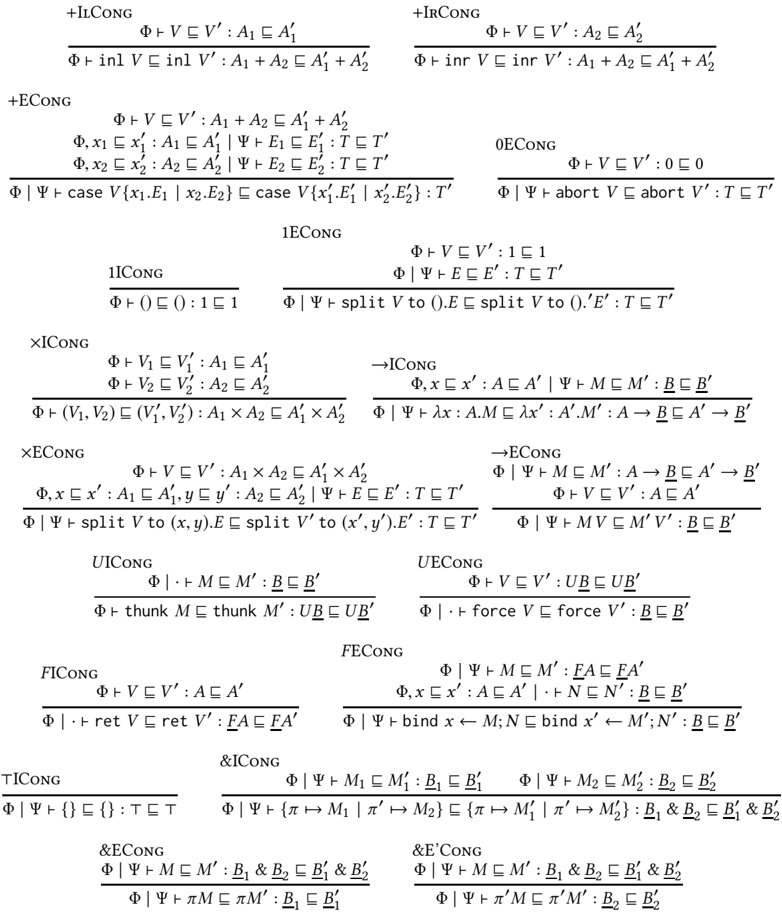
The image presents a collection of mathematical formulas, seemingly related to congruence relations and logical operations. The formulas are arranged in a grid-like structure, each labeled with a prefix like "HlCong", "IrCong", etc. The notation involves symbols from logic and set theory, including quantifiers, implication, and set membership.
### Components/Axes
There are no axes in the traditional sense. Instead, each formula is labeled with a unique identifier at the beginning of the line (e.g., "HlCong", "IrCong", "ECong"). The formulas themselves consist of logical expressions and set-theoretic notation. The image is organized into a grid of these formulas.
### Detailed Analysis or Content Details
Here's a transcription of each formula, along with a breakdown of the symbols where possible. Note that precise interpretation requires domain expertise in mathematical logic.
1. **HlCong:** Φ + V ⊆ V': A₁ ⊆ A₂
2. **IrCong:** Φ + V ⊆ V': A₂ ⊆ A₁
3. **ECong:** Φ + V ⊆ V': A₁ + A₂ ⊆ A₁ + A₂
4. **0ECong:** Φ + V ⊆ V': 0 ⊆ 0
5. **1ECong:** Φ + V ⊆ V': 1 ⊆ 1
6. **11Cong:** Φ + 0 ⊆ 0: 1 ⊆ 1
7. **XICong:** Φ + V ⊆ V': A₁ ⊆ A₂
8. **XECong:** Φ + V ⊆ V': A₁ + A₂ ⊆ A₁ + A₂
9. **UICong:** Φ + l ⊆ M: B ⊆ B'
10. **FECong:** Φ + V ⊆ V': A ⊆ A'
11. **FICong:** Φ + V ⊆ V': A ⊆ A'
12. **TICong:** Φ + l ⊆ {}: T ⊆ T
13. **&ECong:** Φ + V + M ⊆ M': B₁ ⊆ B₂
14. **&IECong:** Φ + V + M ⊆ M': B₂ ⊆ B₁
15. **in1 V ⊆ in1 V': A₁ + A₂ ⊆ A₁ + A₂**
16. **in2 V ⊆ in2 V': A₁ + A₂ ⊆ A₁ + A₂**
17. **case V{x₁ E₁ | x₂ E₂}: T**
18. **abort V ⊆ abort V': T**
19. **split V to ( ) ⊆ split V to ( ): E' ⊆ T**
20. **→Cong:** Φ, x ⊆ X': A ⊆ A' | Ψ + M ⊆ M': B ⊆ B'
21. **→ECong:** Φ + Ψ + x ⊆ x': A ⊆ A' | Ψ + M ⊆ M': A → B ⊆ A → B'
22. **UECong:** Φ + V ⊆ V': U ⊆ U'
23. **thunk M ⊆ thunk M': U ⊆ U'**
24. **force V ⊆ force V': B ⊆ B'**
25. **bind x ⊆ bind x': M ⊆ N**
26. **+ x + M ⊆ M': B₁ ⊆ B₂**
27. **+ x + M ⊆ M': B₂ ⊆ B₁**
28. **+ x + { } ⊆ {}: T**
29. **+ x + M ⊆ M': B₁ ⊆ B₂**
30. **+ x + M ⊆ M': B₂ ⊆ B₁**
The symbols used include:
* Φ, Ψ: Likely represent logical formulas or sets.
* V, V': Variables or sets.
* ⊆: Subset relation.
* A₁, A₂, B₁, B₂: Sets.
* E₁, E₂: Elements or conditions.
* x, y: Variables.
* M, M', N: Sets.
* 0, 1: Possibly representing empty set and universal set, respectively.
* →: Implication.
* +: Set union or addition.
* {}: Empty set.
* T: Possibly representing a truth value or a set.
* ⊆: Subset relation.
### Key Observations
The formulas appear to be exploring different properties of congruence relations, potentially within a formal system or programming language context. The prefixes (e.g., "HlCong", "IrCong") likely denote different rules or theorems. The repeated use of the subset relation (⊆) suggests a focus on set-theoretic properties. The formulas involving "in", "case", "abort", "split", "thunk", "force", and "bind" hint at operations related to computation or program evaluation.
### Interpretation
The image presents a formalization of congruence relations, likely within a logical or computational framework. The formulas define how these relations behave under various operations and conditions. The systematic naming convention (e.g., "HlCong", "IrCong") suggests a structured approach to defining and proving properties of congruence. The presence of terms like "thunk" and "force" indicates a possible connection to functional programming or lazy evaluation. The overall purpose seems to be to establish a set of axioms or rules governing congruence relations, which could be used for reasoning about program correctness or formal verification. The formulas are highly abstract and require specialized knowledge to fully understand their meaning and implications. The image is a collection of facts or data, and does not contain any trends or anomalies. It is a static representation of logical statements.