## Directed Acyclic Graph (DAG): Causal Model with Four Variables
### Overview
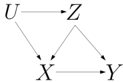
The image displays a directed acyclic graph (DAG) representing a causal or probabilistic model. It consists of four nodes labeled with single uppercase letters, connected by directed edges (arrows) indicating the direction of influence or conditional dependence. The graph is minimal, containing only nodes and edges without additional annotations, scales, or legends.
### Components/Axes
* **Nodes (Variables):** Four nodes, each represented by a single letter:
* **U** (Top-left position)
* **Z** (Top-right position)
* **X** (Bottom-left position)
* **Y** (Bottom-right position)
* **Edges (Relationships):** Five directed edges, represented by solid black arrows:
1. **U → Z** (Arrow from U to Z)
2. **U → X** (Arrow from U to X)
3. **Z → X** (Arrow from Z to X)
4. **Z → Y** (Arrow from Z to Y)
5. **X → Y** (Arrow from X to Y)
### Detailed Analysis
* **Spatial Layout & Connectivity:**
* The graph is arranged in a roughly rectangular layout.
* **U** is a root node (no incoming edges) with two outgoing edges to **Z** and **X**.
* **Z** has one incoming edge (from U) and two outgoing edges (to X and Y).
* **X** has two incoming edges (from U and Z) and one outgoing edge (to Y).
* **Y** is a leaf node (no outgoing edges) with two incoming edges (from Z and X).
* **Pathways:** The structure defines several pathways of influence:
* **U → Z → Y**
* **U → Z → X → Y**
* **U → X → Y**
* There is no direct edge from **U** to **Y**.
### Key Observations
1. **Confounding Structure:** Node **U** acts as a common cause (confounder) for both **Z** and **X**, as indicated by the edges U→Z and U→X.
2. **Mediation:** Node **Z** mediates the effect of **U** on both **X** and **Y**. Node **X** mediates the effect of **Z** on **Y**.
3. **Collider Structure:** Node **X** is a collider on the path **U → X ← Z**. Conditioning on X would open a non-causal association between U and Z.
4. **Absence of Direct Link:** There is no direct causal path from **U** to **Y**; all influence from U on Y is mediated through Z and/or X.
### Interpretation
This DAG is a formal representation used in fields like causal inference, epidemiology, and machine learning to encode assumptions about data-generating processes.
* **What it Suggests:** The graph posits that variable **Y** (often an outcome) is directly influenced by **Z** and **X**. **X** is itself influenced by both **U** and **Z**. **U** is an exogenous variable that influences the system but is not influenced by it.
* **Relationships:** The edges imply conditional independence statements. For example, given its parents (U and Z), **X** is independent of other variables not its descendants. This structure is crucial for identifying causal effects (e.g., the effect of Z on Y) from observational data.
* **Notable Implications:** The model explicitly rules out a direct effect of **U** on **Y**. Any observed association between U and Y must be explained by the paths through Z and X. The presence of the collider at X warns against conditioning on it when estimating the association between U and Z, as it would induce a spurious correlation.
* **Peircean Investigative Lens:** The diagram is a *symbol* (the graph structure) representing a *dynamic* (the causal processes). To interpret it is to hypothesize about the *final interpretant*—the practical consequences for analysis, such as which variables must be controlled for to estimate a specific causal effect without bias. The absence of a U→Y arrow is a critical *iconic* claim about the real-world system being modeled.