## Directed Graph Diagram: Node Relationships
### Overview
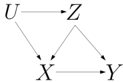
The image depicts a directed graph with four nodes (U, Z, X, Y) and bidirectional/unidirectional edges. Arrows indicate directional relationships between nodes, forming a network structure.
### Components/Axes
- **Nodes**:
- U (top-left)
- Z (center)
- X (bottom-left)
- Y (bottom-right)
- **Edges**:
- Bidirectional arrows between U and Z (mutual relationship)
- Unidirectional arrows from Z to X and Z to Y (one-way influence)
- **No legends, axis titles, or numerical scales present** (pure structural diagram).
### Detailed Analysis
- **Bidirectional Relationship (U ↔ Z)**:
- Arrows point in both directions between U and Z, suggesting a reciprocal interaction or mutual dependency.
- **Unidirectional Relationships (Z → X, Z → Y)**:
- Arrows originate from Z and point to X and Y, indicating Z acts as a source or influencer for X and Y.
- **Node Placement**:
- U and Z are positioned higher in the diagram, while X and Y are lower, potentially implying a hierarchical or sequential flow.
### Key Observations
- Z serves as a central hub, connecting to all other nodes.
- No self-loops or additional edges exist beyond the described connections.
- The diagram lacks labels for edge weights or node attributes (e.g., no percentages, timestamps, or categorical markers).
### Interpretation
This diagram likely represents a **process flow**, **dependency network**, or **causal relationship** where:
1. **U and Z** share a bidirectional relationship (e.g., mutual influence, two-way communication).
2. **Z** acts as an intermediary, directing influence to **X** and **Y** (e.g., Z could represent a decision node, data source, or control center).
3. The absence of reverse edges from X/Y to Z or U suggests a unidirectional dependency (e.g., X and Y are outputs or endpoints).
The structure implies a system where Z is pivotal, mediating interactions between U and the downstream nodes X/Y. Without additional context (e.g., labels, weights), the exact nature of relationships remains abstract but highlights Z's central role.