## Violin Plots: F1 Score Analysis of Sentence Training
### Overview
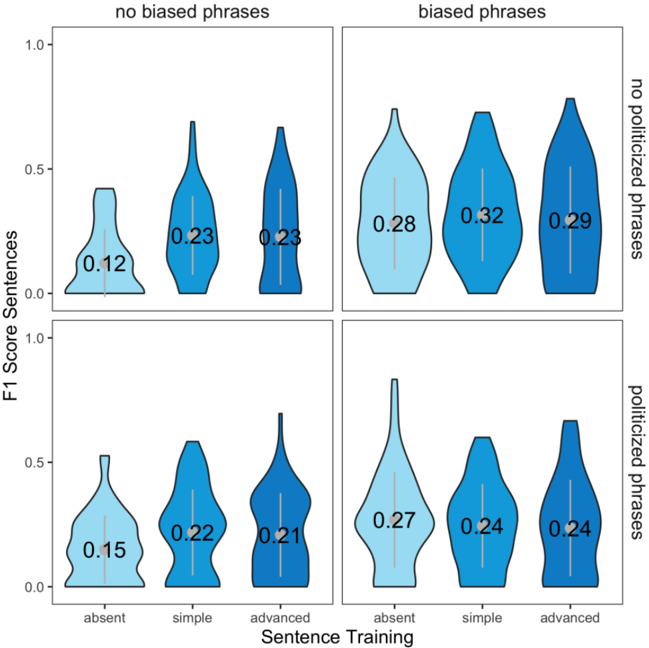
The image presents a 2x2 grid of violin plots, visualizing the distribution of F1 scores for sentences under different training conditions. The plots compare performance with and without biased phrases, and with varying levels of sentence training (absent, simple, advanced). Each violin plot displays the distribution of F1 scores, with a white dot indicating the median and a black line representing the interquartile range.
### Components/Axes
* **X-axis:** "Sentence Training" with categories: "absent", "simple", "advanced".
* **Y-axis:** "F1 Score Sentences" ranging from 0.0 to 1.0.
* **Two main groupings:** "no biased phrases" (top row) and "biased phrases" (bottom row).
* **Two main groupings:** "no politicized phrases" (left column) and "politicized phrases" (right column).
* Each violin plot includes a white dot indicating the median F1 score and a black line indicating the interquartile range.
* Numerical values are displayed within each violin plot, representing the median F1 score.
### Detailed Analysis
The image contains six violin plots, arranged in a 2x3 grid.
**Top Row: No Biased Phrases**
* **No politicized phrases, absent training:** The violin plot is centered around an F1 score of approximately 0.12. The distribution is relatively narrow.
* **No politicized phrases, simple training:** The violin plot is centered around an F1 score of approximately 0.23. The distribution is wider than the "absent" training condition.
* **No politicized phrases, advanced training:** The violin plot is centered around an F1 score of approximately 0.23. The distribution is similar in width to the "simple" training condition.
* **Politicized phrases, absent training:** The violin plot is centered around an F1 score of approximately 0.28. The distribution is wider than the "absent" training condition for no politicized phrases.
* **Politicized phrases, simple training:** The violin plot is centered around an F1 score of approximately 0.32. The distribution is wider than the "absent" training condition for politicized phrases.
* **Politicized phrases, advanced training:** The violin plot is centered around an F1 score of approximately 0.29. The distribution is similar in width to the "simple" training condition for politicized phrases.
**Bottom Row: Biased Phrases**
* **No politicized phrases, absent training:** The violin plot is centered around an F1 score of approximately 0.15. The distribution is relatively narrow.
* **No politicized phrases, simple training:** The violin plot is centered around an F1 score of approximately 0.22. The distribution is wider than the "absent" training condition.
* **No politicized phrases, advanced training:** The violin plot is centered around an F1 score of approximately 0.21. The distribution is similar in width to the "simple" training condition.
* **Politicized phrases, absent training:** The violin plot is centered around an F1 score of approximately 0.27. The distribution is wider than the "absent" training condition for no politicized phrases.
* **Politicized phrases, simple training:** The violin plot is centered around an F1 score of approximately 0.24. The distribution is wider than the "absent" training condition for politicized phrases.
* **Politicized phrases, advanced training:** The violin plot is centered around an F1 score of approximately 0.24. The distribution is similar in width to the "simple" training condition for politicized phrases.
### Key Observations
* Generally, F1 scores increase with more advanced sentence training ("simple" and "advanced" compared to "absent").
* The presence of politicized phrases tends to slightly increase F1 scores compared to the absence of politicized phrases, particularly with "absent" training.
* The impact of biased phrases is less pronounced with "simple" and "advanced" training.
* The distributions of F1 scores are not always symmetrical, suggesting potential skewness in the data.
### Interpretation
The data suggests that sentence training, particularly moving from "absent" to "simple" or "advanced", improves the F1 score for sentence analysis. The inclusion of politicized phrases appears to have a minor positive effect on F1 scores, especially when no training is applied. This could indicate that the model benefits from exposure to more complex or nuanced language, even if it contains potentially sensitive content. However, the effect of politicized phrases diminishes with more advanced training, suggesting that the model learns to handle such language more effectively. The violin plots reveal the variability in F1 scores, highlighting the potential for different outcomes depending on the specific sentences being analyzed. The relatively narrow distributions for "absent" training suggest more consistent performance, while the wider distributions for "simple" and "advanced" training indicate greater variability. This could be due to the increased complexity of the sentences used in these training conditions.