## Image Comparison: Rendering Methods
### Overview
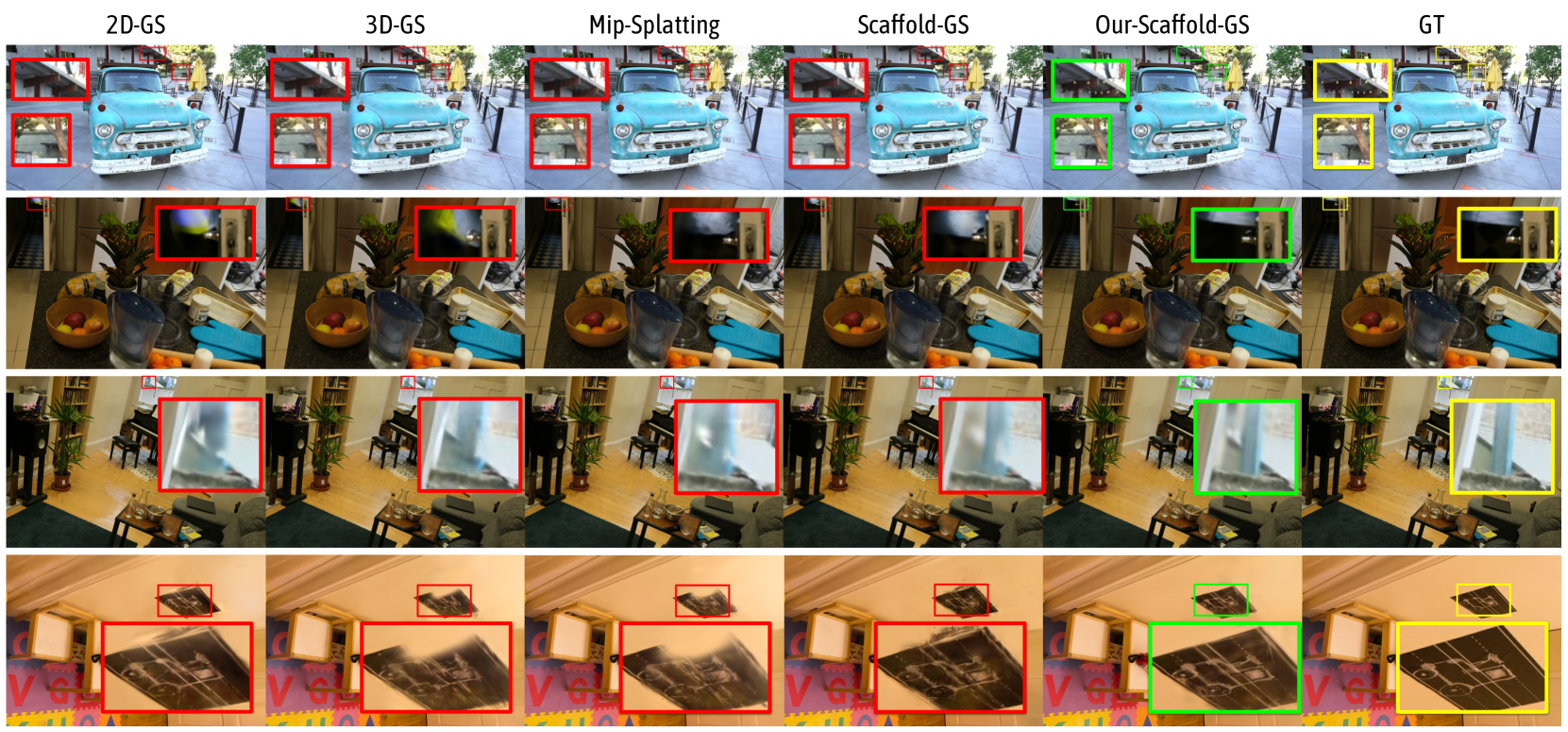
The image presents a visual comparison of different rendering methods applied to various scenes. Six rendering techniques are showcased: 2D-GS, 3D-GS, Mip-Splatting, Scaffold-GS, Our-Scaffold-GS, and GT (Ground Truth). Each method is applied to four different scenes, with zoomed-in regions highlighted by bounding boxes (red, green, or yellow) to emphasize differences in rendering quality.
### Components/Axes
* **Column Headers (Rendering Methods):**
* 2D-GS
* 3D-GS
* Mip-Splatting
* Scaffold-GS
* Our-Scaffold-GS
* GT (Ground Truth)
* **Row Labels (Scenes):** The rows depict different scenes. From top to bottom, they are:
1. A light blue vintage car in a street scene.
2. A kitchen scene with fruits, utensils, and a water filter.
3. A living room scene with a window, piano, and furniture.
4. A room with a whiteboard and a drawing on a table.
* **Bounding Boxes:**
* Red: Highlights areas of artifacts or lower quality in the rendering.
* Green: Highlights areas of improved quality in the rendering (specifically for "Our-Scaffold-GS").
* Yellow: Highlights areas in the Ground Truth (GT) images for comparison.
### Detailed Analysis or ### Content Details
**Scene 1: Vintage Car**
* **2D-GS:** The car appears rendered, but the zoomed-in regions (red boxes) suggest potential artifacts or lower resolution in areas like the roof and the front grill.
* **3D-GS:** Similar to 2D-GS, with red boxes highlighting potential issues in the same areas.
* **Mip-Splatting:** Again, red boxes indicate potential rendering issues.
* **Scaffold-GS:** Red boxes indicate potential rendering issues.
* **Our-Scaffold-GS:** Green boxes highlight improvements in the roof and front grill areas compared to the previous methods.
* **GT:** Yellow boxes highlight the corresponding areas in the ground truth image, showing the desired rendering quality.
**Scene 2: Kitchen**
* **2D-GS:** The kitchen scene is rendered, but the red box focuses on a dark area, possibly indicating rendering difficulties with shadows or reflections.
* **3D-GS:** Similar to 2D-GS, the red box highlights a dark area.
* **Mip-Splatting:** The red box focuses on a dark area.
* **Scaffold-GS:** The red box focuses on a dark area.
* **Our-Scaffold-GS:** A green box highlights the same area, suggesting an improvement in rendering the dark region.
* **GT:** A yellow box highlights the corresponding area in the ground truth image.
**Scene 3: Living Room**
* **2D-GS:** The living room scene is rendered, with the red box focusing on the window area, possibly indicating issues with transparency or reflections.
* **3D-GS:** Similar to 2D-GS, the red box highlights the window area.
* **Mip-Splatting:** The red box focuses on the window area.
* **Scaffold-GS:** The red box focuses on the window area.
* **Our-Scaffold-GS:** A green box highlights the window area, suggesting an improvement in rendering.
* **GT:** A yellow box highlights the corresponding area in the ground truth image.
**Scene 4: Room with Whiteboard**
* **2D-GS:** The room scene is rendered, with the red box focusing on the drawing on the table, possibly indicating issues with texture or detail rendering.
* **3D-GS:** Similar to 2D-GS, the red box highlights the drawing.
* **Mip-Splatting:** The red box focuses on the drawing.
* **Scaffold-GS:** The red box focuses on the drawing.
* **Our-Scaffold-GS:** A green box highlights the drawing, suggesting an improvement in rendering.
* **GT:** A yellow box highlights the corresponding area in the ground truth image.
### Key Observations
* The "Our-Scaffold-GS" method consistently shows improvements over the other methods (2D-GS, 3D-GS, Mip-Splatting, and Scaffold-GS), as indicated by the green bounding boxes.
* The red bounding boxes across the first four methods (2D-GS, 3D-GS, Mip-Splatting, and Scaffold-GS) suggest common rendering challenges in specific areas of each scene.
* The GT (Ground Truth) images provide a visual benchmark for the desired rendering quality.
### Interpretation
The image demonstrates a comparative analysis of different rendering techniques. The consistent placement of red bounding boxes across 2D-GS, 3D-GS, Mip-Splatting, and Scaffold-GS indicates that these methods struggle with similar rendering challenges, such as handling reflections, shadows, transparency, and fine details. The "Our-Scaffold-GS" method appears to address some of these challenges, resulting in improved rendering quality in the highlighted areas, as indicated by the green bounding boxes. The Ground Truth (GT) images serve as a reference point, illustrating the ideal rendering outcome. The comparison suggests that "Our-Scaffold-GS" is a potentially superior rendering technique compared to the others tested, as it more closely approximates the ground truth in the selected scenes.