\n
## Image: Novel View Synthesis Comparison
### Overview
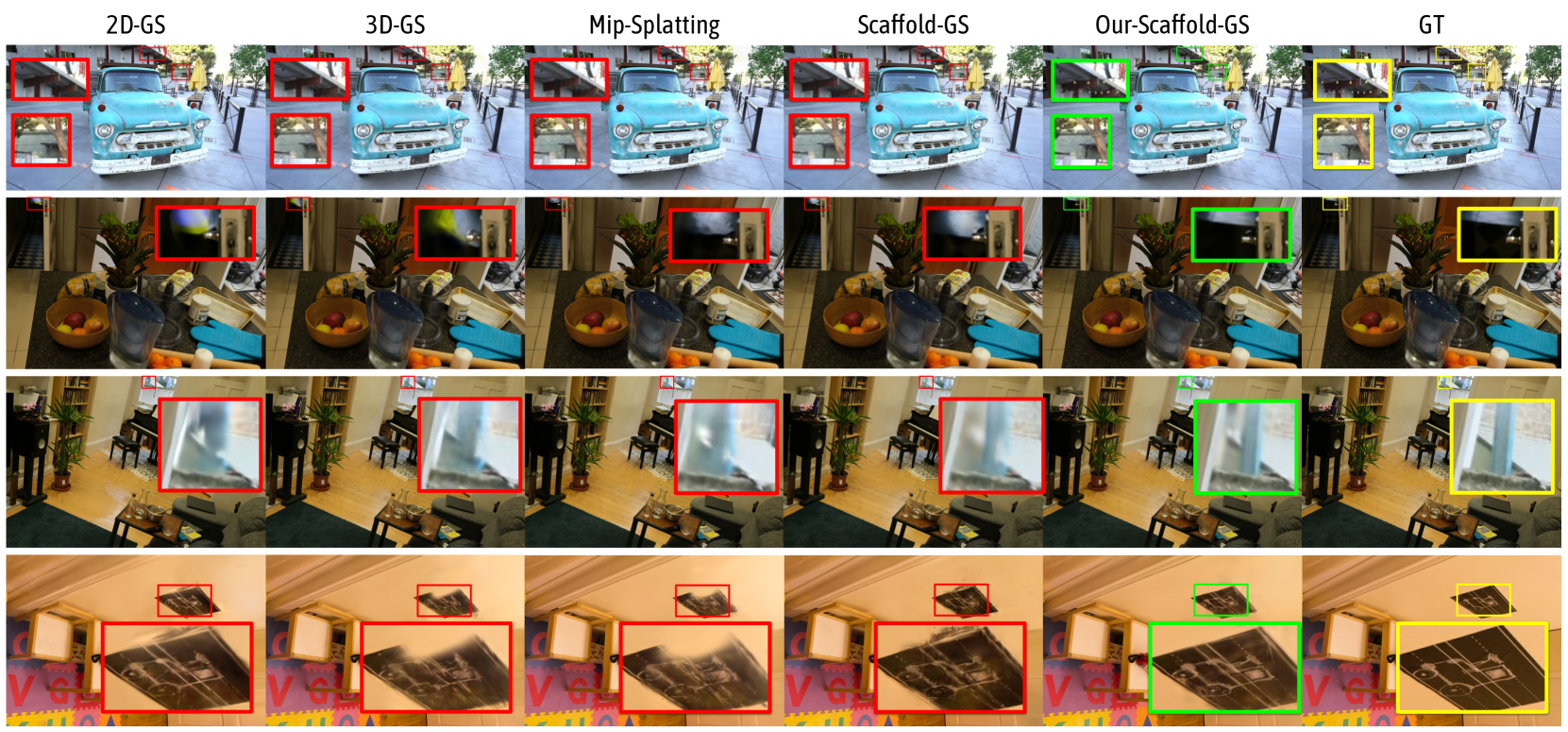
The image presents a comparative visual analysis of different novel view synthesis techniques. It displays four rows of images, each depicting a different scene. Within each row, six columns showcase the results of applying different methods: 2D-GS, 3D-GS, MIP-Splatting, Scaffold-GS, Our-Scaffold-GS, and GT (Ground Truth). Each image contains bounding boxes highlighting areas of interest or potential artifacts.
### Components/Axes
The image is organized as a grid.
- **Rows:** Represent different scenes (car, statue, painting, television).
- **Columns:** Represent different novel view synthesis methods:
- 2D-GS
- 3D-GS
- MIP-Splatting
- Scaffold-GS
- Our-Scaffold-GS
- GT (Ground Truth)
- **Bounding Boxes:** Red, Green, and Yellow boxes are used to highlight specific regions within each synthesized image, likely indicating areas of error or focus.
### Detailed Analysis or Content Details
**Row 1: Car Scene**
- **2D-GS:** The car appears somewhat blurry and distorted. A red bounding box highlights the car.
- **3D-GS:** The car is more defined than in 2D-GS, but still exhibits some distortion. A red bounding box highlights the car.
- **MIP-Splatting:** The car appears relatively clear, but with some artifacts. A red bounding box highlights the car.
- **Scaffold-GS:** The car is reasonably well-rendered, with fewer visible artifacts. A red bounding box highlights the car.
- **Our-Scaffold-GS:** The car is the clearest and most detailed of the synthesized images, closely resembling the GT. A green bounding box highlights the car.
- **GT:** The ground truth image shows a sharp, detailed rendering of the car. A yellow bounding box highlights the car.
**Row 2: Statue Scene**
- **2D-GS:** The statue and surrounding objects are blurry and distorted. A red bounding box highlights the statue.
- **3D-GS:** The statue is slightly more defined, but still blurry. A red bounding box highlights the statue.
- **MIP-Splatting:** The statue is clearer, but with noticeable artifacts. A red bounding box highlights the statue.
- **Scaffold-GS:** The statue is better rendered, with fewer artifacts. A red bounding box highlights the statue.
- **Our-Scaffold-GS:** The statue is the clearest and most detailed, closely resembling the GT. A green bounding box highlights the statue.
- **GT:** The ground truth image shows a sharp, detailed rendering of the statue. A yellow bounding box highlights the statue.
**Row 3: Painting Scene**
- **2D-GS:** The painting is blurry and distorted. A red bounding box highlights the painting.
- **3D-GS:** The painting is slightly more defined, but still blurry. A red bounding box highlights the painting.
- **MIP-Splatting:** The painting is clearer, but with noticeable artifacts. A red bounding box highlights the painting.
- **Scaffold-GS:** The painting is better rendered, with fewer artifacts. A red bounding box highlights the painting.
- **Our-Scaffold-GS:** The painting is the clearest and most detailed, closely resembling the GT. A green bounding box highlights the painting.
- **GT:** The ground truth image shows a sharp, detailed rendering of the painting. A yellow bounding box highlights the painting.
**Row 4: Television Scene**
- **2D-GS:** The television and the image on the screen are blurry and distorted. A red bounding box highlights the television.
- **3D-GS:** The television is slightly more defined, but still blurry. A red bounding box highlights the television.
- **MIP-Splatting:** The television is clearer, but with noticeable artifacts. A red bounding box highlights the television.
- **Scaffold-GS:** The television is better rendered, with fewer artifacts. A red bounding box highlights the television.
- **Our-Scaffold-GS:** The television is the clearest and most detailed, closely resembling the GT. A green bounding box highlights the television.
- **GT:** The ground truth image shows a sharp, detailed rendering of the television. A yellow bounding box highlights the television.
### Key Observations
- The "Our-Scaffold-GS" method consistently produces the most visually accurate and detailed results, closely matching the Ground Truth (GT) images.
- 2D-GS and 3D-GS consistently produce the blurriest and most distorted results.
- MIP-Splatting and Scaffold-GS offer improvements over 2D-GS and 3D-GS, but still fall short of the quality achieved by "Our-Scaffold-GS".
- The red bounding boxes consistently highlight areas where the synthesized images deviate from the GT, indicating artifacts or inaccuracies.
- The green bounding boxes in "Our-Scaffold-GS" images indicate the areas where the method performs well.
- The yellow bounding boxes in the GT images serve as a reference for the expected quality.
### Interpretation
This image demonstrates a comparative evaluation of different novel view synthesis techniques. The results suggest that the "Our-Scaffold-GS" method significantly outperforms the other methods in terms of visual quality and accuracy. The consistent presence of red bounding boxes in the 2D-GS, 3D-GS, MIP-Splatting, and Scaffold-GS images indicates that these methods struggle to accurately reconstruct details and avoid artifacts. The "Our-Scaffold-GS" method, by utilizing a scaffold-based approach, appears to be more effective at generating realistic and detailed novel views. The comparison against the Ground Truth (GT) images provides a clear benchmark for assessing the performance of each method. The consistent improvement of "Our-Scaffold-GS" across all scenes suggests its robustness and generalizability. This data suggests that the proposed "Our-Scaffold-GS" method is a promising approach for novel view synthesis, offering a significant improvement over existing techniques. The bounding boxes serve as a visual indicator of the error rate for each method, allowing for a quick and intuitive assessment of their performance.