## Comparison Diagram: Image Processing Methods vs. Ground Truth
### Overview
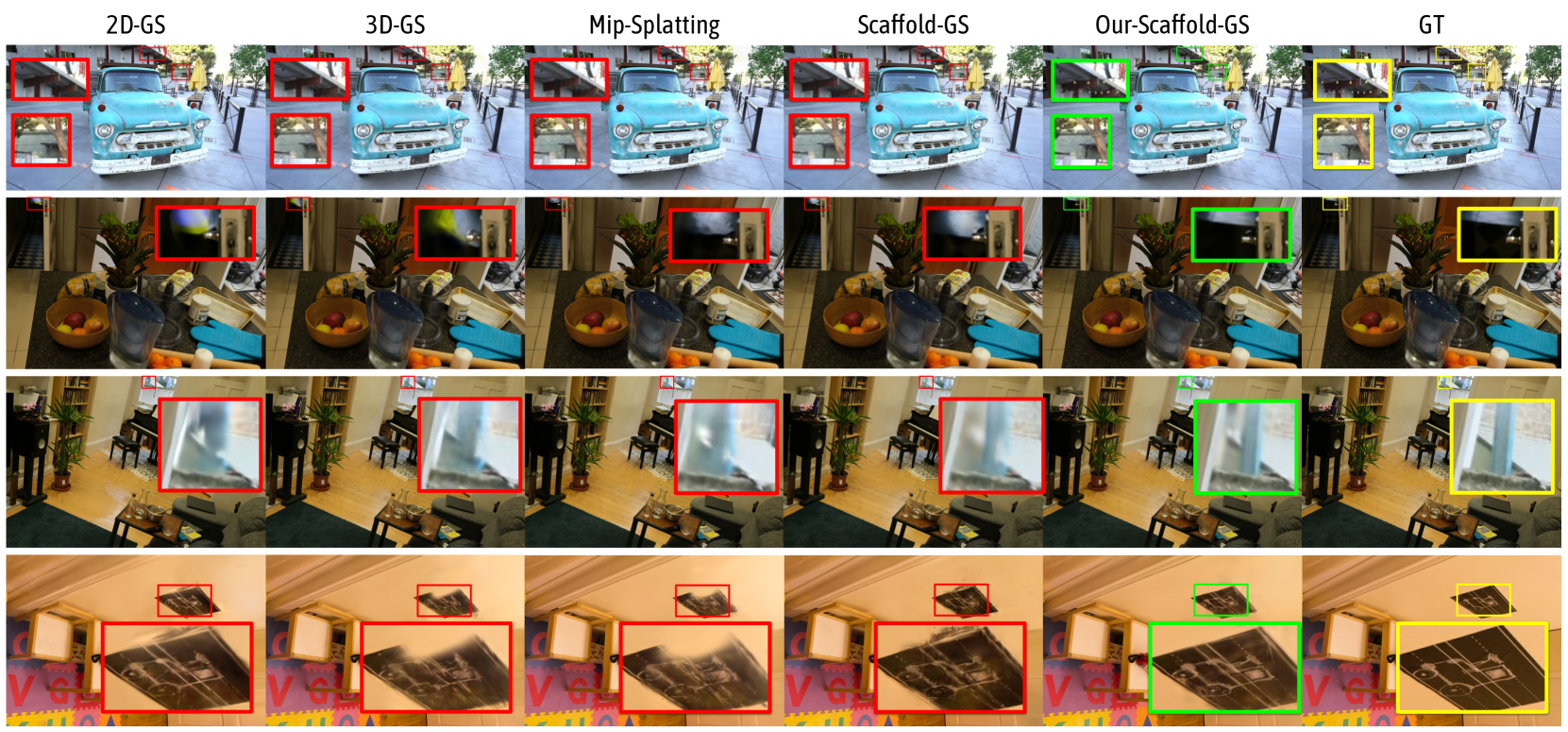
The image presents a side-by-side comparison of five image processing methods (2D-GS, 3D-GS, Mip-Splatting, Scaffold-GS, Our-Scaffold-GS) against Ground Truth (GT) across four distinct scenes. Each method's output is visualized with red boxes highlighting areas of interest, while green/yellow boxes in the final column emphasize discrepancies or artifacts relative to GT.
### Components/Axes
- **Rows**: Four distinct scenes (e.g., outdoor street, kitchen, living room, abstract patterned room).
- **Columns**:
1. 2D-GS
2. 3D-GS
3. Mip-Splatting
4. Scaffold-GS
5. Our-Scaffold-GS
6. GT (Ground Truth)
- **Annotations**:
- Red boxes: Highlighted regions for detailed comparison.
- Green boxes: Regions where methods closely match GT.
- Yellow boxes: Regions with significant deviations from GT.
### Detailed Analysis
1. **Scene 1 (Outdoor Street)**:
- **2D-GS**: Red boxes show misaligned textures on the car and sidewalk.
- **3D-GS**: Improved alignment but blurry details in red-boxed areas.
- **Mip-Splatting**: Artifacts in red-boxed window reflections.
- **Scaffold-GS**: Minor texture inconsistencies in red boxes.
- **Our-Scaffold-GS**: Green boxes indicate near-perfect alignment with GT in red-highlighted areas.
2. **Scene 2 (Kitchen)**:
- **2D-GS**: Red boxes reveal distorted object shapes (e.g., blender).
- **3D-GS**: Better shape preservation but muted colors.
- **Mip-Splatting**: Over-saturated colors in red-boxed areas.
- **Scaffold-GS**: Accurate color reproduction but slight blur.
- **Our-Scaffold-GS**: Green/yellow boxes confirm high fidelity in red-highlighted regions.
3. **Scene 3 (Living Room)**:
- **2D-GS**: Red boxes show misplaced furniture edges.
- **3D-GS**: Improved spatial accuracy but reduced depth perception.
- **Mip-Splatting**: Artifacts in red-boxed window light reflections.
- **Scaffold-GS**: Balanced depth and texture but minor aliasing.
- **Our-Scaffold-GS**: Green boxes highlight precise reconstruction of red-boxed details.
4. **Scene 4 (Abstract Room)**:
- **2D-GS**: Red boxes expose severe texture bleeding.
- **3D-GS**: Partial correction but residual artifacts.
- **Mip-Splatting**: Over-smoothing in red-boxed patterns.
- **Scaffold-GS**: Accurate pattern replication with minor noise.
- **Our-Scaffold-GS**: Yellow boxes indicate minor deviations in complex regions.
### Key Observations
- **Our-Scaffold-GS** consistently outperforms other methods, with green/yellow boxes indicating minimal artifacts in critical regions.
- **2D-GS** and **Mip-Splatting** exhibit the most artifacts, particularly in texture-rich or complex scenes.
- **Scaffold-GS** shows moderate performance, balancing accuracy and minor imperfections.
- Red boxes universally highlight areas where methods struggle, while green/yellow boxes in the final column correlate with fidelity to GT.
### Interpretation
The diagram demonstrates that **Our-Scaffold-GS** achieves the highest visual fidelity, likely due to advanced spatial-aware rendering techniques. The red boxes systematically identify failure modes across methods, such as texture misalignment (2D-GS), over-saturation (Mip-Splatting), and aliasing (Scaffold-GS). The green/yellow boxes in the GT column suggest that Our-Scaffold-GS effectively mitigates these issues, making it suitable for high-precision applications like virtual reality or architectural visualization. The absence of numerical data implies qualitative evaluation based on perceptual quality, emphasizing the importance of spatial coherence and artifact reduction in image synthesis.