## Diagram: AI System with Human Feedback Loop
### Overview
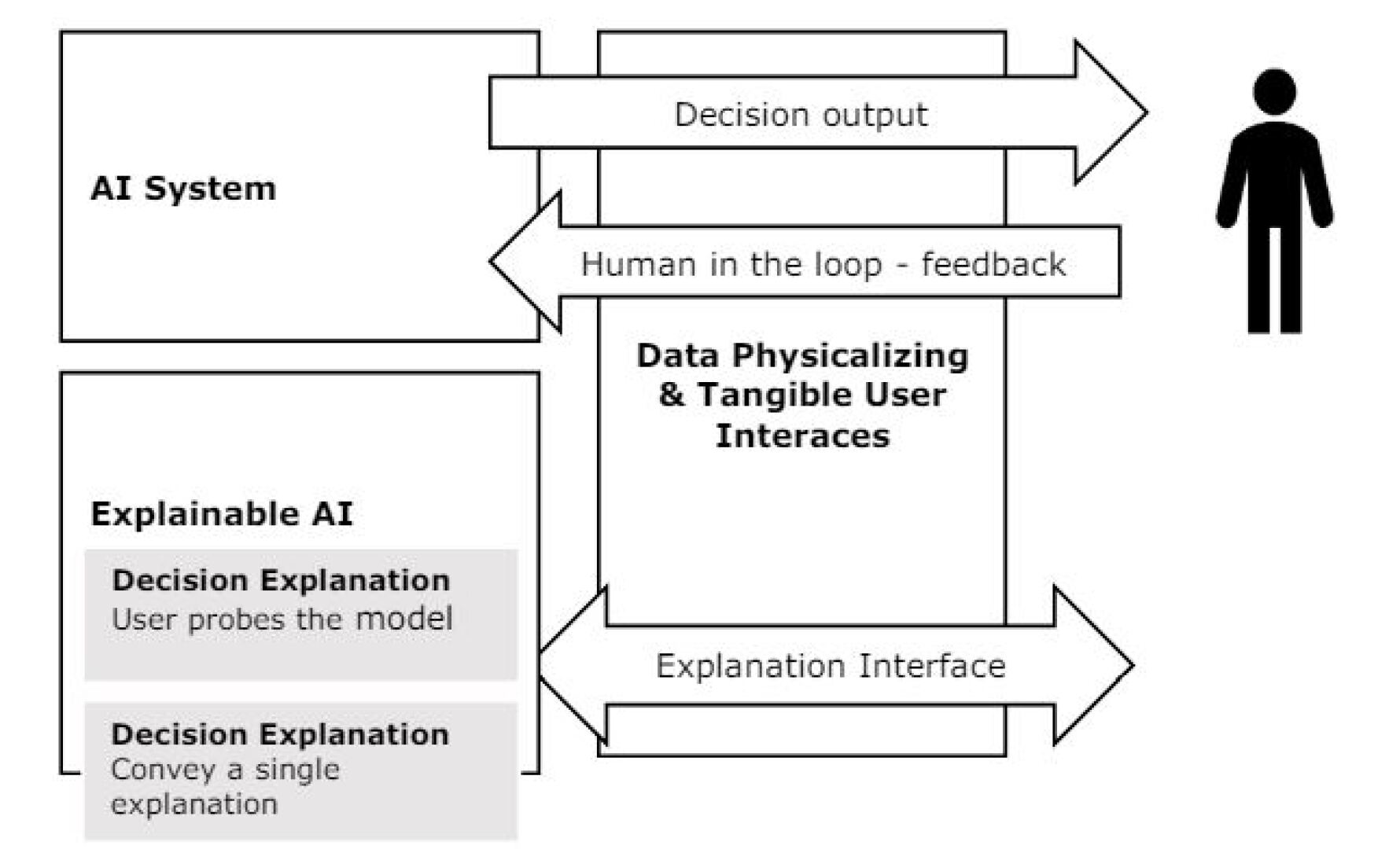
The image is a diagram illustrating an AI system with a human feedback loop. It shows the flow of information and interaction between the AI system, explainable AI components, a data physicalizing interface, and a human user.
### Components/Axes
* **AI System:** A rectangular box labeled "AI System" located at the top-left of the diagram.
* **Explainable AI:** A rectangular box located below the "AI System" box, labeled "Explainable AI". It contains two sub-components:
* **Decision Explanation:** A gray box labeled "Decision Explanation" with the description "User probes the model".
* **Decision Explanation:** A gray box labeled "Decision Explanation" with the description "Convey a single explanation".
* **Data Physicalizing & Tangible User Interfaces:** A rectangular box located to the right of the "Explainable AI" box, labeled "Data Physicalizing & Tangible User Interfaces".
* **Decision Output:** A horizontal arrow pointing to the right, originating from the "AI System" box and leading towards a human figure.
* **Human in the loop - feedback:** A horizontal arrow pointing to the left, originating from above the "Data Physicalizing & Tangible User Interfaces" box and leading towards the "AI System" box.
* **Explanation Interface:** A horizontal arrow pointing to the right, originating from the "Explainable AI" box and leading towards the "Data Physicalizing & Tangible User Interfaces" box.
* **Human Figure:** A stick figure of a person located at the right of the diagram, representing the human user.
### Detailed Analysis or Content Details
The diagram illustrates the following flow of information:
1. The AI System generates a "Decision output" which is directed towards the human user.
2. The human provides "Human in the loop - feedback" which is directed back to the AI System.
3. The "Explainable AI" component provides an "Explanation Interface" to the "Data Physicalizing & Tangible User Interfaces".
4. The "Explainable AI" component has two sub-components:
* One where the "User probes the model" for a decision explanation.
* One that "Conveys a single explanation".
### Key Observations
* The diagram emphasizes the importance of explainability and user interaction in AI systems.
* The human is positioned as both a recipient of the AI's output and a provider of feedback, creating a closed loop.
* The "Data Physicalizing & Tangible User Interfaces" component acts as an intermediary between the AI system and the human user, potentially translating complex data into more understandable formats.
### Interpretation
The diagram suggests a human-centered approach to AI system design. The inclusion of "Explainable AI" and the "Human in the loop - feedback" mechanism highlights the need for transparency and user control in AI decision-making processes. The "Data Physicalizing & Tangible User Interfaces" component suggests a focus on making AI outputs more accessible and understandable to human users. The diagram illustrates a system where the human is not just a passive recipient of AI decisions but an active participant in the decision-making process.