## Diagram: Interconnected System Components
### Overview
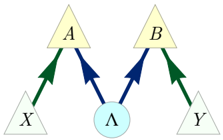
The diagram illustrates a network of four triangular components (A, B, X, Y) and a central circular node (Λ), connected by directional and bidirectional arrows. Arrows are color-coded (blue and green) to indicate different types of relationships or flows between elements.
### Components/Axes
- **Nodes**:
- **A**: Yellow triangle (top-left)
- **B**: Yellow triangle (top-right)
- **X**: Green triangle (bottom-left)
- **Y**: Green triangle (bottom-right)
- **Λ**: Blue circle (center)
- **Arrows**:
- **Blue arrows**:
- From A to X (top-left to bottom-left)
- From A to Y (top-left to bottom-right)
- From B to X (top-right to bottom-left)
- From B to Y (top-right to bottom-right)
- Bidirectional between A and B (top-center)
- **Green arrows**:
- From X to A (bottom-left to top-left)
- From Y to B (bottom-right to top-right)
### Detailed Analysis
- **Directional Flow**:
- Blue arrows indicate unidirectional influence from A and B to X and Y.
- Green arrows suggest feedback loops from X and Y back to A and B.
- The bidirectional blue arrow between A and B implies mutual interaction or dependency.
- **Color Coding**:
- Blue arrows dominate the network, emphasizing primary directional relationships.
- Green arrows are limited to feedback paths, suggesting secondary or reactive interactions.
### Key Observations
1. **Central Node (Λ)**: Positioned at the center but lacks direct connections, potentially acting as a mediator or hub.
2. **Mutual Dependency**: A and B share a bidirectional relationship, indicating interdependence.
3. **Asymmetric Feedback**: Feedback loops (green arrows) only exist from X/Y to A/B, not vice versa.
### Interpretation
This diagram likely represents a system where:
- **A and B** are primary drivers or sources influencing **X and Y**.
- **X and Y** provide feedback to refine or adjust A and B’s outputs.
- The central node **Λ** may symbolize a shared resource, control mechanism, or balancing factor not directly involved in active flows.
- The absence of feedback from X/Y to Λ suggests Λ’s role is passive or observational in this context.
The structure resembles a **feedback control system** or **dependency graph**, where A and B regulate X and Y while receiving corrective input from them. The bidirectional link between A and B could represent collaborative or conflicting objectives requiring synchronization.