## Puzzle: Matching Puzzle Pieces to Assembled Shapes
### Overview
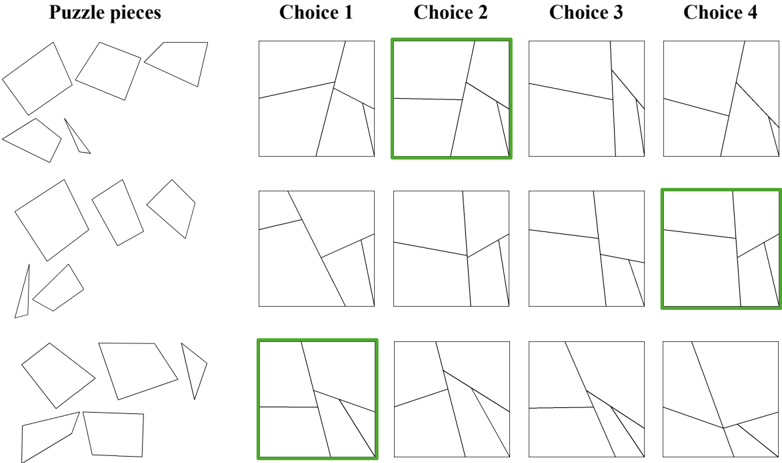
The image presents a puzzle-solving task. On the left, there are scattered puzzle pieces. On the right, there are three rows of four assembled shapes, labeled as "Choice 1", "Choice 2", "Choice 3", and "Choice 4". The task is to identify which assembled shape can be formed using the puzzle pieces on the left. Each row represents a different set of puzzle pieces. The correct choices are highlighted with a green border.
### Components/Axes
* **Puzzle pieces:** Scattered shapes on the left side of the image. There are three distinct sets of puzzle pieces, each corresponding to a row of choices.
* **Choice 1, Choice 2, Choice 3, Choice 4:** Labels for the four assembled shapes in each row.
* **Rows:** Three rows of assembled shapes, each corresponding to a different set of puzzle pieces.
* **Green Border:** Indicates the correct choice in each row.
### Detailed Analysis or ### Content Details
* **Row 1:** The puzzle pieces in the first row can be assembled to form the shape in "Choice 2". This choice is highlighted with a green border.
* **Row 2:** The puzzle pieces in the second row can be assembled to form the shape in "Choice 4". This choice is highlighted with a green border.
* **Row 3:** The puzzle pieces in the third row can be assembled to form the shape in "Choice 1". This choice is highlighted with a green border.
### Key Observations
* Each row presents a unique set of puzzle pieces and assembled shapes.
* Only one choice per row is correct, as indicated by the green border.
* The puzzle pieces are simple geometric shapes.
* The assembled shapes are formed by combining the puzzle pieces without overlap.
### Interpretation
The image demonstrates a spatial reasoning task where the user must mentally manipulate the puzzle pieces to determine which assembled shape they can form. The green borders indicate the correct solutions, providing a visual guide for the user. The task assesses the ability to visualize and combine shapes, a fundamental skill in spatial problem-solving.