## Diagram: Spatial Reasoning Puzzle
### Overview
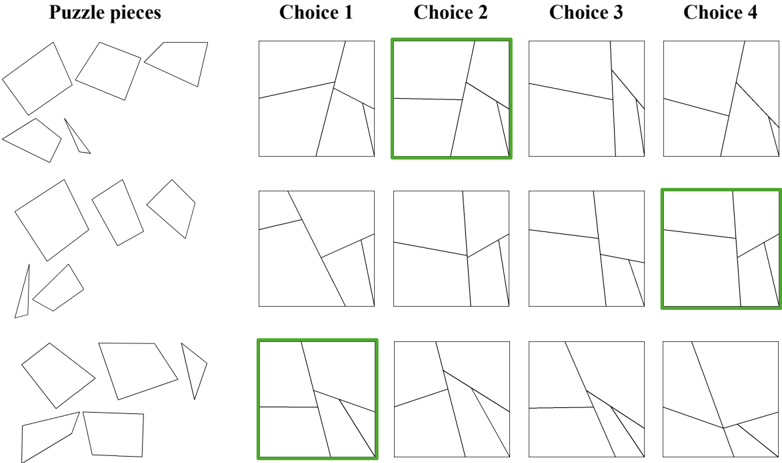
The image displays a visual puzzle or test of spatial reasoning, presented in a grid format. It consists of three horizontal rows. Each row begins with a set of scattered, irregular geometric shapes labeled "Puzzle pieces" on the left. To the right are four potential assembled configurations, labeled "Choice 1" through "Choice 4," each showing the pieces fitted together within a square boundary. One choice in each row is highlighted with a thick green border, indicating it is the correct or selected answer.
### Components/Axes
* **Header Labels (Top Row):** From left to right: "Puzzle pieces", "Choice 1", "Choice 2", "Choice 3", "Choice 4".
* **Structure:** A 3-row by 5-column grid. The first column contains the disassembled pieces. Columns 2-5 contain the four answer choices.
* **Visual Elements:**
* **Puzzle Pieces:** Each row's leftmost cell contains 5-6 outlined, white-filled geometric shapes (irregular quadrilaterals and triangles) scattered randomly.
* **Choice Squares:** Each choice is a square containing a pattern of black lines that divide it into regions. These lines represent the seams where the puzzle pieces would join if assembled correctly.
* **Highlight:** A thick, green rectangular border surrounds one choice in each row.
### Detailed Analysis
**Row 1 (Top):**
* **Puzzle Pieces:** Contains 6 pieces: 4 quadrilaterals and 2 triangles.
* **Choices:**
| Choice | Line Pattern Description | Highlighted |
| :--- | :--- | :--- |
| 1 | Lines form a pattern with a central vertical line and angled branches. | No |
| 2 | Lines form a pattern with a dominant vertical line on the right and a complex junction of lines in the upper-left quadrant. | **Yes** |
| 3 | Lines form a pattern with a central vertical line and a horizontal line in the lower half. | No |
| 4 | Lines form a pattern with a central vertical line and a diagonal line from the top-left. | No |
* **Correct Answer:** Choice 2.
**Row 2 (Middle):**
* **Puzzle Pieces:** Contains 6 pieces: 4 quadrilaterals and 2 triangles.
* **Choices:**
| Choice | Line Pattern Description | Highlighted |
| :--- | :--- | :--- |
| 1 | Lines form a pattern with a strong diagonal from top-left to bottom-right. | No |
| 2 | Lines form a pattern with a central vertical line and a horizontal line in the upper half. | No |
| 3 | Lines form a pattern with a central vertical line and a diagonal line in the lower-right. | No |
| 4 | Lines form a pattern with a central vertical line and a diagonal line from the top-right, creating a distinct "Y" shape in the upper half. | **Yes** |
* **Correct Answer:** Choice 4.
**Row 3 (Bottom):**
* **Puzzle Pieces:** Contains 5 pieces: 3 quadrilaterals and 2 triangles.
* **Choices:**
| Choice | Line Pattern Description | Highlighted |
| :--- | :--- | :--- |
| 1 | Lines form a pattern with a central vertical line and a diagonal line from the top-left, creating a large triangular region in the upper-left. | **Yes** |
| 2 | Lines form a pattern with a central vertical line and a diagonal line from the top-right. | No |
| 3 | Lines form a pattern with a central vertical line and a diagonal line from the top-left, but with a different junction point than Choice 1. | No |
| 4 | Lines form a pattern with a central vertical line and a diagonal line from the top-right, but with a different junction point than Choice 2. | No |
* **Correct Answer:** Choice 1.
### Key Observations
1. **Pattern of Correct Answers:** The highlighted correct answer is not in the same column position across rows (Row 1: Col 3, Row 2: Col 5, Row 3: Col 2). This suggests the puzzle is not based on a simple positional pattern.
2. **Visual Complexity:** The correct choice in each row is not immediately obvious. The line patterns in the choices are subtle variations of each other, requiring careful visual comparison to match the angles and junctions of the scattered pieces.
3. **Consistent Structure:** All puzzles follow the same format: disassembled pieces on the left, four assembled line-pattern options on the right. The task is to mentally assemble the pieces and find the matching seam pattern.
### Interpretation
This image is a **spatial reasoning or perceptual speed test**, commonly found in aptitude assessments or cognitive psychology studies. The task requires the viewer to mentally rotate and assemble the scattered 2D shapes to form a complete square, then identify which of the four line-pattern choices correctly represents the seams of that assembled square.
The data (the visual information) demonstrates:
* **Cognitive Skill Measured:** The ability to perform mental transformation and visualization of objects.
* **Relationship Between Elements:** The "Puzzle pieces" are the components, and the "Choices" are the potential outcomes of an assembly process. The green highlight provides the ground truth for validation.
* **Notable Anomaly:** There is no textual data or numerical values. The entire "information" is encoded in the geometric relationships between the shapes and the line patterns. The challenge lies in the perceptual ambiguity between the very similar choice patterns.
The purpose is likely to evaluate an individual's non-verbal reasoning abilities, which are considered a component of general intelligence (fluid intelligence). The lack of language makes it culture-fair. The green borders transform the image from a pure test into an **answer key or demonstration**, showing the correct solution for each puzzle.