## Puzzle Assembly Diagram: Correct Configuration Identification
### Overview
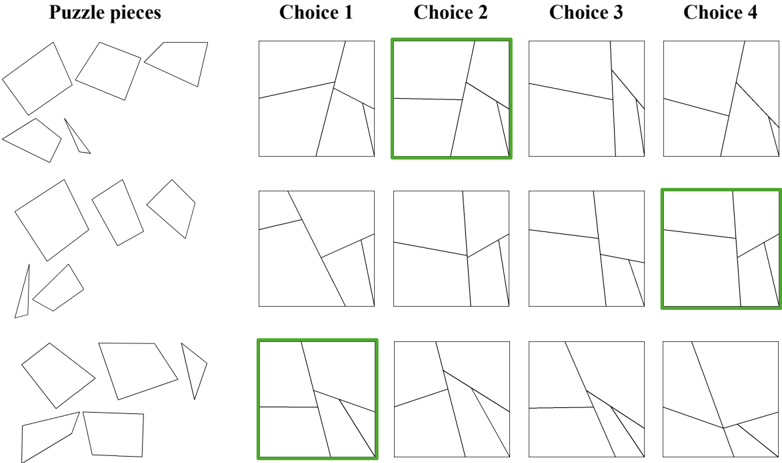
The image presents a spatial reasoning puzzle with three distinct sets of fragmented polygonal pieces arranged vertically on the left. To the right, four configuration options (Choice 1-4) are displayed in a 2x2 grid format for each puzzle set. Correct solutions are highlighted with green borders, indicating successful piece alignment.
### Components/Axes
- **Left Panel**:
- Three vertically stacked puzzle sets labeled implicitly by position
- Each set contains 5-6 irregular polygonal pieces with varying edge configurations
- Piece shapes include rectangles (various sizes), triangles, and trapezoids
- **Right Panel**:
- Four configuration options per puzzle set (Choice 1-4)
- Each choice displays a 2x2 grid of potential solutions
- Green borders highlight correct configurations
### Detailed Analysis
1. **Puzzle Set 1 (Top Row)**:
- Contains 5 pieces: 2 large rectangles, 1 medium rectangle, 1 small rectangle, 1 triangle
- Correct configuration: Choice 1's top-left grid
- Key feature: Triangle piece must occupy bottom-right corner position
2. **Puzzle Set 2 (Middle Row)**:
- Contains 6 pieces: 2 large rectangles, 2 medium rectangles, 1 small rectangle, 1 triangle
- Correct configuration: Choice 2's top-right grid
- Notable: Medium rectangles form a continuous horizontal band in correct solution
3. **Puzzle Set 3 (Bottom Row)**:
- Contains 5 pieces: 2 large rectangles, 2 medium rectangles, 1 triangle
- Correct configuration: Choice 4's bottom-right grid
- Distinctive: Triangle piece connects two medium rectangles diagonally
### Key Observations
- Correct solutions consistently position the triangle piece in corner or junction locations
- Medium rectangles serve as transitional elements between larger shapes
- Incorrect configurations (non-green) show misaligned edges or disconnected shapes
- Green borders appear only on fully contiguous configurations with matching edge patterns
### Interpretation
This diagram evaluates spatial problem-solving skills through:
1. **Pattern Recognition**: Identifying complementary edge geometries
2. **Spatial Reasoning**: Visualizing piece rotations and translations
3. **Hierarchical Assembly**: Progressing from individual pieces to complete configurations
The staggered correct answer positions (top-left, top-right, bottom-right) suggest intentional design to prevent pattern memorization, requiring fresh analysis for each puzzle set. The increasing piece complexity from top to bottom (5→6→5 pieces) may indicate progressive difficulty, though piece count alone doesn't determine solution difficulty - edge configuration complexity is equally critical.