## Chart Type: Probability Curves vs. Alpha
### Overview
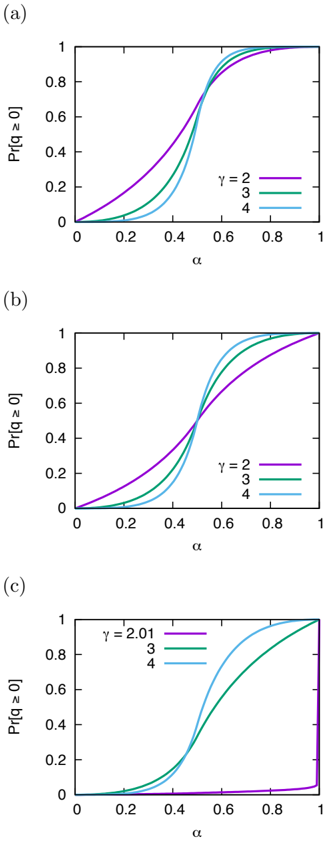
The image presents three separate plots, labeled (a), (b), and (c), each displaying the probability Pr[q ≥ 0] as a function of α (alpha). Each plot contains multiple curves representing different values of γ (gamma). The plots illustrate how the probability changes with alpha for different gamma values.
### Components/Axes
* **X-axis (Horizontal):** α (alpha), ranging from 0 to 1 in all three plots. Increments are marked at 0, 0.2, 0.4, 0.6, 0.8, and 1.
* **Y-axis (Vertical):** Pr[q ≥ 0], representing the probability that q is greater than or equal to 0. The range is from 0 to 1 in all three plots. Increments are marked at 0, 0.2, 0.4, 0.6, 0.8, and 1.
* **Legends:** Each plot includes a legend in the top-right corner indicating the gamma values associated with each curve.
* Plot (a): γ = 2 (purple), γ = 3 (green), γ = 4 (light blue)
* Plot (b): γ = 2 (purple), γ = 3 (green), γ = 4 (light blue)
* Plot (c): γ = 2.01 (purple), γ = 3 (green), γ = 4 (light blue)
### Detailed Analysis
**Plot (a):**
* **γ = 2 (purple):** The curve starts at approximately (0, 0) and gradually increases, reaching approximately 1 at α = 0.8.
* **γ = 3 (green):** The curve starts at approximately (0, 0) and increases more sharply than γ = 2, reaching approximately 1 at α = 0.6.
* **γ = 4 (light blue):** The curve starts at approximately (0, 0) and increases most sharply, reaching approximately 1 at α = 0.5.
**Plot (b):**
* **γ = 2 (purple):** The curve starts at approximately (0, 0) and gradually increases, reaching approximately 1 at α = 0.9.
* **γ = 3 (green):** The curve starts at approximately (0, 0) and increases more sharply than γ = 2, reaching approximately 1 at α = 0.7.
* **γ = 4 (light blue):** The curve starts at approximately (0, 0) and increases most sharply, reaching approximately 1 at α = 0.6.
**Plot (c):**
* **γ = 2.01 (purple):** The curve remains near 0 until α is close to 1, then sharply increases to 1.
* **γ = 3 (green):** The curve starts at approximately (0, 0) and increases, reaching approximately 1 at α = 0.8.
* **γ = 4 (light blue):** The curve starts at approximately (0, 0) and increases more sharply than γ = 3, reaching approximately 1 at α = 0.7.
### Key Observations
* In all three plots, as γ increases, the curves tend to shift to the left, indicating that the probability Pr[q ≥ 0] reaches 1 at lower values of α.
* Plot (c) shows a distinct behavior for γ = 2.01, where the probability remains close to zero until α approaches 1.
* The curves in plots (a) and (b) are smoother compared to the curve for γ = 2.01 in plot (c).
### Interpretation
The plots illustrate the relationship between α, γ, and the probability Pr[q ≥ 0]. The data suggests that increasing γ generally leads to a faster increase in the probability as α increases. Plot (c) highlights a critical value of γ (around 2) where the behavior of the probability function changes dramatically. Specifically, when γ is slightly above 2, the probability remains very low until α is close to 1, indicating a threshold effect. The plots likely represent a phase transition or a critical phenomenon where the parameter γ controls the behavior of the system.