## Text-Based Problem: Cone Radius Calculation
### Overview
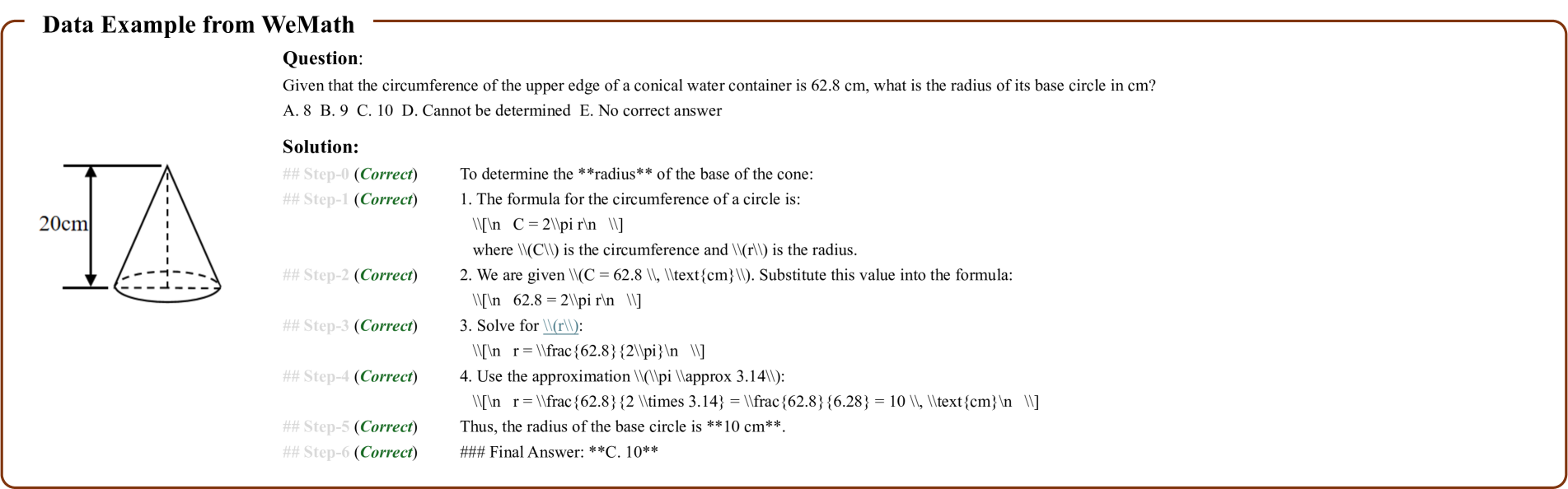
The image presents a mathematical problem from WeMath involving a conical water container. It includes a question, multiple-choice answers, a step-by-step solution, and a labeled diagram of a cone.
### Components/Axes
- **Diagram Labels**:
- Height of the cone: **20 cm** (vertical dashed line).
- Circumference of the base: **62.8 cm** (dashed circle).
- **Text Elements**:
- Question: "Given that the circumference of the upper edge of a conical water container is 62.8 cm, what is the radius of its base circle in cm?"
- Multiple-choice options: A. 8, B. 9, C. 10, D. 10, E. Cannot be determined.
- Solution steps: Numbered 0–6, each with brief explanations.
### Detailed Analysis
1. **Question & Options**:
- The problem asks for the radius of the cone’s base given its circumference (62.8 cm).
- Options include numerical values and an "E. Cannot be determined" choice.
2. **Solution Steps**:
- **Step 0**: Objective to find the radius.
- **Step 1**: Formula for circumference: \( C = 2\pi r \).
- **Step 2**: Substitute \( C = 62.8 \) into the formula: \( 62.8 = 2\pi r \).
- **Step 3**: Solve for \( r \): \( r = \frac{62.8}{2\pi} \).
- **Step 4**: Approximate \( \pi \approx 3.14 \): \( r = \frac{62.8}{6.28} \).
- **Step 5**: Final calculation: \( r = 10 \).
- **Step 6**: Answer: **C. 10**.
3. **Diagram**:
- A side view of a cone with a dashed base circle and labeled height (20 cm).
- The circumference (62.8 cm) is annotated near the base.
### Key Observations
- The solution correctly applies the circumference formula \( C = 2\pi r \).
- The approximation \( \pi \approx 3.14 \) simplifies the calculation.
- The final answer matches option **C. 10**, confirming the radius is 10 cm.
### Interpretation
The problem demonstrates the application of geometric formulas to real-world scenarios. By isolating the relationship between circumference and radius, the solution logically derives the radius using algebraic manipulation and numerical approximation. The diagram reinforces the problem’s context, ensuring clarity in visualizing the cone’s dimensions. The absence of conflicting data or outliers underscores the straightforward nature of the calculation.