\n
## Screenshot: Math Problem and Solution
### Overview
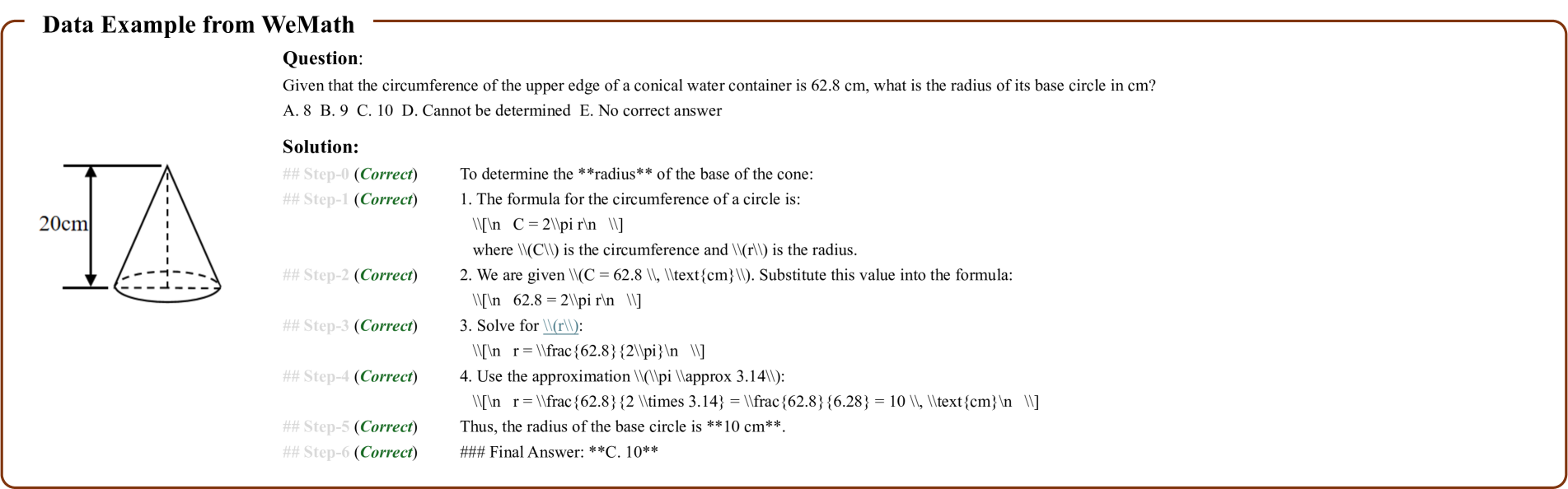
The image is a digital document snippet titled "Data Example from WeMath." It presents a geometry problem involving a conical container, provides multiple-choice answers, and includes a detailed, step-by-step solution. A diagram of the cone is shown to the left of the text.
### Components/Axes
* **Header:** "Data Example from WeMath" at the top left.
* **Diagram (Left Side):** A line drawing of a right circular cone. A vertical double-headed arrow to its left is labeled "20cm," indicating the cone's height. The base is depicted as an ellipse with a dashed line showing its radius.
* **Question Block (Right Side, Top):** Contains the problem statement and answer choices.
* **Solution Block (Right Side, Below Question):** A numbered, step-by-step mathematical derivation. Each step is prefixed with a label like "## Step-0 (Correct)" in light gray text.
### Detailed Analysis / Content Details
**1. Question Text:**
> Given that the circumference of the upper edge of a conical water container is 62.8 cm, what is the radius of its base circle in cm?
> A. 8 B. 9 C. 10 D. Cannot be determined E. No correct answer
**2. Solution Steps (Transcribed with original formatting):**
The solution uses a mix of plain text and LaTeX-like notation (e.g., `\\( ... \\)`, `\\[ ... \\]`).
* **## Step-0 (Correct):** To determine the **radius** of the base of the cone:
* **## Step-1 (Correct):** 1. The formula for the circumference of a circle is:
`\\[ C = 2\\pi r \\]`
where `\\(C\\)` is the circumference and `\\(r\\)` is the radius.
* **## Step-2 (Correct):** 2. We are given `\\(C = 62.8 \\, \\text{cm}\\)`. Substitute this value into the formula:
`\\[ 62.8 = 2\\pi r \\]`
* **## Step-3 (Correct):** 3. Solve for `\\(r\\)`:
`\\[ r = \\frac{62.8}{2\\pi} \\]`
* **## Step-4 (Correct):** 4. Use the approximation `\\(\\pi \\approx 3.14\\)`:
`\\[ r = \\frac{62.8}{2 \\times 3.14} = \\frac{62.8}{6.28} = 10 \\, \\text{cm} \\]`
* **## Step-5 (Correct):** Thus, the radius of the base circle is **10 cm**.
* **## Step-6 (Correct):** ### Final Answer: **C. 10**
### Key Observations
* The problem provides the circumference of the cone's base (referred to as the "upper edge") and asks for its radius.
* The diagram includes a height measurement (20cm), but this information is **not used** in the solution. The solution relies solely on the circumference formula.
* The solution correctly identifies that the circumference of the base circle is given, making the height irrelevant for finding the radius.
* The calculation uses the approximation π ≈ 3.14, leading to a clean, integer result of 10 cm.
* The final answer corresponds to option **C**.
### Interpretation
This image serves as an educational example demonstrating the direct application of the circle circumference formula (`C = 2πr`). The core investigative reading is the identification of relevant versus irrelevant information: the problem includes a distractor (the cone's height of 20cm) which is not needed to solve for the radius when the circumference is known. The step-by-step solution reinforces proper algebraic manipulation and the use of a standard π approximation. The "WeMath" header suggests this is from a platform or resource focused on mathematical problem-solving, likely intended for students learning geometry. The structure, with labeled "Correct" steps, is designed to build confidence by validating each part of the logical process.