\n
## Diagram: Chain-of-Thought Prompting Approaches
### Overview
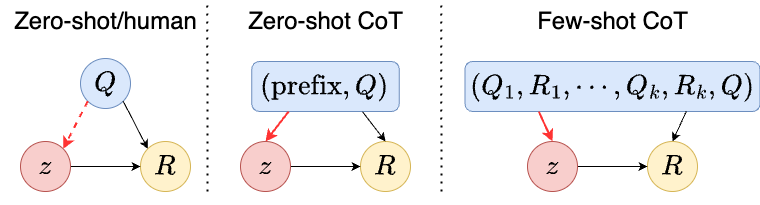
The image presents a comparative diagram illustrating three different approaches to prompting a language model: Zero-shot/human, Zero-shot CoT (Chain-of-Thought), and Few-shot CoT. Each approach is represented visually using nodes and arrows to depict the flow of information. The diagram highlights how the input and reasoning process differ between these methods.
### Components/Axes
The diagram consists of three distinct sections, each representing a prompting approach. Each section contains three nodes labeled 'z', 'Q', and 'R'. Arrows indicate the flow of information between these nodes. The Zero-shot/human section has a dashed red arrow. The Zero-shot CoT and Few-shot CoT sections have solid black arrows. Each section also has a rectangular box containing text representing the input prompt. The titles of each section are "Zero-shot/human", "Zero-shot CoT", and "Few-shot CoT".
### Detailed Analysis or Content Details
**Zero-shot/human:**
* **Nodes:**
* 'z' (Red circle, bottom-left)
* 'Q' (Light blue circle, top-left)
* 'R' (Yellow circle, bottom-right)
* **Arrows:**
* Solid black arrow from 'z' to 'R'.
* Dashed red arrow from 'Q' to 'z'.
* **Text Box:** No text box is present.
**Zero-shot CoT:**
* **Nodes:**
* 'z' (Red circle, bottom-left)
* 'Q' (Light blue circle, top-right)
* 'R' (Yellow circle, bottom-right)
* **Arrows:**
* Solid black arrow from 'z' to 'R'.
* Solid black arrow from '(prefix, Q)' to 'z'.
* **Text Box:** "(prefix, Q)" - This represents the input prompt.
**Few-shot CoT:**
* **Nodes:**
* 'z' (Red circle, bottom-left)
* 'Q' (Light blue circle, top-right)
* 'R' (Yellow circle, bottom-right)
* **Arrows:**
* Solid black arrow from 'z' to 'R'.
* Solid black arrow from '(Q1, R1, …, Qk, Rk, Q)' to 'z'.
* **Text Box:** "(Q1, R1, …, Qk, Rk, Q)" - This represents the input prompt, including multiple question-answer pairs.
### Key Observations
The diagram illustrates a progression in complexity of prompting. Zero-shot/human relies on a direct connection from the question 'Q' to the initial state 'z'. Zero-shot CoT introduces a 'prefix' to guide the reasoning process. Few-shot CoT expands on this by providing multiple examples of question-answer pairs (Q1, R1…Qk, Rk) before the final question 'Q'. The color coding of the nodes is consistent across all three sections.
### Interpretation
The diagram demonstrates how Chain-of-Thought (CoT) prompting enhances the ability of language models to solve complex problems. The 'z' node likely represents the initial state or context. 'Q' represents the question, and 'R' represents the answer. The arrows signify the flow of information and reasoning.
* **Zero-shot/human:** This approach relies on the model's inherent knowledge and ability to directly map the question to the answer. The dashed line from 'Q' to 'z' suggests a less direct or weaker influence.
* **Zero-shot CoT:** The 'prefix' guides the model's reasoning process, providing a starting point for generating the answer.
* **Few-shot CoT:** Providing multiple examples (Q1, R1…Qk, Rk) allows the model to learn the desired reasoning pattern and apply it to the final question 'Q'. This is a form of in-context learning.
The diagram suggests that CoT prompting, especially the few-shot variant, can significantly improve the performance of language models by providing them with the necessary context and guidance to reason effectively. The use of examples helps the model understand the desired format and style of the answer. The diagram is a conceptual illustration and does not contain specific numerical data. It focuses on the qualitative differences in prompting strategies.