## Diagram: Comparative Analysis of Zero-shot/human, Zero-shot CoT, and Few-shot CoT Methods
### Overview
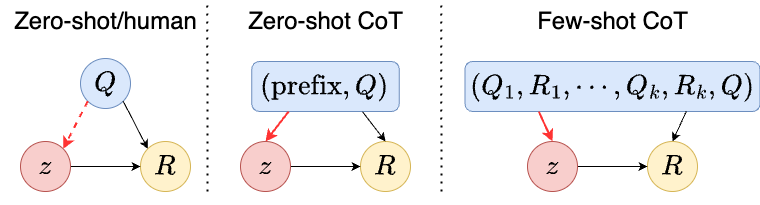
The image presents three side-by-side diagrams comparing three reasoning methods: **Zero-shot/human**, **Zero-shot Chain-of-Thought (CoT)**, and **Few-shot CoT**. Each diagram illustrates the flow of information between three core components: **Q** (query), **R** (response), and **z** (context/knowledge). Arrows represent directional relationships, with labels indicating specific processes or inputs.
---
### Components/Axes
1. **Nodes**:
- **Q**: Blue circle (query/input).
- **R**: Yellow circle (response/output).
- **z**: Pink circle (context/knowledge base).
2. **Arrows**:
- **Zero-shot/human**:
- Dashed arrow from **z** → **Q** (context influences query).
- Solid arrow from **Q** → **R** (direct query-to-response mapping).
- **Zero-shot CoT**:
- Single arrow from **z** → **R** labeled **(prefix, Q)** (context + query prefix guides response).
- **Few-shot CoT**:
- Single arrow from **z** → **R** labeled **(Q₁, R₁, ..., Qₖ, Rₖ, Q)** (sequence of query-response pairs + final query).
3. **Color Coding**:
- Blue (**Q**), Pink (**z**), Yellow (**R**) are consistent across diagrams but lack a formal legend.
---
### Detailed Analysis
#### Zero-shot/human
- **Flow**: Context (**z**) indirectly shapes the query (**Q**), which directly determines the response (**R**).
- **Key Feature**: Human-like reasoning where context is preprocessed into the query before response generation.
#### Zero-shot CoT
- **Flow**: Context (**z**) directly influences the response (**R**) via a **prefix** combined with the query (**Q**).
- **Key Feature**: Explicit use of a prefix (e.g., "Let's think step by step") to guide reasoning without intermediate query refinement.
#### Few-shot CoT
- **Flow**: Context (**z**) incorporates a **sequence of query-response pairs** (Q₁→R₁, ..., Qₖ→Rₖ) alongside the final query (**Q**) to generate **R**.
- **Key Feature**: Leverages multiple examples to condition the response, mimicking few-shot learning in NLP.
---
### Key Observations
1. **Zero-shot/human** relies on indirect context integration, while **CoT methods** directly embed context into the response process.
2. **Few-shot CoT** introduces complexity by requiring multiple example pairs, suggesting scalability challenges.
3. All methods share the same core components (**Q**, **R**, **z**), but differ in how **z** is utilized.
---
### Interpretation
This diagram highlights evolutionary steps in reasoning methods:
- **Zero-shot/human** represents baseline human-like reasoning.
- **Zero-shot CoT** introduces explicit reasoning guidance via prefixes.
- **Few-shot CoT** advances further by incorporating example-driven context, aligning with modern few-shot learning paradigms in AI.
The absence of numerical data suggests this is a conceptual comparison rather than an empirical study. The progression from dashed to sequential arrows implies increasing complexity and potential performance gains at the cost of computational overhead.