## Diagram: Sound Capture and Transmission System
### Overview
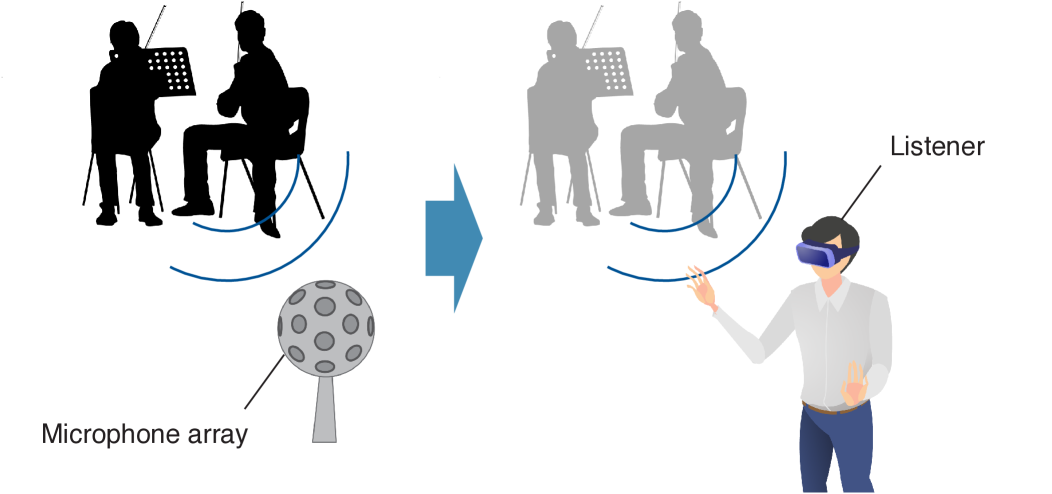
The diagram illustrates a sound capture and transmission system involving a microphone array, two sound sources (represented by silhouettes), and a listener using virtual reality (VR) technology. The system demonstrates the flow of audio from the microphone array to the listener through a spatial audio pathway.
### Components/Axes
1. **Microphone Array**:
- Positioned at the bottom-left of the diagram.
- Depicted as a spherical object with a dotted pattern (likely representing omnidirectional sound capture).
- Labeled explicitly as "Microphone array".
2. **Sound Sources**:
- Two silhouetted figures seated at a table with a grid-like object (possibly a music stand or control panel).
- Positioned above the microphone array, emitting sound waves represented by blue curved lines.
3. **Listener**:
- Located at the bottom-right of the diagram.
- Depicted as a human figure wearing a VR headset.
- Labeled explicitly as "Listener".
- Shown interacting with sound waves via hand gestures, suggesting spatial audio manipulation.
4. **Flow Indicator**:
- A blue arrow connects the microphone array to the listener, indicating the direction of sound transmission.
- Sound waves are visualized as curved lines emanating from the sources and converging toward the listener.
### Detailed Analysis
- **Microphone Array**: The dotted pattern suggests a spherical or omnidirectional capture mechanism, designed to capture sound from multiple directions.
- **Sound Sources**: The grid-like object on the table may represent a music score or control interface, implying structured audio input (e.g., music or speech).
- **Listener Interaction**: The VR headset and hand gestures imply immersive audio experiences, where the listener can manipulate or perceive sound spatially.
### Key Observations
- The system emphasizes spatial audio processing, with the microphone array capturing sound from multiple sources and transmitting it to a VR listener.
- The absence of explicit numerical data or scales suggests the diagram focuses on conceptual workflow rather than quantitative analysis.
- The blue color is consistently used for sound waves and the flow arrow, reinforcing the theme of audio transmission.
### Interpretation
This diagram likely represents a conceptual model for a spatial audio system, where a microphone array captures environmental or structured sound (e.g., music, speech) and transmits it to a VR listener. The interaction between the listener and the sound waves (via hand gestures) hints at potential applications in virtual reality environments, such as immersive audio experiences, 3D sound localization, or real-time audio manipulation. The system bridges physical sound capture with digital spatial audio rendering, highlighting advancements in audio technology for immersive media.