\n
## Diagram: Spatial Audio Capture and Reproduction
### Overview
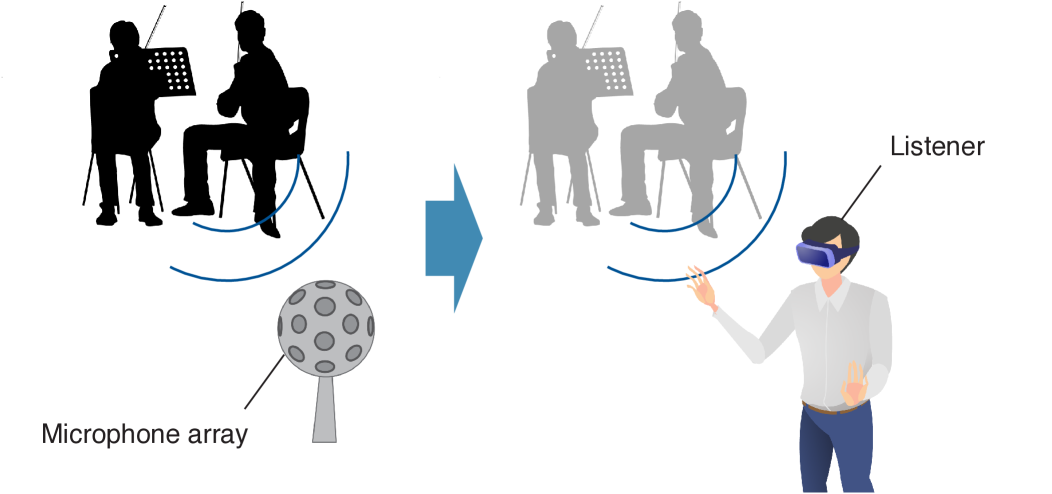
The image depicts a diagram illustrating a system for capturing spatial audio from a source (two speakers) and reproducing it to a listener using a virtual reality (VR) headset. The diagram shows a transition from a captured audio scene to a reproduced audio experience.
### Components/Axes
The diagram consists of three main components:
1. **Source Scene:** Two figures, presumably speakers, are shown in silhouette on the left side of the image.
2. **Capture System:** A "Microphone array" is positioned below the source scene.
3. **Reproduction System:** A "Listener" wearing a VR headset is shown on the right side of the image.
An arrow indicates the flow of information from the source scene, through the microphone array, to the listener. Curved blue lines represent sound waves emanating from the speakers and reaching both the microphone array and the listener.
### Detailed Analysis or Content Details
* **Source Scene:** Two figures are depicted, one slightly in front of the other. Both figures are wearing headsets with microphones. The figure in the front is darker in color, appearing as a silhouette.
* **Microphone Array:** The microphone array is represented as a parabolic dish with multiple circular elements representing individual microphones. It is positioned centrally at the bottom of the diagram.
* **Listener:** The listener is a person wearing a VR headset. They are depicted with their right arm extended, as if interacting with a virtual environment.
* **Arrow:** A blue arrow points from the source scene towards the listener, indicating the direction of audio processing and reproduction.
* **Sound Waves:** Curved blue lines emanate from each speaker in the source scene. These lines represent the propagation of sound waves. They curve towards both the microphone array and the listener.
### Key Observations
The diagram illustrates a process of spatial audio capture and reproduction. The microphone array captures the sound field from the source scene, and this information is then used to recreate the audio experience for the listener through the VR headset. The curved lines suggest that the system is designed to capture and reproduce the directionality of sound.
### Interpretation
This diagram demonstrates a system for creating immersive audio experiences. The use of a microphone array suggests that the system is capable of capturing spatial information about the sound source, such as its location and direction. This information is then used to recreate the audio experience for the listener in a way that accurately reflects the original sound field. The VR headset is crucial for providing the visual context necessary for a truly immersive experience. The diagram highlights the importance of capturing and reproducing spatial audio for applications such as virtual reality, augmented reality, and teleconferencing. The transition from silhouette to grayscale suggests a transformation of the audio signal from raw capture to processed reproduction.