## Diagram: Social Network Interaction Models
### Overview
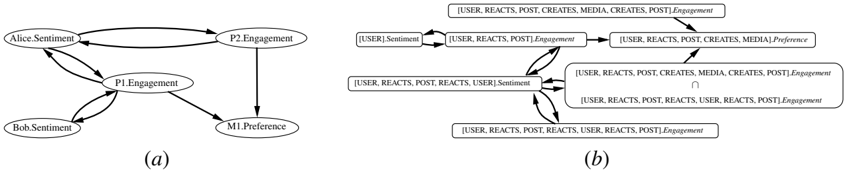
The image presents two diagrams, labeled (a) and (b), illustrating different models of social network interactions. Diagram (a) depicts a simplified model with named entities and their relationships, while diagram (b) presents a more complex model using abstract categories of user actions and their interdependencies.
### Components/Axes
**Diagram (a):**
* **Nodes:** Represented as ovals, each labeled with a specific entity.
* Alice.Sentiment
* P1.Engagement
* Bob.Sentiment
* P2.Engagement
* M1.Preference
* **Edges:** Represented as arrows, indicating the direction of influence or interaction between entities.
**Diagram (b):**
* **Nodes:** Represented as rounded rectangles, each labeled with a set of user actions or categories enclosed in square brackets.
* \[USER, REACTS, POST, CREATES, MEDIA, CREATES, POST] Engagement
* \[USER] Sentiment
* \[USER, REACTS, POST] Engagement
* \[USER, REACTS, POST, CREATES, MEDIA] Preference
* \[USER, REACTS, POST, REACTS, USER] Sentiment
* \[USER, REACTS, POST, REACTS, USER, REACTS, POST] Engagement
* **Edges:** Represented as arrows, indicating the direction of influence or interaction between categories.
### Detailed Analysis
**Diagram (a):**
* Alice.Sentiment influences P1.Engagement and P2.Engagement.
* P1.Engagement influences Alice.Sentiment, Bob.Sentiment, and M1.Preference.
* Bob.Sentiment influences P1.Engagement.
* P2.Engagement influences Alice.Sentiment and M1.Preference.
* M1.Preference is influenced by P1.Engagement and P2.Engagement.
**Diagram (b):**
* \[USER, REACTS, POST, CREATES, MEDIA, CREATES, POST] Engagement influences \[USER, REACTS, POST, CREATES, MEDIA] Preference.
* \[USER] Sentiment influences \[USER, REACTS, POST] Engagement and vice versa.
* \[USER, REACTS, POST, REACTS, USER] Sentiment influences \[USER] Sentiment and \[USER, REACTS, POST] Engagement.
* \[USER, REACTS, POST, CREATES, MEDIA, CREATES, POST] Engagement and \[USER, REACTS, POST, REACTS, USER, REACTS, POST] Engagement are related by an intersection symbol (∩), suggesting a shared subset of actions.
* \[USER, REACTS, POST, REACTS, USER, REACTS, POST] Engagement influences \[USER, REACTS, POST, REACTS, USER] Sentiment.
* \[USER, REACTS, POST, REACTS, USER, REACTS, POST] Engagement influences \[USER, REACTS, POST] Engagement.
### Key Observations
* Diagram (a) uses specific entities (Alice, Bob, P1, P2, M1) to represent the social network, while diagram (b) uses abstract categories of user actions.
* Both diagrams illustrate the flow of influence or interaction between different elements within the social network.
* Diagram (b) is more complex, with multiple interconnected categories and a shared subset of actions represented by the intersection symbol.
### Interpretation
The diagrams represent two different approaches to modeling social network interactions. Diagram (a) provides a simplified view with specific entities, which might be useful for understanding individual relationships and influences. Diagram (b) offers a more abstract and generalized model, focusing on the types of user actions and their interdependencies. This model could be used to analyze broader patterns of engagement and sentiment within the network. The intersection between two engagement categories suggests that certain actions can contribute to multiple types of engagement, highlighting the complexity of user behavior in social networks.