TECHNICAL ASSET FINGERPRINT
a0ffbfef4ecf6e463fcd2218
Click to view fullscreen
Press ESC or click to close
FOUND IN PAPERS
EXPERT: healer-alpha-free VERSION 1
RUNTIME: free/openrouter/healer-alpha
INTEL_VERIFIED
## Directed Graph Diagrams: User Interaction Models
### Overview
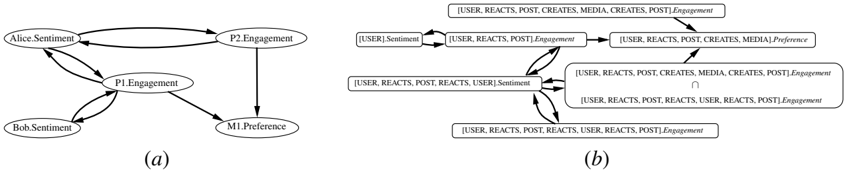
The image displays two directed graph diagrams, labeled (a) and (b), which model relationships between entities related to user sentiment, engagement, and preference in a social media or content interaction context. Diagram (a) is a simpler, named-entity model, while diagram (b) is a more complex, generalized model using bracketed notation to represent sets of actions or entities.
### Components/Axes
The diagrams consist of oval-shaped nodes connected by directed arrows (edges). There are no traditional chart axes, legends, or numerical scales. The key components are the node labels and the directional relationships indicated by the arrows.
**Diagram (a) - Left Side:**
* **Nodes (5):**
1. `Alice.Sentiment` (Top-left)
2. `Bob.Sentiment` (Bottom-left)
3. `P1.Engagement` (Center-left)
4. `P2.Engagement` (Top-right)
5. `M1.Preference` (Bottom-right)
* **Edges (Directed Arrows):**
* `Alice.Sentiment` ↔ `P2.Engagement` (Bidirectional)
* `Alice.Sentiment` → `P1.Engagement`
* `Bob.Sentiment` → `P1.Engagement`
* `P1.Engagement` → `Alice.Sentiment`
* `P1.Engagement` → `M1.Preference`
* `P2.Engagement` → `M1.Preference`
**Diagram (b) - Right Side:**
* **Nodes (7):**
1. `[USER] Sentiment` (Top-left)
2. `[USER, REACTS, POST] Engagement` (Top-center)
3. `[USER, REACTS, POST, CREATES, MEDIA, CREATES, POST] Preference` (Top-right)
4. `[USER, REACTS, POST, REACTS, USER] Sentiment` (Center-left)
5. `[USER, REACTS, POST, CREATES, MEDIA, CREATES, POST] Engagement` (Center-right)
6. `[USER, REACTS, POST, REACTS, USER, REACTS, POST] Engagement` (Bottom-center)
7. `[USER, REACTS, POST, CREATES, MEDIA] Engagement` (Bottom-right)
* **Edges (Directed Arrows):**
* `[USER] Sentiment` → `[USER, REACTS, POST] Engagement`
* `[USER, REACTS, POST] Engagement` → `[USER, REACTS, POST, CREATES, MEDIA, CREATES, POST] Preference`
* `[USER, REACTS, POST] Engagement` → `[USER, REACTS, POST, REACTS, USER] Sentiment`
* `[USER, REACTS, POST, REACTS, USER] Sentiment` → `[USER, REACTS, POST, REACTS, USER, REACTS, POST] Engagement`
* `[USER, REACTS, POST, REACTS, USER] Sentiment` → `[USER, REACTS, POST, CREATES, MEDIA, CREATES, POST] Engagement`
* `[USER, REACTS, POST, REACTS, USER] Sentiment` → `[USER, REACTS, POST, CREATES, MEDIA] Engagement`
* `[USER, REACTS, POST, REACTS, USER, REACTS, POST] Engagement` → `[USER, REACTS, POST, REACTS, USER] Sentiment`
* `[USER, REACTS, POST, CREATES, MEDIA, CREATES, POST] Engagement` → `[USER, REACTS, POST, REACTS, USER] Sentiment`
* `[USER, REACTS, POST, CREATES, MEDIA] Engagement` → `[USER, REACTS, POST, REACTS, USER] Sentiment`
### Detailed Analysis
**Diagram (a) Analysis:**
This diagram models a specific scenario involving two users (Alice, Bob), two posts (P1, P2), and one media item (M1). The flow suggests:
1. Alice's sentiment directly influences her engagement with Post 2 (P2) and Post 1 (P1).
2. Bob's sentiment influences his engagement with Post 1 (P1).
3. Engagement with Post 1 (P1) feeds back to influence Alice's sentiment and also drives preference for Media 1 (M1).
4. Engagement with Post 2 (P2) also drives preference for Media 1 (M1).
The model implies that user sentiment and post engagement are interrelated and collectively contribute to media preference.
**Diagram (b) Analysis:**
This diagram presents a more abstract, generalized model. The node labels use a bracketed notation `[ENTITY, ACTION, ...]` to define complex states or event sequences.
1. The model starts with a basic `[USER] Sentiment`.
2. This leads to an engagement event `[USER, REACTS, POST]`.
3. From this engagement, two paths diverge: one leads to a complex `Preference` state, and the other leads to a social `Sentiment` state involving user-to-user interaction (`[USER, REACTS, POST, REACTS, USER]`).
4. This social sentiment state becomes a central hub, connecting to three different, more complex `Engagement` states and receiving feedback from two of them.
5. The notation suggests that "Engagement" and "Sentiment" are not monolithic but are composed of specific sequences of user actions (REACTS, POST, CREATES, MEDIA).
### Key Observations
1. **Complexity Gradient:** Diagram (a) is a concrete instance with named entities, while (b) is an abstract schema using symbolic notation.
2. **Central Node in (b):** The node `[USER, REACTS, POST, REACTS, USER] Sentiment` acts as a major hub with the highest degree of connectivity (3 outgoing, 2 incoming edges), suggesting that social sentiment (user reacting to another user's reaction) is a critical driver in this generalized model.
3. **Feedback Loops:** Both diagrams contain feedback loops. In (a), `P1.Engagement` influences `Alice.Sentiment`. In (b), two `Engagement` nodes feed back into the central `Sentiment` node.
4. **Label Specificity:** The labels in (b) are highly specific about the action sequences that constitute an "Engagement" or "Sentiment" state, implying a fine-grained event logging or modeling system.
### Interpretation
These diagrams appear to be conceptual models from a research paper or technical document on modeling user behavior in social networks or content platforms.
* **What the data suggests:** The models propose that user preference (for media/content) is not a direct function but is mediated through layers of sentiment and engagement. Furthermore, engagement itself is not a single metric but a composite of specific user actions (reacting, posting, creating media). Diagram (b) particularly emphasizes that social interactions (user-to-user reactions) are a pivotal component that generates further engagement cycles.
* **Relationship between elements:** The arrows represent causal or influential relationships. Sentiment drives engagement, engagement can modify sentiment (creating a loop), and both ultimately influence preference. The transition from (a) to (b) shows an evolution from a simple, illustrative example to a formal, generalizable schema that could be used to define data structures or algorithms for tracking and predicting user behavior.
* **Notable patterns:** The presence of feedback loops is the most significant pattern, indicating these are dynamic systems where effects can become causes. The high connectivity of the social sentiment node in (b) suggests the hypothesis that interpersonal reactions are a key amplifier or modulator of user engagement within the modeled system. The explicit breakdown of "Engagement" into action sequences in (b) implies that the quality or type of engagement (e.g., creating media vs. simple reacting) is considered important for determining subsequent user states and preferences.
DECODING INTELLIGENCE...