## Geometry Diagram: Circle and Tangent
### Overview
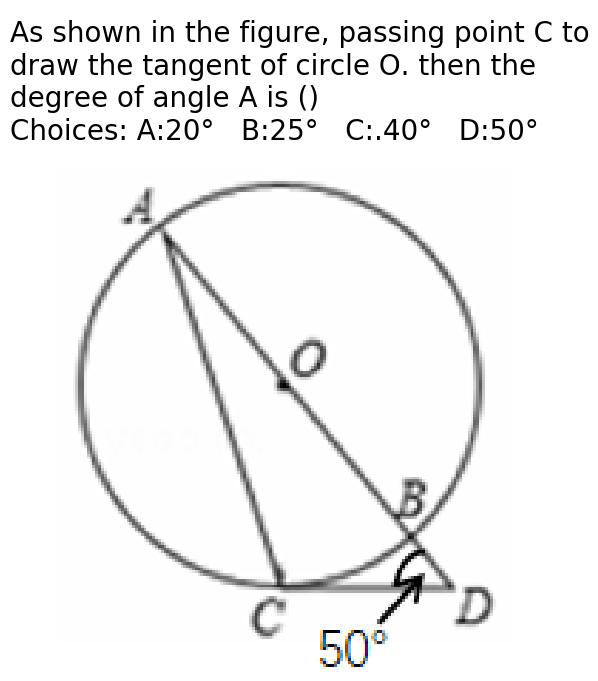
The image presents a geometry problem involving a circle with center O, a tangent line at point C, and an angle A formed by lines intersecting the circle. The problem asks for the degree of angle A, given that the angle between the tangent line and line segment CB is 50 degrees. Multiple choice answers are provided.
### Components/Axes
* **Circle:** Labeled with center "O".
* **Points:** Labeled A, B, C, and D. Point C lies on the circle and is the point of tangency.
* **Tangent Line:** A line that touches the circle at point C.
* **Lines:** Line segments connect points A to C, A to B, C to B, and C to D (tangent line).
* **Angle:** The angle between the tangent line CD and the line segment CB is labeled as 50°.
* **Text:**
* "As shown in the figure, passing point C to draw the tangent of circle O. then the degree of angle A is ()"
* "Choices: A:20° B:25° C:.40° D:50°"
### Detailed Analysis
The diagram shows a circle with center O. Point C lies on the circle, and line CD is tangent to the circle at point C. The angle between the tangent line CD and the line segment CB is given as 50°. The problem asks to find the measure of angle A.
The multiple-choice options provided are:
* A: 20°
* B: 25°
* C: 40°
* D: 50°
### Key Observations
* The angle between the tangent and the chord (angle BCD) is 50 degrees.
* Angle A subtends the same arc as angle BCD.
* The inscribed angle theorem states that an inscribed angle is half the measure of its intercepted arc.
* The angle formed by a tangent and a chord is half the measure of the intercepted arc.
### Interpretation
The problem is a geometry question that requires knowledge of circle theorems, specifically the relationship between the angle formed by a tangent and a chord, and the inscribed angle subtending the same arc. Since the angle between the tangent CD and the chord CB is 50°, the inscribed angle A, which subtends the same arc BC, should also be 50°. However, the relationship between the tangent-chord angle and the inscribed angle is that they are equal if they intercept the same arc. Therefore, angle A should be 50°.