TECHNICAL ASSET FINGERPRINT
a11b9a8100b3aab703aeaa98
Click to view fullscreen
Press ESC or click to close
FOUND IN PAPERS
EXPERT: healer-alpha-free VERSION 1
RUNTIME: free/openrouter/healer-alpha
INTEL_VERIFIED
## System Architecture Diagram: Synergized AI Framework
### Overview
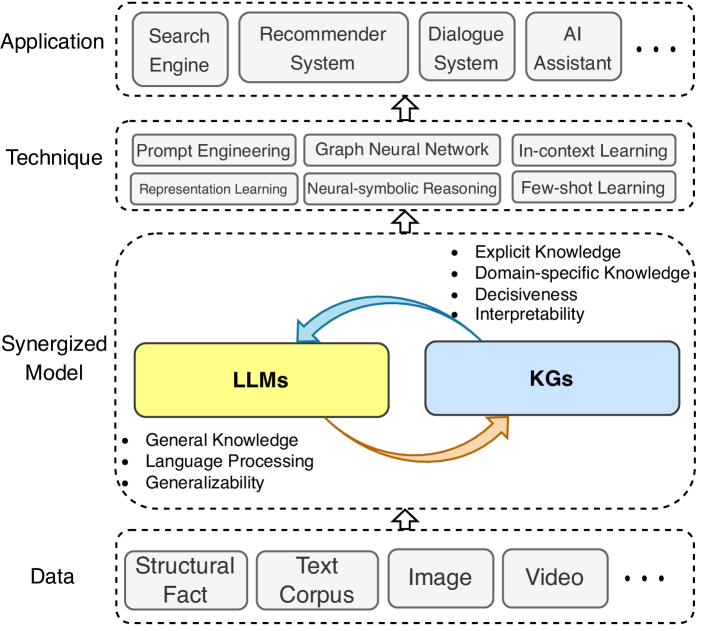
This image is a technical system architecture diagram illustrating a four-layered framework for artificial intelligence systems. It depicts the flow from raw data, through a synergistic core model and various techniques, to final applications. The diagram emphasizes the integration of Large Language Models (LLMs) and Knowledge Graphs (KGs) as the central, synergistic component.
### Components/Axes
The diagram is structured into four horizontal layers, stacked vertically. From bottom to top, they are:
1. **Data Layer**: The foundational input layer.
2. **Synergized Model Layer**: The core processing layer showing the interaction between LLMs and KGs.
3. **Technique Layer**: The methodological layer listing various AI techniques.
4. **Application Layer**: The top layer representing end-user applications.
Upward-pointing arrows connect each layer to the one above it, indicating a flow of information or capability from data to application.
**Detailed Component List:**
* **Data Layer (Bottom):**
* A dashed-line box labeled "Data" on the left.
* Inside the box, four rounded rectangles represent data types: "Structural Fact", "Text Corpus", "Image", "Video".
* An ellipsis ("...") follows "Video", indicating other possible data types.
* **Synergized Model Layer (Center):**
* A large dashed-line box labeled "Synergized Model" on the left.
* **Central Components:** Two colored rectangles.
* A **yellow** rectangle labeled **"LLMs"**.
* A **light blue** rectangle labeled **"KGs"**.
* **Bidirectional Arrows:** Two curved arrows connect the LLMs and KGs boxes.
* A **blue arrow** curves from the top of the KGs box to the top of the LLMs box.
* An **orange arrow** curves from the bottom of the LLMs box to the bottom of the KGs box.
* **Attribute Lists:**
* To the **left of the LLMs box**, a bulleted list: "General Knowledge", "Language Processing", "Generalizability".
* To the **right of the KGs box**, a bulleted list: "Explicit Knowledge", "Domain-specific Knowledge", "Decisiveness", "Interpretability".
* **Technique Layer (Upper Middle):**
* A dashed-line box labeled "Technique" on the left.
* Inside, six rounded rectangles in two rows list techniques:
* Top Row: "Prompt Engineering", "Graph Neural Network", "In-context Learning".
* Bottom Row: "Representation Learning", "Neural-symbolic Reasoning", "Few-shot Learning".
* **Application Layer (Top):**
* A dashed-line box labeled "Application" on the left.
* Inside, four rounded rectangles represent applications: "Search Engine", "Recommender System", "Dialogue System", "AI Assistant".
* An ellipsis ("...") follows "AI Assistant", indicating other possible applications.
### Detailed Analysis
The diagram presents a clear hierarchical and relational structure.
* **Flow Direction:** The primary flow is upward, from the **Data** layer, through the **Synergized Model**, enabled by various **Techniques**, to produce **Applications**.
* **Core Synergy:** The central and most detailed component is the **Synergized Model**. The bidirectional arrows between **LLMs** (yellow) and **KGs** (blue) signify a two-way, mutually reinforcing integration.
* The **blue arrow (KGs → LLMs)** suggests that Knowledge Graphs provide structured, explicit knowledge to enhance LLMs.
* The **orange arrow (LLMs → KGs)** suggests that LLMs provide language processing and generalization capabilities to enhance or populate Knowledge Graphs.
* **Attribute Mapping:** The bulleted lists explicitly define the complementary strengths each component brings to the synergy:
* LLMs contribute broad, implicit knowledge and language fluency.
* KGs contribute precise, structured, and domain-specific knowledge with higher interpretability.
* **Technique Support:** The **Technique** layer lists methods (e.g., Graph Neural Networks, Neural-symbolic Reasoning) that likely facilitate the integration and operation of the synergized LLM+KG model.
* **Extensibility:** The ellipses ("...") in the **Data** and **Application** layers explicitly indicate that the framework is designed to be extensible to other data modalities and application domains.
### Key Observations
1. **Central Synergy:** The diagram's visual focus is the LLM-KGs interaction, highlighted by their central placement, color, and the detailed attribute lists and connecting arrows.
2. **Layered Abstraction:** The architecture follows a classic layered pattern, abstracting complexity from raw data (bottom) to user-facing applications (top).
3. **Complementary Design:** The framework is explicitly designed to combine the strengths of connectionist AI (LLMs) with symbolic AI (KGs), as evidenced by the attribute lists and the "Neural-symbolic Reasoning" technique.
4. **Bidirectional Enhancement:** The relationship between LLMs and KGs is not a simple pipeline but a continuous feedback loop, as shown by the two opposing arrows.
### Interpretation
This diagram illustrates a **modern AI system architecture aimed at overcoming the limitations of standalone LLMs**. The core premise is that while LLMs excel at language tasks and general knowledge, they lack precision, structured reasoning, and domain-specific expertise. Knowledge Graphs provide these missing elements.
The framework suggests that the future of robust AI applications lies in **hybrid systems**. By synergizing LLMs and KGs, the system aims to achieve:
* **More Accurate and Grounded Outputs:** KGs can "ground" LLM responses in verified facts, reducing hallucinations.
* **Enhanced Reasoning:** The combination allows for both statistical pattern recognition (LLMs) and logical, rule-based inference (KGs).
* **Interpretability:** The structured nature of KGs can help explain the reasoning behind an LLM's output.
The **Technique** layer acts as the toolbox for building this synergy. For example, "Graph Neural Networks" can be used to process the KG structure, while "Prompt Engineering" and "In-context Learning" are key to effectively querying and utilizing the LLM within this integrated system.
Ultimately, the diagram maps a path from heterogeneous **Data** to sophisticated **Applications** (like advanced AI Assistants or Search Engines) by leveraging a **synergistic core model** that is more capable than its individual parts. It represents a shift towards composite, neuro-symbolic AI systems.
DECODING INTELLIGENCE...